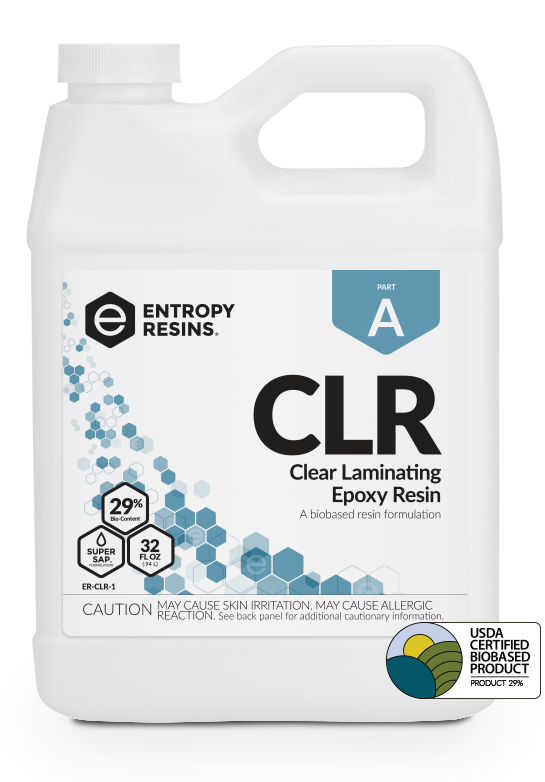
Clear Laminating Epoxy is the Entropy Resins CLR system for water-clear composite laminates, coatings and adhesive work. Marjan Polymer Industries supplies CLR in Pakistan with CLX Extra Fast, CLF Fast or CLS Slow hardener selected against the required working and cure window.
Product Identity
The current manufacturer designation is CLR Clear Laminating Epoxy. It is a low-colour, UV-stabilized two-component system designed for hand lamination, vacuum-assisted work, clear coatings and compatible adhesive applications. It is not a deep-casting resin; thick pours require a dedicated casting formulation.
System Options
- CLR + CLX Extra Fast: shortest working and tack-free window for small, controlled jobs.
- CLR + CLF Fast: balanced working time for general laminating.
- CLR + CLS Slow: longest working window for larger laminates, warmer shops or more complex reinforcement placement.
Manufacturer-Published Processing Data
| Parameter | CLX Extra Fast | CLF Fast | CLS Slow |
|---|---|---|---|
| Mix ratio by volume | 2:1 | 2:1 | 2:1 |
| Mix ratio by weight | 100:43 | 100:45 | 100:43 |
| Mixed viscosity at 25°C | 990 mPa·s | 1,040 mPa·s | 700 mPa·s |
| Pot life at 25°C | 18 min | 21 min | 43 min |
| Tack-free time at 35°C | 2 h | 4 h | 8 h |
| Full cure at 25°C | 7 days | 7 days | 7 days |
Published values are typical and not a customer specification. Pot life is highly sensitive to batch mass, container geometry and temperature; a large mix can exotherm and cure substantially faster.
Key Characteristics
- water-clear appearance for visually exposed laminates and coatings;
- UV-stabilized formulation for improved colour retention;
- three hardener speeds for process control;
- good fibre wetting for hand lay-up and selected vacuum processes;
- compatible use as a clear adhesive or coating after application-specific testing.
Typical Applications
- clear carbon-, glass- and natural-fibre laminates;
- surfacing and sealing of suitably prepared wood and composite parts;
- boards, sporting goods, decorative components and prototypes;
- hand lay-up and vacuum-bagged composite development;
- clear bonding and coating trials in Pakistan.
Recommended Laminating Workflow
- Select the hardener: match the working time to part size, shop temperature and reinforcement complexity.
- Prepare surfaces: keep reinforcement, mould and substrate clean, dry and compatible.
- Measure: use a calibrated scale at the specified weight ratio or accurate metering at 2:1 by volume.
- Mix: blend thoroughly while scraping the sides and bottom, then transfer to a clean container for critical clear work.
- Laminate: wet the reinforcement uniformly and remove entrained air without excessive resin-rich zones.
- Cure: hold the validated temperature and protect the part from dust, moisture and movement.
- Post-cure and inspect: follow the current data sheet when higher properties are required, then verify clarity, cure and laminate quality.
Clarity and UV Expectations
UV stabilization improves colour retention but does not make any epoxy permanently immune to yellowing. Exposure intensity, heat, section thickness, substrate colour and protective coatings influence appearance. Outdoor or high-visibility parts should be tested with the intended topcoat and service exposure.
Storage and Safety
Store sealed resin and hardener according to current manufacturer instructions. Use gloves, eye protection and ventilation. Avoid skin contact and control mixed-batch depth because exotherm can generate high temperature. Review the current safety data sheets before use.
Information Required for a Quotation
Provide the reinforcement and substrate, process method, laminate area and thickness, shop temperature, desired pot life, visual clarity requirement, trial or production quantity and delivery city. MPI will confirm hardener selection, pack availability and documentation.
Frequently Asked Questions
What is Entropy CLR Clear Laminating Epoxy?
CLR is a water-clear, UV-stabilized laminating epoxy resin used with CLX Extra Fast, CLF Fast or CLS Slow hardener for composite laminates, coatings and adhesive applications.
What is the mixing ratio?
All three systems use 2:1 resin to hardener by volume. The published weight ratios are 100:43 with CLX, 100:45 with CLF and 100:43 with CLS.
Which hardener gives the longest working time?
CLS Slow provides the longest published pot life—about 43 minutes at 25°C—compared with 21 minutes for CLF and 18 minutes for CLX under the stated test conditions.
Is CLR suitable for clear composite laminates?
Yes. It is formulated for water-clear laminates and includes UV stabilization, but outdoor appearance still depends on exposure, thickness, reinforcement and any protective topcoat.
Can CLR be used for deep casting?
No. CLR is primarily a laminating system. Use a dedicated low-exotherm casting resin such as CCR when the application requires thick pours, embedding or deep casting.
Can CLR be used with carbon and glass fibre?
It is intended for composite laminating and can be evaluated with carbon, glass and other compatible reinforcements. Fibre sizing and the full laminate schedule should be qualified.
How long does CLR take to cure?
The manufacturer lists seven days at 25°C for full cure. Published tack-free times at 35°C are approximately 2 hours with CLX, 4 hours with CLF and 8 hours with CLS.
Is post-curing recommended?
Yes. A controlled post-cure can improve thermal and mechanical properties. The exact cycle must follow the current technical data sheet and remain compatible with the mould and reinforcement.
What does MPI need to quote CLR in Pakistan?
Provide the process, reinforcement, laminate area and thickness, desired working time, transparency requirement, trial or production quantity and delivery city.
Does UV stabilization make the epoxy permanently non-yellowing?
No epoxy should be described as permanently non-yellowing under every exposure. UV stabilization improves colour retention, while service environment and protective finishing still matter.