

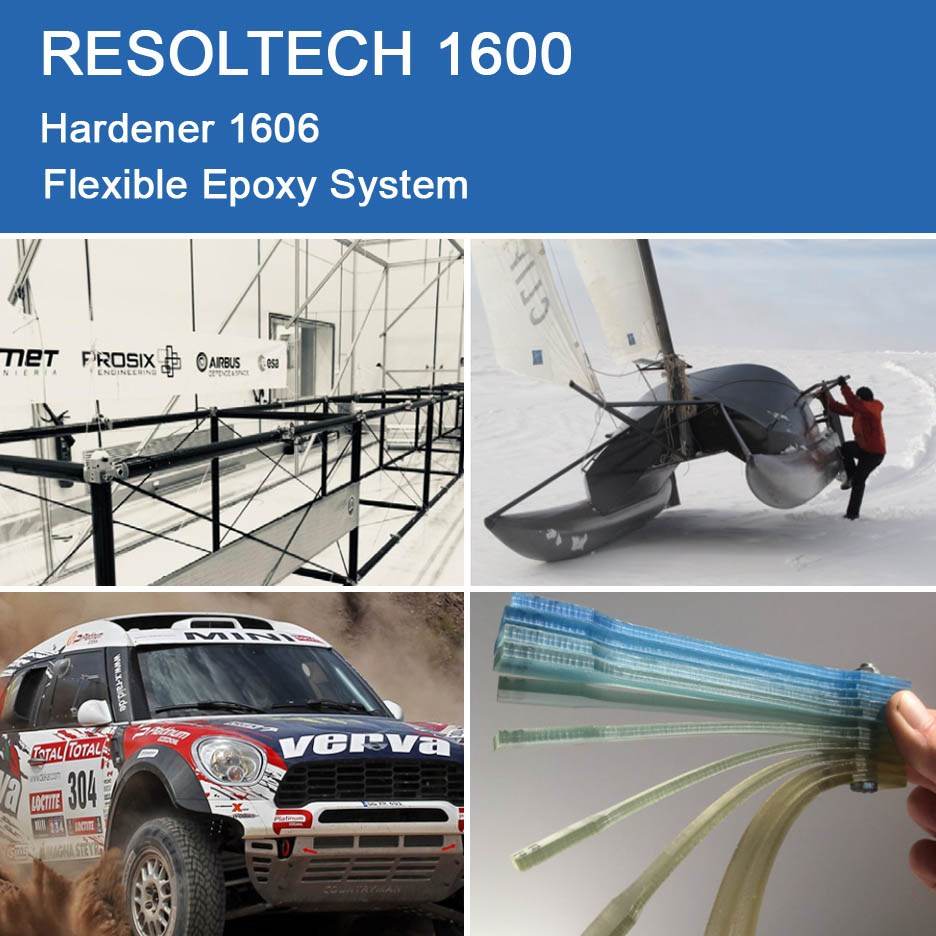
Flexible Epoxy Resin is the RESOLTECH 1600 resin and 1606 hardener system for composite laminates that must bend, absorb impact or withstand repeated fatigue. Marjan Polymer Industries supplies this specialist epoxy system in Pakistan with current technical documentation and application review.
Product Identity
The manufacturer designation is RESOLTECH 1600 / 1606. It is a two-component, room-temperature-curing flexible laminating epoxy. Its unusually low glass-transition temperature is a deliberate design characteristic: the cured matrix remains compliant instead of becoming a conventional rigid structural laminate.
This page applies only to the 1600 resin with 1606 hardener. It must not be confused with Entropy ONE, clear casting epoxy, flexible polyurethane or a plasticised general-purpose epoxy.
Manufacturer-Published Processing Data
| Parameter | RESOLTECH 1600 / 1606 |
|---|---|
| Mix ratio by weight | 100 : 126 |
| Mix ratio by volume | 100 : 144 |
| Mixed density | 1.06 |
| Mixed viscosity | Approximately 500 mPa·s |
| Gel time at 23°C | Approximately 3 h 40 min (70 mL / 4 cm test) |
| Glass-transition temperature, Tg | Approximately −44°C |
| Cure mode | Room-temperature cure |
These are typical manufacturer values, not guaranteed customer specifications. Batch size, ambient temperature, reinforcement, laminate thickness and heat loss affect working and cure behaviour.
Performance Characteristics
- high flexibility after cure for repeatedly deflected composite structures;
- strong wetting and adhesion to suitably prepared reinforcement and substrates;
- resistance to impact and fatigue where a rigid matrix would be unsuitable;
- low mixed viscosity for hand lamination and selected light RTM work;
- long working window for controlled placement and impregnation.
Typical Applications
- flexible carbon-fibre rods and spring-like composite elements;
- rally and motorsport parts exposed to vibration or impact;
- fibre-reinforced membranes and compliant composite skins;
- sensors and assemblies that require a flexible encapsulating laminate;
- light RTM counter-moulds developed with an approved 1050/1600 blend;
- research and product-development programmes in Pakistan.
Reinforcement and Substrate Compatibility
The system can be evaluated with glass, carbon and selected textile reinforcements. Every application must verify fibre sizing, surface preparation, laminate thickness, adhesion and fatigue performance. It should not be assumed compatible with every thermoplastic, rubber, release surface or coating without a representative trial.
Recommended Processing Workflow
- Define the requirement: quantify bend radius, cyclic strain, impact, temperature and service environment.
- Condition materials: stabilize resin, hardener, reinforcement and tooling at the approved shop temperature.
- Measure accurately: use a calibrated scale and the 100:126 weight ratio.
- Mix thoroughly: scrape the container sides and bottom while avoiding unnecessary air.
- Impregnate: apply within the qualified working window and remove trapped air.
- Cure: maintain the validated temperature and protect the laminate from movement and contamination.
- Inspect and test: verify cure, adhesion, flexibility and fatigue on representative coupons before production release.
Special Note on 1050 / 1600 Blends
RESOLTECH documents selected blends for light RTM counter-mould development. The 1050 resin system and the 1600 resin system must each be mixed correctly with their own designated hardener before the two prepared systems are blended. Never combine raw resins and guess a single hardener ratio. Blend percentage and cure must be qualified for the mould.
Storage and Safety
Store sealed components under the conditions stated in the current technical data sheet. Prevent moisture and contamination. Wear chemical-resistant gloves and eye protection and provide suitable ventilation. Mixed epoxy can exotherm in bulk; spread or process the mix promptly and do not leave a large quantity in a deep container.
Information Required for a Quotation
Send the application, reinforcement, part size and thickness, required bend or impact performance, expected service temperature, process method, shop temperature, trial quantity and delivery city. MPI will confirm current pack availability, documentation and whether this flexible grade suits the requirement.
Frequently Asked Questions
What is RESOLTECH 1600 / 1606 designed for?
It is a highly flexible, room-temperature-curing epoxy system for laminates and composite structures that must tolerate repeated deflection, impact or fatigue.
What is the correct mixing ratio?
The manufacturer-published ratio is 100 parts 1600 resin to 126 parts 1606 hardener by weight, or 100:144 by volume. Weight measurement is preferred for process control.
How long is the working time?
The published gel time is approximately 3 hours 40 minutes at 23°C for the stated 70 mL test quantity. A larger or deeper batch can react faster because epoxy generates heat.
Does this system cure at room temperature?
Yes. It is formulated for room-temperature cure. Final properties still depend on time, temperature, mix accuracy and laminate thickness, so the current technical data sheet and a qualified shop procedure must be followed.
Why is the published Tg below room temperature?
A Tg of approximately −44°C is intentional for this very flexible system. It allows the cured matrix to remain compliant rather than behaving like a conventional rigid structural laminating epoxy.
Can RESOLTECH 1600 be used for flexible carbon rods?
Yes. Flexible carbon rods are among the manufacturer-listed applications, provided the fibre construction and cure process are qualified for the required bending and fatigue performance.
Is it suitable for mould making?
The manufacturer lists light RTM counter-mould applications, including controlled blends with the 1050 system. Each resin and hardener system must first be mixed at its own correct ratio before any qualified blend is made.
Can it be used as a general-purpose rigid laminating epoxy?
No. Its low Tg and high flexibility distinguish it from rigid laminating systems. Select a rigid epoxy when dimensional stiffness or elevated-temperature performance is the primary requirement.
What information does MPI need for a quotation?
Provide the application, reinforcement, part dimensions, required flexibility, expected deflection or impact, process method, workshop temperature, trial quantity and delivery city in Pakistan.
Does MPI supply technical documentation in Pakistan?
Yes. Marjan Polymer Industries can supply the current product documentation and help review the intended process, but final material qualification remains the customer’s responsibility.