

Marjan Polymer Industries supplies Aremco-Bond™ 2300 in Pakistan for industrial bonding where low mixed viscosity, high lap-shear strength, chemical resistance and a toughened rubberized epoxy response are required. The product is a two-part, unfilled system supplied under the Aremco grade identity.
Grade 2300 is materially different from ceramic-filled Aremco-Bond 2310. It uses a 100:10 resin-to-hardener ratio by weight, has a published mixed viscosity near 5,000 cP and cures to a milky-clear material. Selection must follow the current Aremco TDS, SDS and assembly qualification.
Aremco-Bond 2300 Product Identity
Aremco Products, Inc. lists grade 2300 in its ultra-high-bond-strength range as an unfilled, low-viscosity, rubberized epoxy with exceptional bond strength and chemical resistance.
The grade name, matched resin and hardener, lot, shelf life and manufacturer documents must stay traceable. A locally mixed “high-strength epoxy” or a 1:1 cartridge is not an equivalent unless Aremco approves it as grade 2300.
Key Application Characteristics
| Characteristic | Manufacturer Description | Engineering Meaning |
|---|---|---|
| Unfilled system | No heavy ceramic or metal filler | Lower viscosity and milky-clear cured appearance |
| Rubberized epoxy | Toughened structural formulation | Designed to reduce brittleness under appropriate loading |
| Mix ratio | 100:10 resin to hardener by weight | Precise weighing is essential; not a 1:1 system |
| Low viscosity | Approximately 5,000 cP mixed at 25 °C | Supports wetting and thin controlled bond lines |
| Bond strength | High tensile lap-shear reference | Joint performance depends on substrate and preparation |
| Chemical resistance | Manufacturer rating: very good | Specific-fluid testing remains necessary |
Applications
- Metal-to-metal industrial assembly
- Bonding ceramics, glass and compatible rigid composites
- Instrument, sensor and electrical-mechanical component assembly
- Machinery, fixture and equipment manufacture
- Thin-gap bonding where a lower-viscosity epoxy is advantageous
- Laboratory, prototype and development assemblies
- Qualified automotive, aerospace and industrial hardware
- Bonded joints exposed to oils, cleaning agents or chemicals after testing
- Maintenance and repair where the original component permits adhesive use
- Mixed-material joints requiring a tougher epoxy response
Manufacturer Reference Properties
| Property | Published Reference | Test / Use Note |
|---|---|---|
| Mix ratio | 100:10 by weight, resin:hardener | Current TDS and calibrated weighing govern |
| Mixed specific gravity | Approximately 1.10 g/cm³ at 25 °C | Reference value for mixed adhesive |
| Mixed viscosity | Approximately 5,000 cP at 25 °C | Temperature and time after mixing change flow |
| Pot life | Approximately 0.75 h for 100 g at 25 °C | Bulk pot life is not identical to open time |
| Recommended cure | 2 h at 150 °F (about 66 °C) | Bond line must reach temperature for the specified time |
| Alternate cure | 48 h at room temperature | Ambient conditions and fixture time require control |
| Temperature resistance | −67 to +350 °F (−55 to +175 °C) | Published range is not an automatic design allowable |
| Tensile lap shear | Approximately 4,560 psi | Aremco reference based on ASTM D1002 metal lap-joint testing |
| Flexural strength | Approximately 13,500 psi | Neat cured-material reference under ASTM D790-type testing |
| Hardness | Approximately Shore D 85 | Reference cured property |
Data control: published catalog values support product selection. They are not guaranteed properties for every substrate, bond line, cure or operating environment.
Electrical and Physical References
| Property | Published Reference | Limitation |
|---|---|---|
| Coefficient of thermal expansion | Approximately 37 × 10⁻⁶ in/in/°F (66 × 10⁻⁶ /°C) | Method, temperature range and cure state matter |
| Volume resistivity | Approximately 1.0 × 10¹⁵ ohm-cm at room temperature | Not a certified electrical-insulation-system value |
| Dielectric strength | Approximately 380 V/mil | Thickness, defects and conditioning affect breakdown |
| Dielectric constant | Approximately 3.5 at 1 kHz | Frequency and environment affect response |
| Dissipation factor | Approximately 0.008 | Use current manufacturer method |
| Cure shrinkage | Approximately 0.003 in/in | Catalog method uses a casting mass, not every joint geometry |
| Colour | Milky clear | Not optically water-clear |
Why the 100:10 Mix Ratio Matters
The correct published ratio is 100 parts resin to 10 parts hardener by weight. The former website claim of 1:1 was inaccurate and has been removed.
A small hardener fraction makes visual portioning unreliable. Use a calibrated balance with suitable resolution and calculate batch quantities before dispensing. Ratio error can leave uncured material and reduce heat, chemical and mechanical performance.
Substrate Compatibility
Grade 2300 can be evaluated for metals, ceramics, glass, thermoset composites and selected rigid plastics. Each surface needs a preparation process that removes contamination and creates a stable bonding layer.
Low-surface-energy plastics, flexible plastics, silicone, fluoropolymers and unknown coatings require specialized treatment or a different adhesive. Compatibility must include both adhesion and environmental ageing.
Joint Design
Use overlap and load distribution to place the adhesive mainly in shear or compression. Avoid peel and cleavage concentration at free edges wherever possible.
Account for substrate thickness, stiffness, thermal expansion, gap, service temperature and movement. A rubberized formulation improves toughness but does not eliminate stress analysis or the need for mechanical retention in high-consequence joints.
Low Viscosity and Bond-Line Control
At roughly 5,000 cP, mixed 2300 flows more readily than paste-filled systems. This can support wetting and application to thin bond lines but can also drain from vertical gaps or porous surfaces.
Aremco’s general application guidance indicates adhesive on both prepared surfaces and a glue line below approximately 10 mils in many cases. The actual joint should be qualified with controlled spacers, fixtures and orientation.
Surface Preparation
Aremco states that surfaces must be free from oil, grease, dirt, corrosives, oxides, paint and other foreign matter. Non-porous surfaces may be sandblasted or abraded, or treated by an approved chemical process.
Cleaning materials must not leave residue or attack the substrate. Bond promptly after preparation, use clean gloves and record the treatment for production control.
Weighing and Batch Preparation
For a 100:10 ratio, a convenient batch example is 100 g resin plus 10 g hardener. Smaller batches require a balance capable of accurately resolving the hardener quantity.
Use clean, compatible containers and separate tools for unmixed components. Do not return dispensed material to original containers.
Mixing Procedure
Mix thoroughly while scraping the container wall and bottom until uniform. Transfer to a second clean cup and mix again for critical work to reduce unmixed streaks.
Aremco notes that high-viscosity components can sometimes be preheated separately to 100–125 °F for handling. Grade 2300 is relatively low viscosity, and any preheat must follow current manufacturer approval because heat shortens working time.
Pot Life and Working Time
The published pot life is approximately 45 minutes for a 100 g mass at 25 °C. More material or a warmer shop increases exotherm and reduces time.
Open time in a thin film may differ from bulk pot life. Establish an internal cutoff based on wetting, assembly time and coupon results rather than using material until obvious gelation.
Application and Clamping
Apply to the prepared surfaces, assemble without trapping air and apply enough pressure to maintain alignment and reduce voids without starving the joint.
Low viscosity may require edge dams or controlled fixturing. Clean squeeze-out only through an approved procedure and do not disturb the joint once cure has begun.
Cure Schedule
The current Aremco catalog lists 2 hours at 150 °F (approximately 66 °C) as the recommended cure for 2300, with 48 hours at room temperature as an alternate.
Part temperature, not oven setpoint alone, controls the heat cure. Thermocouples or validated load studies may be required for thick assemblies. Any faster or hotter cure needs manufacturer or qualification support.
Temperature Performance
The published reference range is −67 to +350 °F (−55 to +175 °C). Actual bond performance varies within that range and depends on load duration, substrate expansion, humidity, chemical exposure and cycle count.
Use representative thermal ageing and cycling for critical assemblies. The upper figure is not a declaration that full room-temperature shear strength remains available at 175 °C.
Chemical Resistance
Aremco rates the grade “very good” for chemical resistance. This broad category is useful for screening but does not specify every chemical, concentration or exposure condition.
Immersion, vapour, splash and cleaning cycles can produce different results. Test bonded coupons, not only cured adhesive, because failure may occur at the substrate interface.
Rubberized Toughness
Rubber modification is intended to improve toughness and reduce the brittle response associated with some unmodified epoxies. It can support assemblies exposed to impact, vibration or differential movement.
Flexibility is relative: Shore D 85 is still a hard cured material. For large movement, soft substrates or elastomeric sealing, a urethane, silicone or different toughened adhesive may be more appropriate.
Mechanical Performance and Test Meaning
The published tensile lap-shear value of approximately 4,560 psi comes from controlled single-lap metal coupons under an ASTM D1002-type method. It is not a universal bond strength on glass, plastic or customer metals.
Joint allowable stress requires specimen preparation, failure mode, ageing and statistical treatment. Flexural strength is a neat-material property and should not be used as bonded-joint bending capacity.
Electrical Applications
Published volume resistivity, dielectric strength and dielectric constant indicate electrically insulating behaviour in controlled specimens. The grade is not described as thermally conductive or electrically conductive.
Creepage, clearance, voids, moisture, contamination and temperature govern finished electrical insulation. Use applicable component and system standards.
Quality-Control Checks
| Stage | Control | Evidence |
|---|---|---|
| Receiving | Grade 2300, resin/hardener, lot, seal and expiry | Label, CoA and receiving record |
| Preparation | Cleanliness, abrasion and time to bond | Process checklist |
| Mixing | 100:10 weight ratio and homogeneity | Batch record and balance ID |
| Application | Open time, coverage, gap and assembly pressure | Traveller or work order |
| Cure | Actual time and part temperature | Cure chart or ambient log |
| Acceptance | Visual, witness coupon or specified proof test | Inspection report |
Storage and Shelf-Life
Keep both components in original, sealed, labelled containers under the temperature and segregation stated in the current SDS and TDS. Prevent contamination, direct heat and unauthorized component interchange.
The label expiry or retest date governs. Quarantine material with damaged seals, uncertain ratio history, crystallization, contamination or expired documentation.
Safety and Handling
- Review current Aremco resin and hardener SDS documents before use.
- Wear chemical-resistant gloves and eye protection and provide ventilation.
- Avoid skin exposure because epoxy systems can cause sensitization.
- Control mixed-batch exotherm and do not leave large masses unattended.
- Use approved cleaning agents and keep solvents away from ignition sources.
- Do not machine cured adhesive without suitable dust control.
- Dispose of components, wipes, solvent and cured waste according to site and Pakistan requirements.
Packaging and Supply Scope
Because grade 2300 is mixed at 100:10 by weight, it should not be presented as the same 1:1 dual-barrel package used for some Aremco products. Available matched kits and pack sizes are confirmed with the manufacturer.
MPI can include current TDS, SDS, batch records and import documentation. A generic substitute is not supplied under the Aremco-Bond 2300 identity.
Information Required for Selection
| Customer Input | Required Detail |
|---|---|
| Substrates | Material, grade, coating, roughness and thickness |
| Joint | Overlap, gap, load direction and assembly tolerances |
| Environment | Temperature, chemicals, humidity, pressure and cycles |
| Process | Surface preparation, batch size, application and clamping |
| Cure | Oven capability or room-temperature schedule |
| Quantity | Bond area, parts per batch, annual usage and pack size |
| Quality | Traceability, coupon testing and documents |
| Delivery | City, schedule and handling requirement in Pakistan |
Supply and Support in Pakistan
MPI can coordinate technical selection, manufacturer documentation, import and delivery for customers in Lahore, Karachi, Faisalabad, Islamabad and other Pakistani industrial centres.
Representative substrate coupons are recommended before production. Critical assembly approval remains with the customer’s design, safety and quality authority.
Important Performance Boundaries
Grade 2300 is not a universal adhesive for every plastic, flexible material, pressure joint, food contact, medical device or safety-critical structure. Published data applies to controlled specimens.
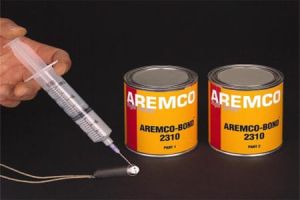
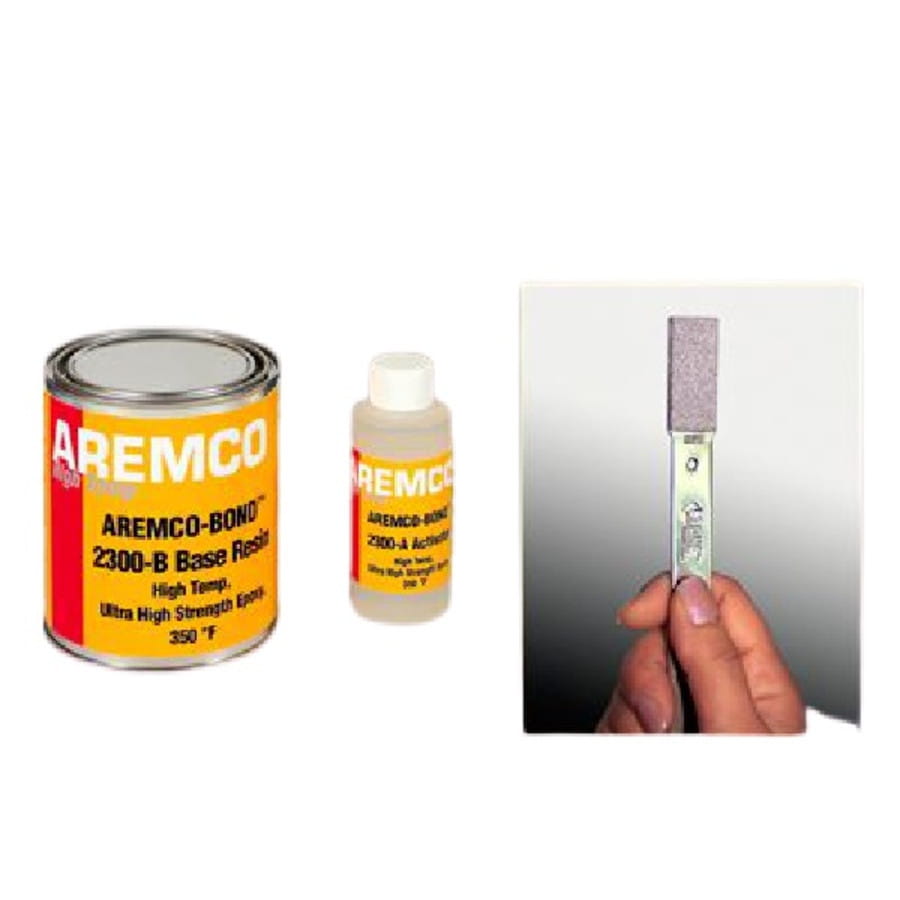
Product photos are illustrative. Manufacturer, grade, component ratio, package, colour, lot, cure and current documentation are confirmed in the quotation.
Why 2300 and 2310 Must Stay Distinct
Aremco-Bond 2300 is unfilled, low viscosity, rubberized and mixed 100:10 by weight. Grade 2310 is ceramic-filled, much more viscous, black and mixed 1:1 by weight. They cannot be described with the same specifications.
MPI preserves the correct grade identity so Pakistani buyers can select the appropriate flow, cure, toughness and environmental profile.
Frequently Asked Questions
What is Aremco-Bond 2300?
It is a two-part, unfilled, low-viscosity rubberized epoxy adhesive with high bond strength and very good chemical resistance.
What is the correct mix ratio?
The published ratio is 100 parts resin to 10 parts hardener by weight. It is not a 1:1 system.
What is the mixed viscosity?
The manufacturer publishes approximately 5,000 cP at 25 °C, subject to temperature and time after mixing.
How long is the pot life?
Approximately 45 minutes for a 100 g mass at 25 °C. Larger or warmer batches cure faster.
What cure schedule is recommended?
Aremco lists 2 hours at 150 °F (about 66 °C), with 48 hours at room temperature as an alternate.
What temperature range is published?
The catalog reference is −67 to +350 °F (−55 to +175 °C), subject to joint-specific testing.
How is 2300 different from 2310?
2300 is unfilled, lower viscosity and mixed 100:10; 2310 is ceramic-filled, black, much more viscous and mixed 1:1 by weight.
Can it bond plastics?
Some rigid plastics may be suitable after preparation and testing, but low-surface-energy or flexible plastics often need a different adhesive or treatment.
What information is needed for a quotation?
Share substrates, joint geometry, loads, temperature, chemicals, cure capability, quantity, documentation and delivery city.
Can MPI supply Aremco 2300 in Pakistan?
MPI can coordinate current grade documentation, matched packaging, import and delivery subject to Aremco availability.