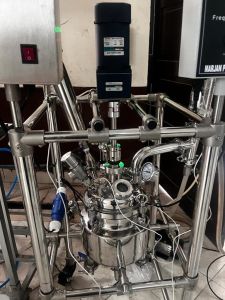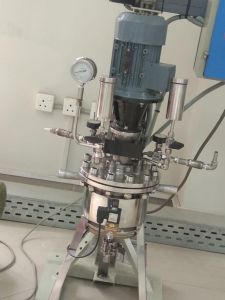


High Pressure Autoclave Reactor is a stirred, sealed laboratory system for conducting controlled chemical reactions above atmospheric pressure and, where specified, at elevated temperature. Marjan Polymer Industries configures the reactor around the chemistry, charge volume, design pressure, temperature, agitation, wetted materials, gas service, cooling and control requirements rather than treating one catalogue number as suitable for every process.
The reference MPI scope covers compact 600 mL and approximately 1 L reactor classes for polymer research, catalysis, hydrogenation, hydrothermal work, chemical synthesis and materials testing. Maximum allowable working pressure, temperature and charge volume are interdependent; the certified vessel drawing, nameplate and approved operating procedure always govern.
Reference laboratory reactor configuration
| Parameter | Reference engineered scope |
|---|---|
| Equipment type | Electrically heated, magnetically stirred high-pressure batch reactor/autoclave |
| Nominal vessel classes | Approximately 600 mL and 1,000 mL; usable liquid charge is lower and is defined by reaction, fill limit and headspace requirement |
| Reference pressure class | Up to 3,000 psi / 207 bar for an approved vessel design; larger volumes and special materials may have different MAWP |
| Reference temperature class | Up to 350 °C with a compatible PTFE flat-gasket design; O-ring, graphite and other seals have different limits |
| Baseline wetted material | 316 stainless steel where compatible with the process; alternative alloys, liners or coatings require corrosion review |
| Agitation | Magnetically coupled drive with application-selected impeller; reference speed approximately 0–600 rpm |
| Reference drive | Approximately 1/8 hp variable-speed motor and about 16 in-lb coupling torque in one compact configuration |
| Heating | Electrically controlled heater with PID temperature regulation and independent over-temperature protection |
| Cooling | Internal cooling coil, jacket or external cooling arrangement subject to vessel design and process duty |
| Temperature measurement | Internal thermocouple or approved thermowell sensor with digital display and control input |
| Pressure measurement | Mechanical gauge and/or pressure transducer; the reference display range can extend to approximately 200 bar |
| Over-pressure protection | Correctly sized and rated rupture disc and, where engineered, relief valve with a safe discharge route |
| Gas and liquid connections | Application-selected inlet, outlet, purge, sampling and cooling connections rated for the full service condition |
| Controls | PID temperature control with speed and pressure display; ramp/soak, interlocks, alarms and data logging are configurable |
| Electrical supply | 220–230 V, 50 Hz is the normal Pakistan reference; phase, connected load and protection are confirmed in the quotation |
| Documentation | General arrangement, pressure/temperature rating, materials list, operating instructions, calibration records and test documentation as contracted |
Do not combine the highest published pressure, temperature, volume and agitation values unless the final vessel, closure, seal, fittings, drive and relief system are rated for that exact condition.
Pressure, temperature and volume are linked
Increasing vessel diameter or temperature can reduce allowable pressure or require heavier construction. Seal material also limits the temperature range. Published high-pressure reactor guidance commonly rates compact vessels up to about 600 mL at 3,000 psi / 207 bar, while 1 L and larger vessels may use different standard ratings unless a dedicated high-pressure design is selected. MPI therefore confirms a pressure–temperature rating envelope, not a single isolated maximum.
Working volume and safe headspace
Nominal vessel volume is the internal free volume, not the recommended liquid charge. Gas evolution, solvent expansion, foaming, suspended solids and agitation require headspace. As a conservative selection reference, sealed batch reactors are often charged to no more than about two-thirds of free volume, but the approved process hazard assessment and operating procedure may require a lower limit.
Materials of construction and corrosion review
316 stainless steel is a common baseline, but it is not universally resistant to acids, chlorides, halides, caustic solutions, sulfides or every catalyst system. The customer must disclose all reactants, solvents, catalysts, intermediates, cleaning chemicals, concentrations, impurities and credible upset products. MPI then evaluates 316L stainless steel, Hastelloy, Inconel, titanium, glass/PTFE liners or other wetted-material options with the vessel specialist.
Magnetically coupled agitation
A magnetic drive transmits torque through the pressure boundary without a conventional dynamic shaft seal. Impeller style is selected from gas dispersion, liquid–liquid mixing, solids suspension, heat transfer and viscosity requirements. Speed alone does not define mixing performance; vessel geometry, impeller diameter, torque, baffles, fill level and fluid properties must be considered together.
Heating, cooling and temperature control
The heater is sized for vessel mass, process load and required heat-up rate. A thermocouple measures the process or thermowell temperature for PID control, while an independent high-temperature cut-out protects against control failure. Cooling coils or jackets can remove reaction heat or shorten cooldown, but cooling-water pressure, fouling, thermal shock and the possibility of coil leakage into the vessel must be reviewed.
Pressure measurement and gas handling
A pressure gauge provides local indication and a transducer can support digital display, recording and interlocks. Gas inlet, purge, vent and sampling valves must be compatible with the service gas and maximum rating. Hydrogen, oxygen, carbon monoxide, toxic or corrosive gases require a dedicated regulator, non-return protection, ventilation, leak testing, gas detection and discharge strategy.
Rupture disc, relief and safe discharge
A rupture disc is a last-resort over-pressure device, not a process-control valve. Its material, burst rating, temperature correction, size and holder must match the vessel and service. Any relief device must discharge to a verified safe location or treatment system. It must never be isolated, substituted or reused contrary to the manufacturer’s instructions.
Controls, interlocks and data logging
- PID temperature control with ramp/soak recipes where required.
- Digital display and recording of temperature, pressure and stirring speed.
- Independent high-temperature and high-pressure trip functions where engineered.
- Motor current or torque monitoring for viscosity or solids-loading changes.
- Cooling-water, ventilation or gas-supply permissives for automated operation.
- USB, Ethernet or other data interface subject to the selected controller.
- Batch records, alarm history and user access levels where validation is required.
Typical research and process applications
- Polymerization, depolymerization and resin-development studies.
- Catalyst screening, hydrogenation, carbonylation and gas–liquid reactions.
- Hydrothermal synthesis, biomass conversion and supercritical-fluid research.
- Petrochemical, lubricant, fuel and refinery laboratory studies.
- Corrosion, materials compatibility and chemical exposure testing.
- Pharmaceutical and fine-chemical route development, subject to suitable materials and validation.
- University teaching, process development and scale-up data generation.
What this reactor is not
This product is not a hospital steam sterilizer and is not the same as a small screw-closure PTFE-lined hydrothermal digestion vessel. Sterilization autoclaves are designed around saturated steam cycles and validated microbial performance. Simple hydrothermal vessels often operate at much lower pressure and without driven agitation, instrumentation or gas-handling systems.
Configurable reactor options
- Moveable vessel, fixed-head, bench, floor-stand or cart mounting.
- Alternative volumes, pressure classes, temperature classes and closure systems.
- 316/316L stainless steel, nickel alloy, titanium or lined wetted construction.
- Turbine, pitched-blade, paddle, anchor, dispersion or solids-suspension impellers.
- Gas entrainment, liquid sampling, dip tube, catalyst basket or condenser connections.
- Internal cooling coil, external jacket, recirculating chiller or controlled quench.
- Pressure transducer, mass-flow control, automated back-pressure or gas-feed systems.
- Touchscreen controller, recipe control, data logging and remote monitoring.
- Fume-hood integration, blast shield, gas cabinet and safe vent manifold.
Code, certification and documentation
Where the project requires an ASME-stamped vessel, CE/UKCA conformity, third-party inspection, material certificates, welding records, NDE, hydrostatic testing or calibration certificates, those deliverables must be stated before manufacture. A general statement such as “designed to ASME” is not equivalent to an ASME certification mark. Pakistan site requirements and the customer’s insurer, university or corporate EHS rules are reviewed during project definition.
Site, utilities and installation planning
MPI confirms floor or bench loading, clearance, lifting access, electrical supply, earthing, cooling water, drain, ventilation, fume extraction, inert gas, reactant-gas cylinders, regulators and a safe relief route. The reactor should be installed in a controlled laboratory area with appropriate fire protection, gas detection and emergency access for the chemicals in use.
Commissioning and operator training
The agreed scope can include placement, electrical and utility checks, leak testing, instrument verification, dry cycling, water or inert-media trials, alarm and interlock tests, operating instruction and maintenance training. Reactive chemical commissioning proceeds only under an approved method statement, risk assessment and customer safety system.
Inspection, maintenance and lifecycle control
Maintenance includes closure and gasket inspection, thread and compression-bolt care, rupture-disc replacement, gauge/transducer calibration, valve and fitting checks, magnetic-drive inspection, heater and thermocouple verification, agitation checks and cleaning validation. Corrosion, pitting, distortion, over-temperature, over-pressure or damaged threads require immediate engineering review before further use.
Supply and technical support in Pakistan
Marjan Polymer Industries supplies configured high-pressure autoclave reactors in Pakistan for universities, R&D laboratories, chemical manufacturers, polymer institutes and industrial development teams. Services may include requirements review, sourcing or fabrication coordination, factory inspection, installation planning, commissioning, operator training, documentation, spare-parts planning and after-sales support.
Information required for a technical quotation
- All reactants, solvents, catalysts, gases, concentrations and cleaning chemicals.
- Target reaction volume, normal fill volume, gas headspace and batch frequency.
- Normal and maximum temperature and pressure, including credible runaway conditions.
- Viscosity, solids content, gas-consumption rate and required mixing duty.
- Required wetted materials, seal type, corrosion allowance and product-purity limits.
- Heating, cooling, sampling, gas feed, vent treatment and automation requirements.
- Required design code, certification, inspection, calibration and documentation.
- Available electricity, cooling water, ventilation, gas storage and installation location.
Frequently asked questions
What is a high pressure autoclave reactor?
It is a sealed pressure vessel with controlled heating, measurement and usually driven agitation for chemical reactions above atmospheric pressure. It is different from a steam sterilizer.
What vessel volumes are available?
The reference MPI scope covers approximately 600 mL and 1,000 mL classes. Other volumes can be evaluated, but working charge and pressure rating are confirmed for each design.
Can the reactor operate at 3,000 psi and 350 °C?
An approved compact configuration can be rated up to 3,000 psi / 207 bar and 350 °C with a compatible flat gasket. The nameplate rating and pressure–temperature envelope of the contracted vessel govern.
Is 316 stainless steel suitable for every chemical?
No. Chemical compatibility depends on composition, concentration, temperature, pressure, contaminants and cleaning media. Alternative alloys or liners may be required.
Can the reactor be used for hydrogenation?
Yes, when the vessel, gas train, regulator, valves, agitation, ventilation, detection, relief route and operating procedure are specifically engineered for hydrogen service.
How much liquid can be charged into the vessel?
The nominal vessel volume is not the safe liquid charge. Headspace is required for expansion, gas and foaming; the approved process procedure defines the maximum fill, often below two-thirds of free volume.
Does the reactor include a rupture disc?
A correctly rated rupture disc is included in the reference safety scope. Its material, burst rating and discharge arrangement must match the final vessel and process.
Is this an ASME-certified pressure vessel?
ASME certification is supplied only when explicitly specified and documented in the contract. A standard laboratory reactor should not be described as ASME stamped without the required certification mark and records.
Is the High Pressure Autoclave Reactor available in Pakistan?
Yes. Marjan Polymer Industries supplies configured laboratory high-pressure reactors in Pakistan with technical review, installation planning and after-sales support.
Are commissioning and operator training available?
Yes. Installation checks, inert-media trials, control verification and operator training can be included according to the agreed equipment, site and safety scope.
Request a high-pressure reactor proposal
Contact Marjan Polymer Industries with your chemistry, charge volume, pressure, temperature, agitation, materials, cooling, gas and certification requirements. MPI will prepare a suitable technical configuration and quotation.