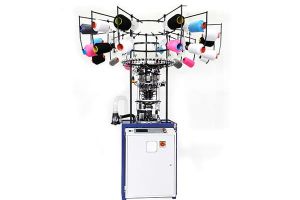
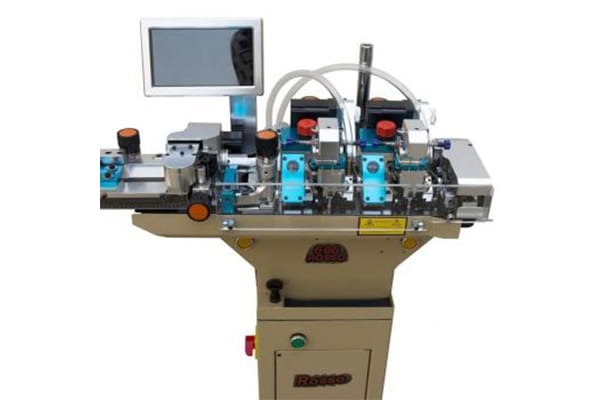
A Sock Toe Closing Machine sews or links the open toe of a knitted sock after it leaves the circular knitting machine. Marjan Polymer Industries (MPI) supplies project-matched mechanical or electronic toe-closing systems, optional sock turners, commissioning, operator training and spare-parts support for hosiery manufacturers in Pakistan.
The correct machine is selected from the sock needle count and gauge, yarn/fabric structure, seam type, required flatness, size range, production target and operator workflow. The product is a hosiery machine; it must not be confused with a shoe toe-lasting machine.
Toe-Closing Process
The operator or automatic handling device presents the open sock toe to the transport/conveyor. Fabric edges are aligned, trimmed when required and passed through one or two sewing heads to form a controlled overlock or linking seam. Optional turning equipment returns the sock to the required side after closing.
Available Machine Configurations
| Configuration | Typical use | Available functions |
|---|---|---|
| Mechanical toe closer | Reliable standard hosiery production | Manual adjustment, speed control, trimming and production counter options |
| Electronic toe closer | Frequent style changes and repeatable settings | Touchscreen, saved recipes, electronic conveyor/head adjustment and diagnostics |
| Twin-head/profile system | Low-profile or shaped toe seams | Independent head movement, variable stitch zones and curved-profile control |
| Toe closer with turner | Reduced manual handling after sewing | Integrated or standalone turning tube, suction and electronic coordination |
| Automatic cell | High-volume line integration | Feed handling, sensing, turning, counting and production-data interface |
Configurable Technical Range
| Parameter | Common project class | Selection basis |
|---|---|---|
| Sock needle range | Approximately 64–280 needles, model-dependent | Knitting machine, sock diameter, fabric and seam architecture |
| Sewing-head speed | Commonly approximately 3,500–5,200 rpm | Machine model, thread, fabric, seam quality and operator capability |
| Production output | Approximately 300–800 pairs/hour under suitable conditions | Sock style, loading/turning, operator, speed and quality requirement |
| Electrical power | Approximately 140–600 W for the closing machine/control package; turner/extraction additional | Number of motors, vacuum fan, automation and voltage |
| Supply | Commonly 220–240 V, 50 Hz; final model confirmed for Pakistan | Motor/control package and site electrical system |
| Control | Mechanical or PLC/electronic touchscreen | Style change frequency, recipe control, diagnostics and production reporting |
Seam and Fabric Capability
| Product | Selection considerations |
|---|---|
| Dress/fashion socks | Fine yarn, low seam bulk, precise alignment and small stitch profile |
| Sports/terry socks | Higher fabric thickness, elastic recovery, trimming and feed stability |
| Children’s socks | Small diameter, fine adjustment and operator handling |
| Medical/comfort socks | Low-profile seam and validated product-quality requirement |
| Technical or specialty socks | Yarn type, plating, reinforcement and product-specific trial |
Machine compatibility must be verified using actual socks and sewing thread. Needle count alone does not establish seam quality because yarn, terry, elastane, fabric thickness and toe geometry also affect the process.
Electronic Controls and Production Data
- Electronic sewing-head and conveyor speed control on applicable models.
- Multi-shift, preset and protected total counters with production-per-minute display.
- Thread-break, fabric-feed and microswitch alarms where included.
- Saved article settings for blade opening, conveyor height, knife and sewing-head position.
- Diagnostic functions and optional plant production-data connection.
Trimming, Turning and Handling Options
- Automatic edge/chain trimming with accessible waste collection.
- Reversible or profile-controlled transport to support seam appearance.
- Standalone or integrated sock-turning device for men’s, women’s and children’s socks.
- Suction fan and filter package selected from the turning/cleaning system.
- Work table, lighting, ergonomic seating and balanced material flow.
Applications in Pakistan
- Export hosiery, sports-sock and fashion-sock factories.
- School, uniform, workwear and everyday sock production.
- Medical/comfort and low-seam product lines subject to validated seam acceptance.
- Sample rooms, new-product development and medium-volume hosiery units.
- Integration with circular sock knitting, inspection, boarding and packing departments.
Safety and Maintenance
The machine scope can include needle/knife guards, belt and moving-part covers, emergency stop, electrical protection and safe isolation. Operators require training for threading, needle/looper replacement, knife setting and jam clearing. Routine cleaning, lubrication, lint removal and inspection of needles, loopers, knives, transport components and sensors protect seam quality and machine life.
Factory Acceptance and Documentation
| Deliverable | Typical scope |
|---|---|
| Configuration record | Machine model, needle/gauge range, heads, turner, electrical supply and included accessories |
| Functional check | Speed, transport, stitch formation, trimming, counters, alarms and turning functions |
| Sock trial | Customer sock/thread trial when agreed samples, seam requirement and acceptance method are available |
| Documentation | Operation, threading, adjustment, lubrication, maintenance and parts information |
| Training | Operator setup, quality checks, style change, troubleshooting and preventive maintenance |
Information Required for a Proposal
- Sock types, sizes, needle counts/gauges, yarn/fabric and terry/non-terry construction.
- Required seam style, flatness/comfort standard and reference sample.
- Pairs per hour/shift, number of operators and style-change frequency.
- Mechanical or electronic control preference and required saved settings/data.
- Integrated/standalone turning requirement and available utilities.
- Installation location, voltage and service expectations in Pakistan.
Installation and After-Sales Support
MPI can provide delivery coordination, installation, commissioning, sample setup, operator training and spare/consumable planning in Pakistan. Needles, loopers, knives, belts, sensors and model-specific service parts are identified in the quotation.
Frequently Asked Questions
What is a Sock Toe Closing Machine?
It is a hosiery sewing or linking machine that aligns and joins the open toe edges of a knitted sock to create the final toe seam.
Is this the same as a shoe toe-lasting machine?
No. A sock toe closer sews knitted hosiery. A shoe toe-lasting machine pulls and forms a shoe upper over a last; it is a different process and machine category.
Which socks can the machine close?
Depending on the selected model, it can process men’s, women’s and children’s dress, sports, terry, fashion and selected medical/comfort socks. Actual samples should be tested.
What needle-count range is available?
Many electronic sock toe-closing systems support approximately 64–280-needle products. The offered machine must be matched to the knitting machines, gauge and fabric.
What production speed is realistic?
Suitable systems may achieve roughly 300–800 pairs per hour, but sock style, operator loading, turning, seam quality, thread and machine setting determine actual output.
Can the machine produce a flat toe seam?
Low-profile seams are possible with suitable twin-head/profile technology, correct alignment, thread and settings. The required comfort or seam-height criterion should be agreed using samples.
Is an automatic sock turner available?
Yes. An integrated or standalone turning device can return the sock after closing and reduce handling, subject to sock size, gauge and line arrangement.
Can article settings be saved?
Electronic models can store settings such as transport speed, blade opening, conveyor/sewing-head height and knife position when the selected control package supports them.
Does MPI provide installation in Pakistan?
MPI can provide installation, commissioning, operator training and after-sales/spare-parts coordination in Pakistan according to the approved scope.
What information is required for a quotation?
Provide sock samples, needle count/gauge, fabric and seam requirement, required output, turning preference, electrical supply and installation location.
Request a Sock Toe Closing Machine Proposal
Send MPI your sock samples, sizes, needle counts, fabric details, seam requirement, target output and turning preference. Marjan Polymer Industries will prepare a project-specific Sock Toe Closing Machine proposal for your hosiery facility in Pakistan.