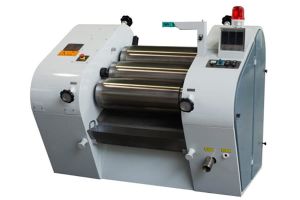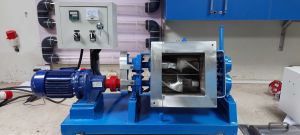
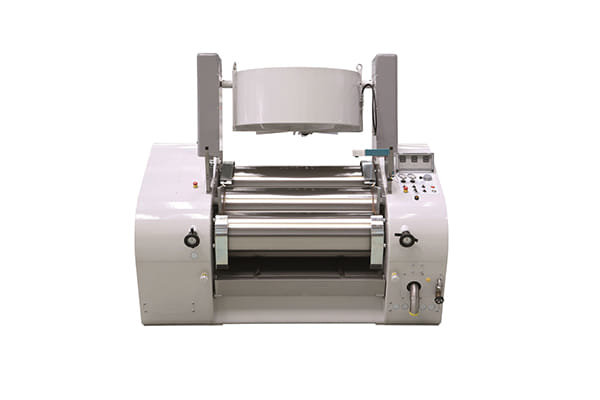
Two Roll Mill is MPI’s configurable open-mixing platform for rubber mastication, ingredient incorporation, compound mixing, warming and sheet preparation. In Pakistan the same equipment is commonly searched as a rubber mixing mill, two roll rubber mill or open mill.
Laboratory, pilot and production configurations are engineered from the compound, batch mass, roll temperature, friction ratio, nip range, throughput and downstream process. Final ratings are issued only in the approved MPI data sheet.
Processing Purpose
Two horizontally arranged rolls rotate toward the nip. Their controlled speed difference creates shear while the operator or stock blender repeatedly bands and cuts the compound. The mill can masticate raw rubber, incorporate fillers and additives, warm mixed stock and form a sheet for extrusion, calendering, moulding or testing.
Typical Applications
- Natural and synthetic rubber mastication and compounding
- EPDM, NBR, SBR, silicone and specialty elastomer processing
- EVA, TPE, selected PVC and thermoplastic blending
- Masterbatch, pigment and additive dispersion trials
- Laboratory formulation development and quality-control samples
- Warming and sheeting downstream of a kneader or internal mixer
Core Machine Assemblies
| Assembly | Function | Selection basis |
|---|---|---|
| Front and rear rolls | Create the working nip, shear and compound band | Diameter, face width, surface, hardness and thermal passages |
| Drive train | Supplies torque and controlled roll speeds | Batch load, friction ratio, duty cycle and starting torque |
| Nip adjustment | Sets roll separation and sheet thickness | Range, repeatability, operating method and safety |
| Bearings and housings | Support rolls under separating force | Mill size, load, speed and lubrication plan |
| Thermal circuit | Heats or cools the rolls | Compound temperature, heat load and site utility |
| Safety system | Stops and isolates hazardous movement | Risk assessment, braking performance and site standard |
| Base and guards | Maintain alignment and protect moving parts | Foundation, access, cleaning and maintenance needs |
Configurable Engineering Range
Capacity is not selected by roll size alone. MPI confirms the usable batch from compound density, band behaviour, viscosity, friction ratio and heat removal.
| Parameter | Available project direction |
|---|---|
| Scale | Benchtop/laboratory, pilot and industrial production mill |
| Roll size | Application-selected diameter and working face width |
| Roll surface | Smooth, polished, hardened or project-specific treatment |
| Roll speed | Fixed, multi-speed or variable-frequency configuration |
| Friction ratio | Selected for mastication, mixing, warming or sheeting duty |
| Nip control | Manual, mechanical, hydraulic or motorised arrangement |
| Thermal control | Internal roll circulation with water or approved heat-transfer system |
| Controls | Conventional controls or PLC/HMI with monitoring and recipes |
| Accessories | Stock guides, stock blender, tray, cutter and downstream interfaces |
Roll and Surface Selection
Roll material, hardness, finish and internal passages are selected for wear, thermal cycling, contamination limits and compound release. Production rubber mills commonly use hardened/chilled working surfaces; laboratory polymer work may require a different finish or corrosion review.
Friction Ratio and Shear
The front and rear rolls can operate at different surface speeds to create frictional shear. More shear is not automatically better: excessive friction can overheat or degrade a sensitive compound. MPI aligns roll speeds and ratio with the material, mixing objective and available temperature control.
Nip Adjustment and Thickness Control
The nip system must resist separating force while allowing controlled adjustment. Scale indication, mechanical stops, equalisation and optional position measurement can improve repeatability. Operators must never use hands or tools inside a moving nip.
Temperature-Control System
Mixing generates heat. Internal roll passages, rotary unions, manifolds and a project-matched circulation unit can remove or supply heat. The data sheet records allowable medium, inlet pressure, temperature and flow; these limits protect the rolls and seals.
Drive, Torque and Braking
The motor, gearbox, coupling and drive arrangement are sized for the most demanding approved compound. Variable-frequency control may support process flexibility, but the safety stop relies on an engineered braking and isolation philosophy rather than normal speed control alone.
Safety by Design
- Front and rear emergency bars, ropes or equivalent trip devices
- Emergency-stop stations and controlled braking
- Guarded gears, couplings and drive components
- Overload, phase and electrical protection
- Safe cleaning, lockout and maintenance provisions
- Documented operator training and nip-hazard procedures
Laboratory and Production Configurations
| Configuration | Primary objective | Typical options |
|---|---|---|
| Laboratory mill | Formulation comparison and test-sheet preparation | Compact rolls, precise gap, variable speed and temperature indication |
| Pilot mill | Scale-up trials and small-batch production | Higher torque, wider rolls, data monitoring and assisted handling |
| Production mixing mill | Warming, mixing or sheeting at sustained duty | Heavy drive, stock blender, powered nip and line integration |
| Special-purpose mill | Silicone, PVC, masterbatch or research service | Selected surface, thermal system, guarding and contamination controls |
Process Sequence
- Verify guards, emergency stops, roll gap, utilities and approved recipe.
- Precondition rolls where the process requires temperature control.
- Charge polymer safely and establish a stable band.
- Add ingredients in the defined order while monitoring stock temperature and motor load.
- Cut and fold the band to achieve distributive mixing.
- Set the finishing nip and sheet the compound for the next operation.
- Stop, isolate and clean using the approved procedure.
Integration Options
The mill can be engineered upstream or downstream of a bale cutter, kneader, internal mixer, extruder, calender, conveyor or batch-off cooling line. Stock blenders and powered handling reduce manual work but require their own guarding and interlocks.
Quality and Acceptance Plan
| Stage | Typical verification |
|---|---|
| Design review | URS, roll arrangement, drive, utilities, controls and foundation |
| Manufacture | Material records, roll dimensions/finish and assembly alignment as contracted |
| Mechanical test | No-load run, bearing temperature, vibration and nip movement |
| Safety test | Emergency trips, braking, guards, permissives and electrical protection |
| Process trial | Customer-agreed material and acceptance criteria when included |
| Handover | Manual, drawings, spares list, training and commissioning record |
Information Required for Sizing
- Polymer/elastomer type and approximate formulation
- Required batch mass and batches or kilograms per hour
- Laboratory, warming, mixing or sheeting duty
- Desired roll diameter, working width or available footprint
- Target roll temperatures, utilities and ambient conditions
- Required friction ratio, speed control and nip range
- Stock blender, cutters, trays and line-integration scope
- Electrical supply, guarding and documentation standard
Installation and Support in Pakistan
MPI can provide foundation and utility review, installation supervision, alignment, commissioning, operator training and lifecycle support across Pakistan. Customer and supplier responsibilities are stated in the proposal.
Maintenance and Spares
Routine inspection covers roll surfaces, nip mechanism, bearings, lubrication, gearbox, couplings, rotary unions, thermal passages, brakes and safety devices. MPI can define commissioning and recommended spares for the selected configuration.
Frequently Asked Questions
What is a two roll mill used for?
A two roll mill uses two counter-rotating rolls to masticate, mix, warm, blend and sheet rubber, elastomers and selected thermoplastic compounds.
Is a two roll mill the same as a rubber mixing mill?
Yes. In Pakistan and the rubber industry it is also called a rubber mixing mill, open mill, two roll open mill or two roll rubber mill.
Can MPI supply laboratory and production sizes?
Yes. Roll diameter, working width, batch capacity, drive and controls can be configured for laboratory, pilot or production duty after the formulation and throughput are reviewed.
Why do the rolls run at different speeds?
A controlled friction ratio creates shear in the nip, helping mastication, ingredient incorporation and dispersion. The correct ratio depends on material and process requirements.
Can roll temperature be controlled?
Yes. Internal roll passages can be engineered for water or an approved thermal system. Temperature sensors, rotary unions and a circulation unit may be included.
How is the roll gap adjusted?
Manual, mechanical, hydraulic or motorised nip adjustment can be specified. The selected arrangement must support repeatability, safe operation and the required thickness range.
Which safety devices are required?
Typical safeguards include front and rear emergency bars or trip wires, emergency stops, guarded drives, braking, overload protection and safe nip-setting procedures, finalised by risk assessment.
Can the mill process plastics as well as rubber?
Selected thermoplastic, TPE, PVC, EVA, masterbatch and polymer blends can be processed when temperature, roll surface, torque and safety conditions are suitable.
Can a stock blender or batch-off line be added?
Yes. Production systems can be integrated with stock blenders, conveyors, mills, extruders, calenders or batch-off cooling equipment.
Does MPI provide commissioning in Pakistan?
MPI can provide installation supervision, commissioning, operator training, documentation and after-sales support across Pakistan under the agreed supply scope.
Request a Two Roll Mill Proposal
Send MPI your compound, batch mass, roll-temperature, nip, friction-ratio and throughput requirements. MPI will prepare a project-specific Two Roll Mill proposal for Pakistan.