

Compression Moulding Epoxy is a heat-activated, two-component resin system for fast press-moulding cycles in fibre-reinforced composites. Marjan Polymer Industries supplies the Entropy Resins CPM system in Pakistan with fast or slow hardener selection, process review and technical documentation.
Product Identity
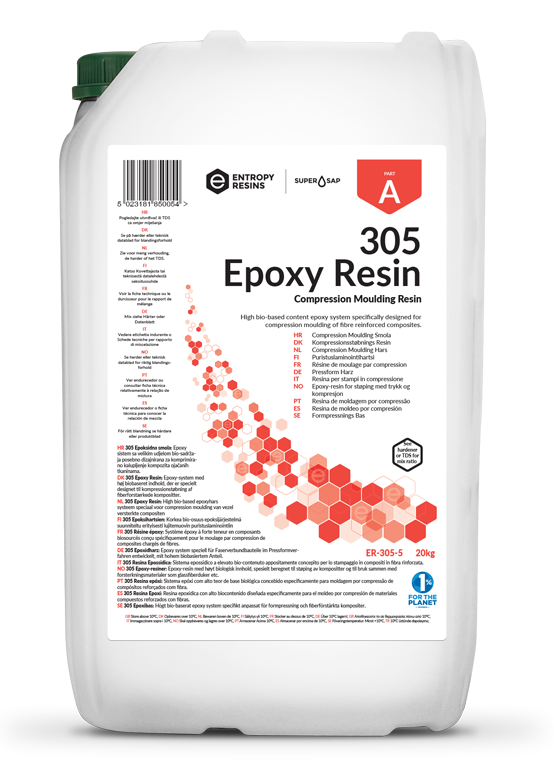
Entropy Resins’ current product designation is CPM Compression Molding Epoxy. Earlier packaging and technical literature may carry the 305 designation; both refer to this compression-moulding product family, but the current CPM technical data sheet must be used for quotation and process approval. This is not a Resoltech grade.
The system is formulated for heat-assisted moulding, with fibre wetting and thixotropic behaviour that helps control sag before the press reaches cure temperature. It is intended for durable, lightweight composite parts rather than room-temperature casting or general adhesive work.
System Options
- CPM Resin + CPF Fast Hardener: shorter working and press cycle for controlled small-to-medium mouldings.
- CPM Resin + CPS Slow Hardener: longer pot life for larger lay-ups, more complex placement or warmer shops.
- Minimum cure temperature: 65°C according to the current manufacturer guidance.
- Supply basis: correctly proportioned resin and hardener kit, with pack size and hardener confirmed at quotation.
Current Manufacturer-Published Processing Data
| Parameter | CPF Fast | CPS Slow |
|---|---|---|
| Mix ratio by volume | 2:1 | 2:1 |
| Mix ratio by weight | 100:42 | 100:42 |
| Mixed viscosity at 25°C | 2,300 mPa·s | 1,600 mPa·s |
| Pot life at 25°C | 20 minutes | 50 minutes |
| Recommended full cure at 82°C | 20 minutes | 40 minutes |
| Ultimate Tg, DSC midpoint | 71°C | 71°C |
| Hardness | Shore D 70–80 | Shore D 70–80 |
| Mixed biobased carbon content, ASTM D6866 | 30% | 33% |
Values are typical manufacturer data and are not a customer specification. Cure response changes with mould temperature, laminate thickness, heat transfer, press pressure and actual production conditions.
Published Mechanical Data
| Test | CPF Fast | CPS Slow |
|---|---|---|
| Tensile modulus, ASTM D638 | 3.0 GPa | 3.0 GPa |
| Tensile strength, ASTM D638 | 61.1 MPa | 62.0 MPa |
| Elongation, ASTM D638 | 6% | 6% |
| Flexural modulus, ASTM D790 | 2.8 GPa | 2.8 GPa |
| Flexural strength, ASTM D790 | 93.5 MPa | 92.7 MPa |
| Compression strength, ASTM D695 | 87.1 MPa | 78.7 MPa |
Final part performance depends on reinforcement, fibre fraction, laminate design, moulding pressure, void content and cure quality. Qualification testing on the customer’s construction remains essential.
Compatible Reinforcements and Forms
- glass-, carbon- and selected natural-fibre fabrics;
- preforms and stacked dry reinforcement suitable for resin application;
- wood laminates and fibre/wood hybrid constructions;
- application-specific compression-moulding charge formats developed through trials.
Compatibility with SMC, BMC, prepreg or any automated charge preparation must be engineered separately; CPM is a liquid epoxy system and should not be assumed to replace those material formats directly.
Typical Applications
- skis, snowboards and skateboards;
- press-moulded fibre-reinforced composite panels and components;
- wood and fibre laminates;
- lightweight sporting and mobility parts;
- industrial composite product-development programmes in Pakistan.
Recommended Moulding Workflow
- Qualify the tool: confirm mould material, release system, heating uniformity, pressure capability and temperature control.
- Prepare reinforcement: cut and stage plies or preforms with controlled weight and orientation.
- Condition materials: stabilize resin, hardener, reinforcement and mould to the approved starting temperature.
- Measure and mix: weigh components at 100:42 and mix for at least two minutes, scraping the sides and bottom.
- Charge the mould: distribute resin and reinforcement consistently within the selected hardener’s working time.
- Close and press: apply the qualified pressure and heat cycle while controlling resin flow and flash.
- Cure and cool: maintain at least the minimum cure temperature and validated dwell; cool under the approved condition before demoulding.
- Inspect: verify dimensions, surface, consolidation, cure and mechanical coupons as required.
Process-Control Requirements
Record batch numbers, resin/hardener weights, mix start, mould temperature by zone, press pressure, close time, dwell, demould temperature and part result. Initial trials should define charge weight, flow stops, venting, flash allowance and the acceptable processing window. Cold moulds or insufficient dwell can leave the epoxy under-cured.
Storage, Surface Preparation and Safety
Store sealed components according to the current technical data sheet. Work in a controlled, low-humidity environment. Bonding and mould-contact surfaces should be clean, dry and prepared for the chosen release or adhesion function. Use gloves, eye protection and ventilation, and review the current safety data sheets. Mixed epoxy can exotherm; do not leave a large batch in a deep container.
Information Required for a Quotation
Provide the part, reinforcement and laminate schedule, mould size and material, available press pressure, heating method and temperature uniformity, target cycle time, workshop temperature, preferred hardener speed, trial or production quantity and delivery city in Pakistan. MPI will confirm the CPM/CPF or CPM/CPS kit and current availability.
Frequently Asked Questions
What is CPM Compression Moulding Epoxy designed for?
Entropy Resins CPM is a two-component, heat-assisted epoxy system for press moulding fibre-reinforced composite parts with controlled fast production cycles.
What is the mixing ratio?
The current CPM data lists 2:1 resin to hardener by volume and 100:42 by weight for both CPF Fast and CPS Slow.
What is the minimum cure temperature?
Manufacturer guidance states a minimum cure temperature of 65°C. The validated production cycle must also provide adequate dwell and uniform heating through the laminate.
How fast is the moulding cycle?
At 82°C, the current guidance lists a recommended full cure of 20 minutes with CPF Fast and 40 minutes with CPS Slow. Actual cycle qualification depends on the mould and part.
Which hardener should I choose?
CPF Fast provides a 20-minute published pot life at 25°C; CPS Slow provides about 50 minutes. Choose against charge size, lay-up time, temperature and press cycle.
Can this epoxy cure at room temperature?
It is designed for heat-assisted moulding and requires the stated minimum elevated cure temperature. It should not be selected as a room-temperature casting resin.
Can it be used with carbon fibre?
Yes, subject to a qualified laminate and process. Glass, carbon and selected natural-fibre constructions can be evaluated.
Which composite parts are best suited to this epoxy system?
The system is suited to qualified press-moulded laminates such as sporting goods, boards, wood-fibre laminates and industrial composite components. Regulated applications require programme-specific material and process approval.
How should cure and part quality be verified before production?
Validate mould temperature, dwell time, pressure, charge weight and cooling through trial parts. Confirm cure and quality using dimensional inspection, surface review and the mechanical or thermal tests required by the product specification.
What information is needed for a Pakistan quotation?
Share part dimensions, reinforcement, mould and press data, cure temperature, required cycle time, hardener preference, quantity and delivery city.