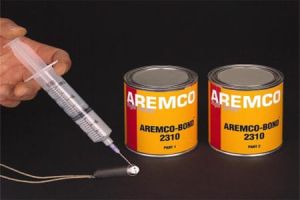


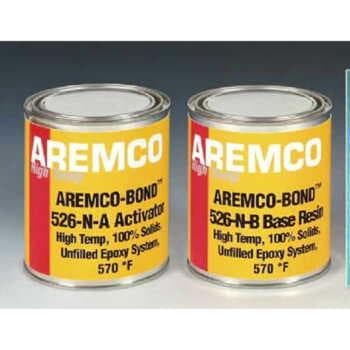
Aremco-Bond 526N is a clear-amber, two-component epoxy adhesive engineered for tough bonding duties at elevated temperature. Marjan Polymer Industries supplies Aremco-Bond 526N in Pakistan with technical-document review, application screening and quotation support for industrial users.
Product Identity
The correct product designation is Aremco-Bond 526N. It is an unfilled 1:1 epoxy adhesive in Aremco’s ultra-high-temperature product group. It should not be confused with Aremco-Bond 525N, electrically conductive grades, ceramic adhesives or general room-temperature construction epoxies.
526N requires a controlled heat cure to develop its published properties. Selection must consider substrate, joint design, continuous and peak temperature, thermal cycling, chemical exposure and the customer’s qualification standard.
Manufacturer-Published Processing Data
| Parameter | Aremco-Bond 526N |
|---|---|
| Mix ratio by weight, resin:hardener | 1:1 |
| Specific gravity at 25°C | 1.23 g/cm³ |
| Mixed viscosity at 25°C | 8,500 cP |
| Pot life, 100 g mass at 25°C | 2.5 hours |
| Recommended cure | 2 hours at 93°C, followed by 2 hours at 163°C |
| Alternate cure | 3–4 hours at 149°C |
| Published service-temperature range | −60°C to +300°C |
| Colour | Clear amber |
These are manufacturer-published typical values, not a customer specification. Always use the current Aremco technical and safety data sheets supplied with the quoted grade.
Published Cured Properties
| Property | Typical value |
|---|---|
| Tensile shear strength | 2,800 psi / approximately 19.3 MPa |
| Flexural strength | 18,000 psi / approximately 124 MPa |
| Coefficient of thermal expansion | 33 × 10⁻⁶ per °C |
| Volume resistivity at room temperature | 4.0 × 10¹⁴ ohm-cm |
| Dielectric strength | 450 V/mil |
| Dielectric constant at 1 kHz | 3.01 |
| Hardness | Shore D 89 |
| Cure shrinkage | 0.01 in/in |
Actual joint performance depends on surface preparation, bond-line thickness, adherend stiffness, cure uniformity and test method. Values must not be treated as a guaranteed result for an unqualified assembly.
Compatible Substrates and Applications
- metals and selected metal alloys;
- technical ceramics and glass;
- qualified composites and temperature-resistant plastics;
- electrical, electronic and laboratory assemblies exposed to elevated temperature;
- industrial fixtures, sensors and components requiring a rigid heat-cured bond.
Compatibility must be confirmed by trials. The published ASTM E595 outgassing data can support engineering review, but it does not by itself approve a finished assembly for aerospace, vacuum or regulated service.
Joint-Design and Surface-Preparation Requirements
Design the joint to carry load mainly in shear or compression and avoid peel concentration. Remove oil, release agent, corrosion and weak surface layers. Abrade or grit-blast suitable non-porous surfaces, remove residue and bond promptly. Any chemical etch or primer must be compatible with the substrate and approved process.
Recommended Application Workflow
- Review the duty: document substrate, operating temperature, cycling, chemicals, load and required standard.
- Prepare surfaces: clean, abrade or blast as appropriate, then remove dust and contamination.
- Condition materials: bring sealed components and parts to the controlled processing temperature.
- Measure: weigh resin and hardener accurately at 1:1 by weight.
- Mix: blend until completely uniform while scraping the container sides and base.
- Apply: wet both surfaces, control the bond line and assemble within the usable working time.
- Fixture: hold alignment without squeezing all adhesive from the joint.
- Heat cure: apply the selected documented cure with verified part temperature, not oven set-point alone.
- Inspect: confirm appearance, dimensions, cure records and qualification-test results.
Process Control and Qualification
Record product and batch numbers, component weights, mix time, application time, bond-line thickness, fixture pressure, oven profile and actual part temperature. Qualification coupons should reproduce the production substrate, preparation, geometry and cure. Thermal cycling and environmental exposure should reflect the real duty.
Storage and Safety
Store sealed components within the temperature and shelf-life limits stated on the current documentation. Use suitable gloves, eye protection and ventilation. Avoid skin contact and uncontrolled heating of mixed material. Do not alter the ratio or add solvents. Dispose of resin, hardener and contaminated materials according to the safety data sheets and local requirements.
Information Required for a Quotation
Provide the substrates, bond area and joint geometry, service and peak temperature, thermal cycles, load, chemical or vacuum exposure, required test standard, quantity, preferred pack size and delivery city in Pakistan. MPI will confirm suitability for review, current documentation, pack availability and lead time.
Frequently Asked Questions
What is Aremco-Bond 526N?
It is a clear-amber, two-component, heat-cured epoxy adhesive developed for tough industrial bonding at elevated temperature.
What is the correct mixing ratio?
The manufacturer publishes a 1:1 resin-to-hardener ratio by weight. Accurate weighing and complete mixing are essential.
What temperature can 526N withstand?
The published service range is −60°C to +300°C. Suitability still depends on load, exposure duration, thermal cycling and the bonded assembly.
Does Aremco-Bond 526N cure at room temperature?
No. The published properties require a controlled elevated-temperature cure. Follow the current cure schedule and verify actual part temperature.
What is the published cure schedule?
The primary schedule is 2 hours at 93°C followed by 2 hours at 163°C. An alternate published schedule is 3–4 hours at 149°C.
Can it bond metal to ceramic?
Metal and technical ceramic combinations can be evaluated, provided their surfaces, thermal expansion mismatch, geometry and service conditions are qualified.
Is 526N electrically conductive?
No conductivity claim should be assumed. The published volume resistivity is 4.0 × 10¹⁴ ohm-cm, so projects requiring conductive adhesive need a different grade.
Is it automatically approved for aerospace or vacuum use?
No. Aremco publishes ASTM E595 outgassing data, but the customer must complete programme-specific material and assembly qualification.
How should the bonded surfaces be prepared?
Remove contamination and weak layers, then abrade or grit-blast suitable non-porous surfaces. Use only a validated preparation for the substrate.
What information is needed for a Pakistan quotation?
Share substrates, joint geometry, temperature, load, exposure, required standard, quantity, pack size and delivery city.