

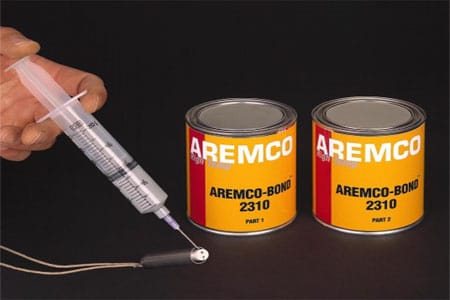
Marjan Polymer Industries supplies Aremco-Bond™ 2310 in Pakistan for demanding industrial bonding applications. It is a two-part, ceramic-filled epoxy adhesive formulated for high lap-shear and peel strength with resistance to shock, vibration and flexing.
The product is associated with autoclave and cryogenic assembly work, but suitability depends on substrates, joint geometry, surface preparation, cure, temperature cycling and qualification. MPI supplies the branded grade with manufacturer technical and safety documentation rather than treating 2310 as a generic clear epoxy.
Aremco-Bond 2310 Product Identity
Aremco Products, Inc. lists grade 2310 in its ultra-high-bond-strength range. The system is ceramic-filled, black, mixed at 1:1 by weight and designed as a tough structural adhesive rather than a low-viscosity casting resin.
Manufacturer data should be checked at quotation because formulations, packaging and published values can change. The container label, current TDS, SDS, order confirmation and lot records govern the material supplied.
Key Application Characteristics
| Characteristic | Manufacturer Description | Engineering Meaning |
|---|---|---|
| Ceramic-filled epoxy | Filled two-part structural system | Paste-like handling and controlled bond-line behaviour |
| Mix ratio | 1:1 resin to hardener by weight | Both components require accurate, homogeneous mixing |
| Mechanical response | High lap-shear and peel strength | Performance depends on substrate and joint design |
| Dynamic environment | Resistant to shock, vibration and flexing | Useful for qualified assemblies experiencing movement or cycling |
| Application category | Autoclave and cryogenic use highlighted | Assembly-level thermal-cycle testing remains required |
| Colour | Black | Visible bond line; not a clear cosmetic adhesive |
Applications
- Bonding and sealing components in laboratory autoclave assemblies
- Cryogenic fixtures and qualified low-temperature joints
- Metal-to-metal structural bonding under vibration
- Ceramic-to-metal and ceramic component assembly
- Glass and selected engineering-material bonding after compatibility trials
- Industrial sensors, fixtures and instrumentation
- Machine, pump and equipment assemblies requiring a tough bond
- Aerospace and research hardware in non-flight or fully qualified programmes
- Electrical or mechanical assemblies needing a rigid filled adhesive
- Repair and prototyping where the original design permits adhesive bonding
Manufacturer Reference Properties
| Property | Published Reference | Test / Use Note |
|---|---|---|
| Mix ratio | 1:1 by weight, resin:hardener | Do not assume volume ratio without current TDS approval |
| Mixed specific gravity | Approximately 1.35 g/cm³ at 25 °C | Reference value; batch and temperature affect dispensing |
| Mixed viscosity | Approximately 45,000 cP at 25 °C | Manufacturer reference for freshly mixed material |
| Pot life | Approximately 0.75 h for 100 g at 25 °C | Larger mass and higher temperature shorten working time |
| Recommended cure | 2 h at 150 °F (about 66 °C) | Part must reach temperature for the defined cure period |
| Alternate cure | 48 h at room temperature | Ambient conditions and bond-line thickness must be controlled |
| Temperature range | Published reference −67 to 325 °F (−55 to 165 °C) | Not an automatic continuous-use rating for every bonded assembly |
| Tensile lap shear | Published reference approximately 4,770 psi | Manufacturer test based on ASTM D1002-type coupons; not a design allowable |
| Flexural strength | Published reference approximately 12,000 psi | Neat cured-material test, not joint flexural capacity |
| Hardness | Approximately Shore D 78 | Reference cured property |
Data control: values are manufacturer-published references for product selection. Use the current Aremco TDS and application-specific test results for engineering design.
Additional Electrical and Physical References
| Property | Published Reference | Limitation |
|---|---|---|
| Volume resistivity | Approximately 3.0 × 10¹³ ohm-cm | Conditioning, temperature and specimen geometry matter |
| Dielectric strength | Approximately 410 V/mil | Not a certified insulation-system rating |
| Dielectric constant | Approximately 4.28 at 1 kHz | Frequency and cure condition affect result |
| Dissipation factor | Approximately 0.4 | Use current test method and datasheet |
| Linear cure shrinkage | Approximately 0.001 in/in | Joint geometry and cure schedule can change movement |
| Chemical resistance | Manufacturer rating: good | Specific chemical immersion data is required for service approval |
Substrate Compatibility
Grade 2310 can be evaluated on metals, ceramics, glass and selected rigid plastics or composites. The substrate must tolerate the cure schedule, thermal range and surface-treatment process.
Low-surface-energy plastics such as polyethylene and polypropylene are difficult to bond and are not approved by generic “most plastics” language. Coated, plated, anodized or passivated surfaces require coupon testing.
Joint Design
Adhesives perform best when loads are distributed in shear, compression or broad-area tension. Peel, cleavage, impact edge loading and large stiffness mismatch can concentrate stress.
Overlap length, bond-line thickness, corner radius, substrate thickness, thermal expansion and assembly tolerances should be established before production. Mechanical fasteners may be retained for safety-critical or fail-safe designs.
Surface Preparation
Remove oil, release agent, oxide, loose coating and other contaminants using a process compatible with the substrate. Abrasion or blasting can increase area and remove weak surface layers when the material permits it.
After preparation, clean and bond within a controlled time. Operators should use clean gloves and dedicated tools. A water-break-free or other validated cleanliness check can support process control for metals.
Mix Ratio and Weighing
The published mix ratio is 1:1 by weight. Use a calibrated balance and clean containers for bulk mixing. Do not estimate equal portions visually where density, shape or component colour can mislead.
For cartridges, use the manufacturer-approved package, dispenser and static mixer. A 1:1 cartridge meters volume by hardware; cartridge suitability must be confirmed by Aremco rather than inferred from the bulk weight ratio.
Mixing Procedure
Condition components to the approved working temperature, pre-mix individual components if required by the TDS, then combine them thoroughly while scraping container sides and bottom. Avoid folding in excessive air.
For critical work, transfer the mixed adhesive to a second clean container and mix again. Record lot numbers, weights, start time, temperature and operator.
Pot Life and Working Time
The published pot life is approximately 45 minutes for a 100 g mass at 25 °C. Pot life is measured in a bulk condition and is not identical to open time on a thin bond line.
Reaction heat increases with mixed mass. Large batches can exotherm, shorten working time and create a burn or smoke hazard. Mix only the quantity that can be applied within the approved process window.
Application and Bond-Line Control
Apply enough mixed adhesive to wet both prepared surfaces and fill the designed gap without trapping air. Assemble within the validated open time and use stops, shims or calibrated spacers when bond-line thickness is important.
Clamping should maintain position and contact without squeezing out nearly all adhesive. Excess material may be tooled or removed according to the process before it hardens.
Cure Options
Aremco’s published reference gives 2 hours at 150 °F (approximately 66 °C) as the recommended cure and 48 hours at room temperature as an alternate. Cure time begins when the bond line reaches the stated temperature.
Oven uniformity, part thermal mass, ramp rate and fixture pressure can affect cure. Any alternate schedule must come from current manufacturer guidance or a documented qualification study.
Autoclave Applications
The product is identified by Aremco as suitable for autoclave-related bonding because its filled, toughened response can tolerate pressure and thermal cycling in appropriate assemblies.
Autoclave temperature, pressure, fluid, vacuum, cycle count and joint stress must be disclosed. Adhesive qualification does not certify a vessel, pressure boundary or safety-critical autoclave component.
Cryogenic Applications
The published lower-temperature reference is approximately −55 °C, and Aremco highlights cryogenic applications. The term “cryogenic” can describe conditions below this figure, so the actual minimum temperature must be checked with Aremco.
Differential thermal contraction between metal, ceramic, glass and adhesive can dominate joint stress. Thermal cycling and leak or mechanical testing should represent the real assembly.
Shock, Vibration and Flexing
Grade 2310 is positioned for resistance to shock, vibration and flexing compared with a brittle general-purpose epoxy. This does not make every joint fatigue-proof.
Mass, resonance, fastener preload, bond-line geometry and operating frequency influence performance. Qualification can include vibration, shock and post-test inspection of representative bonded parts.
Chemical and Environmental Exposure
Manufacturer literature gives a general “good” chemical-resistance rating. Specific resistance to fuel, oil, solvent, water, steam, acid or cleaning fluid must be established under the actual concentration, temperature and stress.
Humidity, salt, ultraviolet exposure and thermal cycling can affect interfaces even when neat resin appears resistant. Accelerated ageing should include the intended substrate and surface preparation.
Quality-Control Checks
| Process Stage | Control | Record |
|---|---|---|
| Receiving | Product, component, lot, seal and expiry | CoA / receiving log |
| Surface preparation | Cleanliness, abrasion or treatment | Work instruction checklist |
| Mixing | 1:1 weight, time, homogeneity and batch size | Mix record |
| Application | Open time, coverage and bond-line control | Traveller / assembly record |
| Cure | Time and actual part temperature | Oven or ambient log |
| Acceptance | Visual, witness coupon or specified joint test | Inspection report |
Storage and Shelf-Life
Store resin and hardener in original sealed, identified containers under the temperature and segregation conditions stated by Aremco. Protect from moisture, contamination, direct heat and unauthorized repacking.
Shelf life is controlled by the product label and current documentation. Expired, crystallized, contaminated or damaged components should be quarantined pending written disposition.
Safety and Handling
- Review the current resin and hardener SDS before use.
- Use chemical-resistant gloves, eye protection and suitable ventilation.
- Avoid skin contact; epoxy components can cause sensitization.
- Control grinding or machining dust from cured ceramic-filled material.
- Do not mix large masses that can create uncontrolled exotherm.
- Keep food, drink and incompatible chemicals out of the work area.
- Dispose of liquid components, solvent and cured waste through approved routes.
Packaging and Supply Scope
Availability may include bulk component sets or approved dual-cartridge packaging depending on current Aremco supply. Pack size, dispensing hardware, static mixers and export availability are confirmed in the quotation.
MPI can include TDS, SDS, batch documentation and application discussion. Any private labelling, repacking or locally formulated substitute requires separate written identification and is not represented as Aremco 2310.
Information Required for Selection
| Customer Input | Required Detail |
|---|---|
| Substrates | Material, grade, coating, finish and thickness |
| Joint | Geometry, overlap, gap, load direction and allowable movement |
| Environment | Minimum / maximum temperature, chemicals, moisture and pressure |
| Mechanical duty | Static load, shock, vibration, peel and cycle count |
| Cure | Available oven, room-temperature schedule and fixture method |
| Quantity | Bond area, batch size, annual usage and package preference |
| Quality | Documentation, coupon test and traceability requirements |
| Delivery | Site, city and schedule in Pakistan |
Supply and Support in Pakistan
MPI can support industrial and research customers in Lahore, Karachi, Faisalabad, Islamabad and other Pakistani locations with product selection, documentation, import coordination and application planning.
For critical bonds, a small evaluation kit and representative coupon programme should precede production. Final approval remains with the assembly designer and customer quality authority.
Important Performance Boundaries
Published lap-shear, flexural, dielectric and temperature values describe controlled test specimens, not every bonded assembly. Safety factors and qualification are required for load-bearing, pressure, flight, medical or other high-consequence use.
Product photographs are illustrative. Manufacturer, grade, colour, package, lot, cure and current documentation are confirmed at order.
Why Use the Branded Grade Specification
Grade 2310 has a defined ceramic-filled, 1:1, toughened performance profile. Replacing it with a generic “ultra-strength epoxy” can change viscosity, cure, colour, thermal response and joint durability.
MPI preserves the Aremco product identity and presents selection data with test limitations so Pakistani customers can plan a defensible bonding process.
Frequently Asked Questions
What is Aremco-Bond 2310?
It is a two-part, ceramic-filled epoxy adhesive designed for high lap-shear and peel strength with shock, vibration and flex resistance.
What is the correct mix ratio?
The manufacturer publishes a 1:1 resin-to-hardener ratio by weight. Use a calibrated balance or an approved cartridge system.
How long is the pot life?
The published reference is about 45 minutes for a 100 g mass at 25 °C. Larger batches and higher temperature shorten working time.
What cure schedule is recommended?
Aremco publishes 2 hours at 150 °F (about 66 °C), with 48 hours at room temperature as an alternate reference.
What temperature range is published?
The reference range is approximately −67 to 325 °F (−55 to 165 °C), subject to assembly-specific qualification.
Can it bond metals and ceramics?
Yes, these are common candidate substrates when properly prepared. Coatings, glass, plastics and dissimilar joints require coupon tests.
Is it suitable for cryogenic service?
Aremco highlights cryogenic applications, but the actual minimum temperature and thermal cycle must be reviewed and tested.
Is it electrically insulating?
Published data includes high volume resistivity and dielectric strength, but a finished insulation system requires its own design and validation.
What information is needed for a quotation?
Share substrates, joint geometry, loads, temperature, chemicals, cure capability, quantity, package and delivery city.
Can MPI supply Aremco 2310 in Pakistan?
MPI can coordinate current grade documentation, packaging, import and delivery subject to Aremco availability and order terms.

