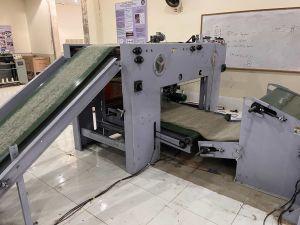

Jigger Dyeing Machine is an open-width batch textile machine in which woven fabric passes repeatedly through process liquor between two winding rollers. MPI manufactures the JD500 platform in Pakistan for laboratory development, pilot work, sampling and application-sized production, with each build engineered to the required fabric width, batch and process.
How Jigger Dyeing Works
Open-width fabric unwinds from one main roller, passes through the process bath and rewinds on the opposite roller. At the end of each pass, the direction reverses. Repeated passages expose the fabric to pretreatment, dye or wash liquor while speed, tension, temperature and cycle count are controlled.
JD500 Configuration Range
| Parameter | Supply basis |
|---|---|
| Manufacturer | Marjan Polymer Industries, Pakistan |
| Machine type | Custom atmospheric open-width batch jigger |
| Working width | Approximately 250–1,500 mm, built to the selected requirement |
| Primary fabric | Woven fabric in open width; other constructions require application review |
| Processes | Pretreatment, scouring, bleaching, dyeing and washing, subject to chemistry and configuration |
| Fabric movement | Reversible passage through the liquor between two main rollers |
| Speed | Variable; final range based on roller, batch, drive and process |
| Tension | Adjustable arrangement selected for fabric sensitivity and roll build |
| Temperature | Atmospheric systems generally engineered up to approximately 98°C |
| Wetted materials | Selected against chemistry; stainless options including SS316L where specified |
| Controls | Practical manual/digital control through PLC/HMI automation |
| Price | Project quotation after technical configuration |
Core Engineering Features
Fabric Handling
Application-sized rollers, guides and frame maintain open-width travel and orderly batch build-up.
Reversible Drive
Forward/reverse variable-speed drive supports controlled passes and repeatable process recipes.
Tension Control
Mechanical, pneumatic or electronic strategy is selected for fabric, roll diameter and automation level.
Liquor Trough
Geometry, working volume, drain and cleaning access are sized to width, batch and chemical service.
Temperature System
Sensor, controller, heater or steam interface and protection are engineered to bath volume and utilities.
Operator Safety
Emergency stop, guarded drives, covers and electrical/process protection follow the approved risk review.
Available Customisation
- Working width, roller face and maximum roll diameter
- Batch length, mass and required process liquor volume
- Roller diameter, surface finish and guide arrangement
- Heating method, installed load and cooling interface
- Circulation, agitation or auxiliary liquor mixing
- Manual, VFD, digital controller or PLC/HMI operation
- Inspection cover or viewing arrangement
- Wetted stainless-steel grade and frame finish
- Expander or auxiliary fabric-handling options
- Recipe, alarm, data and batch-reporting functions
Fabric and Process Suitability
The JD500 is primarily intended for dimensionally stable woven fabric. Knitted, stretch, delicate or highly tension-sensitive textiles need a technical review because lengthwise tension is inherent to jigger transport. Dye class, fibre, construction, pretreatment, liquor ratio, temperature and required fastness must be considered together.
Laboratory, Pilot and Production Use
Laboratory
Small-width machines for recipe development, education, samples and comparative process trials.
Pilot
Intermediate systems for scale-up, batch studies, fabric handling and equipment-development work.
Production
Wider application-sized units when batch, throughput, utilities and automation have been defined.
Scale-up depends on more than width. Bath volume, circulation, heat transfer, fabric tension, speed, roll build and pass sequence must be reviewed when transferring a laboratory recipe.
Controls and Safety
- Emergency stop and guarded transmissions, shafts and nip points
- Motor overload, electrical earthing and suitable enclosure protection
- Over-temperature cut-out independent of routine process control
- Controlled reversing and acceleration/deceleration
- Safe covers, access, drain and chemical-handling provisions
- Pressure-rated design only where explicitly engineered and documented
Acceptance, Installation and Support
Factory and site acceptance can verify working width, speed, direction change, tension response, temperature control, alarms, drain/cleaning function and an agreed fabric trial. MPI can provide installation, commissioning, operator training and after-sales support in Pakistan. A one-year limited company warranty applies subject to the final quotation and warranty terms.
Information Required for a Quotation
- Fabric fibre, construction and intended process
- Minimum/maximum working width
- Fabric length, batch mass and roll diameter
- Operating temperature and chemistry
- Speed, tension and automation requirement
- Heating, cooling and circulation utilities
- Wetted-material preference and cleaning needs
- Installation city and delivery schedule
Frequently Asked Questions
Is the JD500 manufactured in Pakistan?
Yes. Marjan Polymer Industries manufactures and fabricates the JD500 in Pakistan against the approved technical requirement.
What working widths are available?
Machines can be engineered from approximately 250 mm to 1,500 mm working width. Each supplied unit is built for its selected width and required roller/guide clearance.
Is it only a laboratory jigger?
No. The JD500 is a configurable platform for laboratory, pilot or wider production work. Batch capacity, utilities and throughput are designed separately.
Which fabrics can be processed?
It is primarily intended for woven fabric in open width. Knitted, stretch or very tension-sensitive fabrics require a specific suitability review.
What processes can be performed?
Suitable configurations may support pretreatment, scouring, bleaching, dyeing and washing. Compatibility depends on fibre, dye/chemical system, materials and controls.
What is the maximum temperature?
Atmospheric configurations are generally engineered up to approximately 98°C. Higher-temperature or pressurised operation is not claimed unless separately engineered and documented.
Can PLC and recipe control be supplied?
Yes. Options range from practical manual/digital controls to PLC/HMI recipe, alarm and batch-reporting functions.
What is the price in Pakistan?
There is no universal price because width, batch, materials, heating, controls and auxiliary systems change the build. MPI issues a project quotation after application review.
Are installation and training available?
Yes. Installation, commissioning, operator training and after-sales support can be included, with responsibilities defined in the quotation.
What warranty is provided?
The machine is offered with a one-year limited company warranty subject to the supplied scope, correct operation, exclusions and final warranty document.
Configure a Jigger Dyeing Machine
Share your fabric, working width, batch and process. MPI will prepare an engineered JD500 configuration and technical quotation for supply in Pakistan.