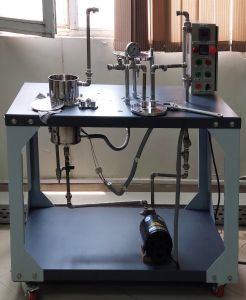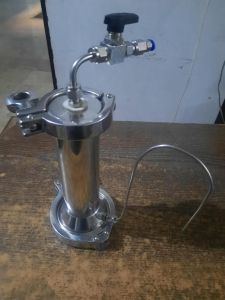
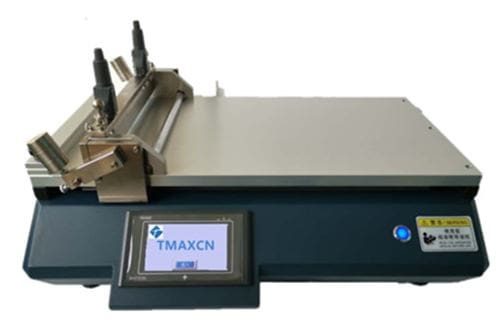
Flat Sheet Membrane Casting Machine is a motorised laboratory film applicator for drawing a controlled polymer-dope layer across a glass, metal or supported substrate. It improves casting-speed and wet-gap repeatability for phase-inversion, evaporation and membrane-development experiments in universities, research laboratories and pilot programmes.
Casting Process
Prepare & Degas
Polymer solution is mixed, filtered and degassed according to the formulation and solvent-safety procedure.
Set Gap & Speed
The substrate is levelled and secured, the blade gap is set, and motorised travel applies the wet film at a defined speed.
Form the Membrane
The cast film undergoes controlled evaporation, immersion precipitation or another validated solidification route.
Reference Machine Specification
The following describes the existing reference configuration. Final dimensions and values are confirmed in the quotation after the required membrane size, solvent, substrate and process are reviewed.
| Parameter | Reference / configurable value |
|---|---|
| Machine format | Laboratory/pilot flat-bed motorised film applicator |
| Casting blade | SS304 reference blade; fixed or adjustable gap options |
| Wet-gap range | Approximately 100–300 µm in the reference configuration; wider ranges by blade selection |
| Useful casting width | Application selected; approximately 12–15 in reference work |
| Coating travel / bed | Up to approximately 3.5 × 3 ft reference area, subject to final machine drawing |
| Casting surface | SS316 reference plate or removable glass/support surface as specified |
| Travel speed | Approximately 0.1–10 cm/s, continuously adjustable |
| Bed heating | Optional controlled surface heating up to approximately 100°C in the reference design |
| Levelling | Rigid frame with adjustable levelling and sealed level indication |
| Controls | Digital speed and temperature indication/control as configured |
Configurable Equipment Options
- Fixed-gap bar, micrometric doctor blade or slot-die head
- Glass, stainless, PET or nonwoven support handling
- Heated or ambient casting platform
- Vacuum hold-down or mechanical substrate clamps
- Custom casting width and travel length
- Enclosed solvent-extraction hood interface
- Temperature/humidity chamber for VIPS development
- Coagulation bath and removable plate transfer aid
- Recipe, position and travel-cycle control
- Continuous unwind, casting and take-up pilot architecture
Membrane Processes
NIPS
Non-solvent-induced phase separation after controlled dope casting and transfer to a compatible coagulation bath.
VIPS
Vapour-induced phase separation using a controlled humidity and temperature environment before or during coagulation.
Evaporation / Dense Films
Solvent evaporation or thermal treatment for dense films, coatings and selected ion-exchange or gas-separation materials.
Materials and Applications
- Microfiltration and ultrafiltration membrane development
- Nanofiltration or reverse-osmosis support research
- Gas-separation and pervaporation film development
- Battery separator, fuel-cell and ion-exchange membrane research
- Supported coatings on nonwoven, PET or other compatible substrates
- Polymer, ceramic-slurry and functional thin-film experiments
Compatibility with PVDF, PES, polysulfone, PAN, cellulose acetate, polyimide or another formulation depends on solvent, viscosity, temperature and contact materials.
Parameters That Determine Membrane Quality
- Polymer concentration, molecular weight and dope viscosity
- Solvent/non-solvent composition and degassing
- Blade gap, alignment and casting speed
- Substrate chemistry, smoothness and tension
- Bed, dope and ambient temperature
- Relative humidity and evaporation time
- Coagulation-bath composition and temperature
- Post-wash, conditioning and drying protocol
Solvent and Laboratory Safety
Many membrane dopes use volatile, toxic or reproductive-hazard solvents. The machine must be used under a compatible extraction system with a documented chemical risk assessment, suitable gloves and eye protection, spill control, grounded electrical equipment and approved solvent-waste handling.
Calibration and Acceptance
- Bed flatness and blade parallelism across the useful width
- Travel-speed verification at low, medium and high settings
- Gap verification using calibrated shims or metrology
- Temperature uniformity and stability where heating is fitted
- Repeatability trial with a standard fluid or customer formulation
- Wet-film mass/thickness mapping and finished-membrane characterisation
Installation and Support in Pakistan
MPI can provide installation, levelling, commissioning, operating guidance and process-training support across Pakistan. Exhaust, solvent storage, coagulation bath, utilities and local safety infrastructure are confirmed before delivery. A 12-month limited warranty is available subject to the final scope and warranty terms.
Information Required for a Quotation
- Polymer, solvent and approximate viscosity range
- Self-supporting or supported membrane
- Required wet gap, width and casting length
- Casting speed and temperature range
- NIPS, VIPS, evaporation or other process
- Vacuum bed, humidity chamber or coagulation needs
- Site ventilation and electrical supply
- Controls, documentation and delivery schedule
Frequently Asked Questions
What is a flat sheet membrane casting machine?
It is a motorised applicator that draws a controlled polymer-solution film across a flat substrate at a defined blade gap and travel speed for membrane development.
Does the doctor-blade gap equal final membrane thickness?
No. Gap controls the initial wet film. Final thickness changes with solids content, substrate penetration, solvent evaporation, phase inversion, washing and drying.
What wet-gap range is available?
The reference configuration covers approximately 100–300 µm. Alternative fixed or micrometric blades can be selected for a wider application-specific range.
What casting speed is available?
The reference drive is adjustable from approximately 0.1 to 10 cm/s. The useful setting depends on dope viscosity, blade, substrate and required coating quality.
Can the casting plate be heated?
Yes. The reference system can include controlled bed heating up to about 100°C. Higher or different ranges require a separate thermal and solvent-safety design.
Can it cast on nonwoven support?
Yes, if the support can be held flat and its wetting, penetration and tension are controlled. Vacuum hold-down or continuous handling may be selected.
Can it support NIPS and VIPS?
It supports casting for NIPS. VIPS requires controlled humidity and temperature exposure, so an appropriate environmental chamber is added where needed.
Is the machine suitable for flammable solvents?
Not automatically. Solvent use needs extraction and risk assessment; an ignitable atmosphere requires specifically engineered hazardous-area equipment.
Does MPI provide installation in Pakistan?
Yes. Installation, levelling, commissioning and operating guidance can be included, with laboratory ventilation and utilities reviewed beforehand.
What is needed for a quotation?
Provide polymer/solvent, viscosity, substrate, wet gap, width, length, speed, temperature, process route, environmental controls, ventilation and delivery location.
Configure a Flat Sheet Membrane Caster
Share the formulation, substrate and membrane process. MPI will define the blade, casting bed, controls and safety interfaces for your laboratory or pilot work in Pakistan.