

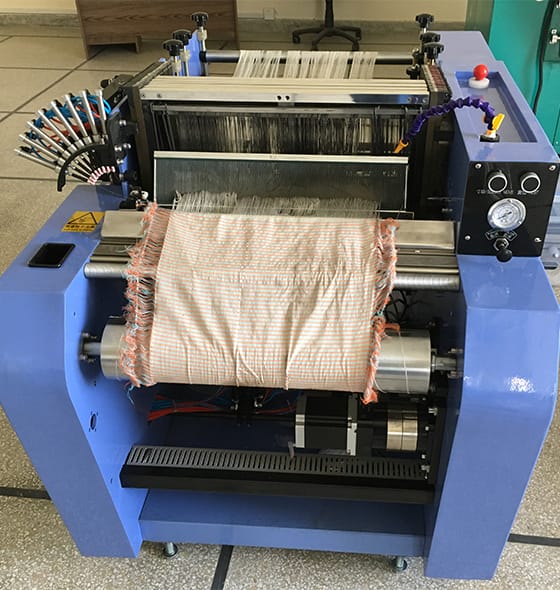
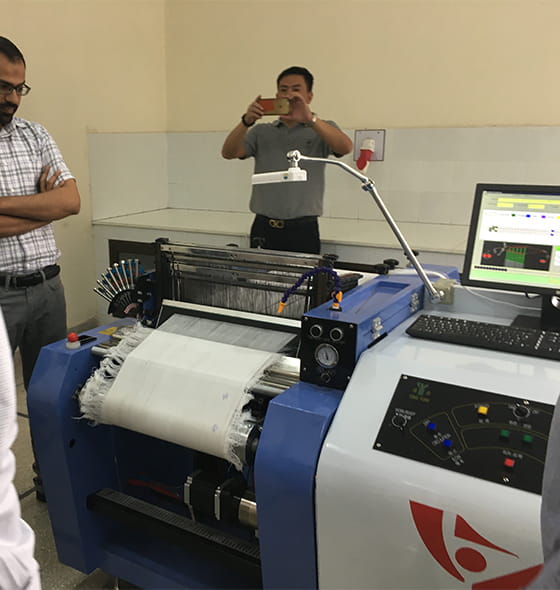

Terry Towel Rapier Loom is a compact weaving system for towel sampling, textile research, design development and controlled small-batch trials. The SGA598 reference platform combines separate ground- and pile-warp management, programmable shedding, servo-driven rapier weft insertion and a terry beat-up sequence so laboratories and mills can evaluate towel constructions before committing them to production machinery.
Marjan Polymer Industries supplies configured terry towel sample looms in Pakistan with application review, installation planning, commissioning and operator training. Fabric width, shedding system, weft colours, pile-height range, yarn suitability, utilities and software are confirmed against the customer’s approved development brief and quotation.
How a terry towel loom forms pile
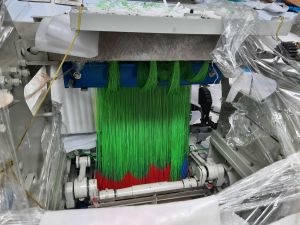
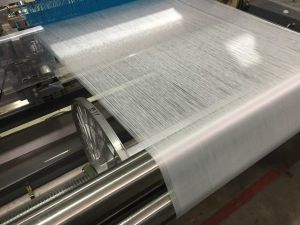
Terry fabric requires two warp systems. The ground warp is held at controlled tension to create the base cloth, while the pile warp is supplied under a different tension and feed condition. A programmed loose-pick and fast-pick beat-up sequence accumulates selected wefts away from the cloth fell and then pushes the group into position, causing the pile warp to form loops. This separation of ground and pile control is the essential difference between a terry loom and a standard flat-fabric sample loom.
Reference SGA598 development configuration
| Parameter | Reference development scope |
|---|---|
| Machine type | Rapier terry sample loom for laboratory, sampling and product-development work |
| Effective fabric-width options | 20, 30, 40, 50, 60 or 70 cm; the selected width is fixed in the approved configuration |
| Reference development width | Approximately 508 mm (20 in) for the commonly specified laboratory configuration |
| Reference operating speed | Approximately 30–45 picks/min; some configurations may operate from about 25 picks/min depending on pattern, yarn, pile cycle and shedding load |
| Weft selection | Up to 8 colours in the common reference scope; expanded selection is available only when specifically engineered and quoted |
| Shedding | Electronic dobby/multi-arm arrangement in the reference scope; electronic jacquard can be evaluated as an option |
| Heald-frame capacity | Up to 20 shafts in a typical dobby development configuration, subject to selected shedding equipment |
| Weft insertion | Servo-driven single-rapier insertion in the reference configuration |
| Ground-warp control | Positive electronic let-off with separate tension management |
| Pile-warp control | Independent pile beam/feed and tension arrangement selected for the required loop formation |
| Take-up | Programmable electronic take-up; achievable density is verified against the weave and yarn rather than treated as a universal catalogue maximum |
| Reference pile-height range | Approximately 0–9 mm where supported by the approved terry mechanism and construction |
| Indicative yarn range | Approximately 5–500 tex is an equipment reference only; actual cotton, regenerated-cellulose, synthetic or blended yarn must be approved by trial |
| Compressed air | Reference supply about 0.45–0.75 MPa; required flow and air quality are confirmed for the selected pneumatic functions |
| Electrical and controls | PLC/HMI or computer-assisted pattern control with emergency-stop and machine-interlock provisions; voltage and software package are quotation items |
| Installed power | Approximately 4 kW in one published reference configuration; final connected load is confirmed from the selected width and options |
| Footprint and mass | Configuration-dependent; the approved general-arrangement drawing governs foundation, access and handling requirements |
These figures describe a reference SGA598 development platform, not a universal performance guarantee. Final values depend on machine width, shedding equipment, pattern complexity, yarn, pile geometry and the contracted supply scope.
Ground warp and pile warp architecture
The ground beam supplies the structural warp at stable tension. The pile beam or pile-yarn supply must release the additional yarn required for each loop while avoiding slack, snarling and uncontrolled variation. Independent warp-stop sensing, guided yarn paths and suitable beam or creel capacity are specified from the customer’s yarn package and sample dimensions.
Terry beat-up and pile-cycle control
Conventional three-pick terry uses controlled loose picks followed by a fast pick, although other pile cycles can be engineered where the motion and control system support them. Loop height, pile density and towel weight interact with pile-yarn delivery, ground tension, take-up, reed motion and beat-up position. Settings are therefore validated as a recipe, not adjusted as unrelated numbers.
Rapier weft insertion and shedding
A servo-driven rapier carries the weft through the open shed without requiring an air-jet insertion system. Electronic dobby shedding is appropriate for many structured towel patterns and borders; an electronic jacquard option is evaluated where individual warp control and more complex motifs are required. The approved pattern format, shaft count, hooks, harness, selectors and software interface form part of the supply definition.
Colour, border and pattern development
- Multi-colour weft trials within the installed selector capacity.
- Plain, twill, satin and structured ground constructions subject to shedding capability.
- Dobby borders, stripes, checks and texture changes.
- Jacquard motifs where the optional jacquard package is selected.
- Cut-pile development only as a downstream finishing trial; the loom itself forms loop pile.
- Recipe comparison for pile height, pick density, yarn count and towel hand.
Yarn and sample compatibility
Cotton is the principal towel yarn, while bamboo-labelled regenerated cellulose, viscose, polyester, blends and specialty yarns may be evaluated after reviewing count, twist, hairiness, elongation, package build and sizing condition. A representative yarn sample should be tested before final acceptance because an extremely broad catalogue yarn range does not mean every yarn can run with the same reed, heald, rapier and tension settings.
Laboratory sampling versus production weaving
This compact SGA598 configuration is intended for research, shade and weave approval, new-product development, educational training, quality investigations and limited sample lengths. It is not presented as a substitute for a wide, high-speed industrial terry production loom. Customers planning continuous commercial towel output require a separate production-machine study covering reed width, speed, beam capacity, automation, efficiency and finishing flow.
Typical users and applications
- Terry towel mills developing bath, hand, face, kitchen and hospitality constructions.
- Textile universities, institutes and teaching laboratories.
- Yarn, chemical and finishing suppliers evaluating performance in woven towel structures.
- Quality-control and product-engineering teams reproducing construction variables at sample scale.
- Research centres comparing cotton, regenerated-cellulose, recycled or blended yarn systems.
- Export development departments preparing customer approval samples before mill trials.
Quality variables to control during trials
| Variable | Why it matters |
|---|---|
| Ground-warp tension | Controls base-cloth stability, width and beat-up consistency |
| Pile-warp delivery | Determines loop formation, pile ratio, towel weight and loop uniformity |
| Pick density and pile cycle | Influence construction, mass, firmness and the spacing of pile rows |
| Reed and heald plan | Must suit yarn count, ends per dent, shedding load and required pattern |
| Weft tension and selector timing | Affect insertion reliability, colour changes, selvedges and appearance |
| Yarn moisture and package condition | Influence friction, tension behaviour, breakage and sample repeatability |
| Finishing route | Scouring, bleaching, dyeing, drying and raising can materially change GSM, dimensions, absorbency and hand |
Configurable machine options
- Working-width selection within the available compact loom range.
- Electronic dobby or application-specific electronic jacquard package.
- Weft-colour selection and associated feeder arrangement.
- Ground- and pile-warp beam, creel, tension and stop-motion configuration.
- Electronic let-off, take-up and recipe-control functions.
- Reeds, healds, drop wires, temples, selvedge arrangement and initial tooling.
- Pattern-preparation computer, software interface and file-transfer method.
- Compressed-air preparation, transformer, stabilizer or electrical adaptation where required.
- Initial spare-parts, consumables and maintenance-tool package.
Site, utilities and layout planning
Before dispatch, MPI confirms the approved machine drawing, access route, floor loading, levelling, operator clearances, electrical voltage and frequency, earthing, compressed-air pressure, dry-air quality, lighting and environmental requirements. The customer provides safe lifting access, suitable utilities and statutory compliance unless those items are expressly included in the contract.
Installation, commissioning and training
The agreed service scope can include machine placement, levelling, electrical and pneumatic checks, warp-path setup, dry cycling, pattern loading, initial weaving trials and operator training. Commissioning should use representative ground, pile and weft yarns plus an agreed towel construction so that controls, timing and sample quality can be evaluated against measurable acceptance criteria.
Safety and preventive maintenance
Operators must be protected from the rapier path, reed and beat-up motion, shedding mechanism, rotating beams, take-up rollers and electrical or pneumatic energy. Guards, emergency stops and isolation procedures must remain functional. Routine care includes cleaning lint, checking lubrication, inspecting rapier components, healds and reed, monitoring beam and yarn paths, verifying sensors and interlocks, and maintaining correct pneumatic pressure and air quality.
Supply and support in Pakistan
Marjan Polymer Industries supplies terry towel sample looms in Pakistan for textile mills, universities, laboratories and development departments. Services may include requirements review, machine configuration, sourcing or manufacturing coordination, pre-dispatch inspection, installation planning, commissioning, training, documentation, spare-parts planning and after-sales technical support. International enquiries can also be evaluated.
Information required for a technical quotation
- Required product: bath, hand, face, kitchen, hotel or technical terry sample.
- Finished sample width and required compact loom working width.
- Ground, pile and weft yarn fibre, count/tex, twist, package and sizing condition.
- Target pile height, pile ratio, GSM, pick density, pattern repeat and sample length.
- Dobby shaft requirement or jacquard hook and harness requirement.
- Number of weft colours and required feeders or selectors.
- Available electricity, compressed air, room dimensions and installation location.
- Required tooling, software, documentation, training, spare parts and warranty scope.
Frequently asked questions
What is a terry towel rapier loom?
It is a shuttleless loom that inserts weft with a rapier and controls separate ground and pile warp systems to form loop-pile towel fabric. This page describes a compact sample and development configuration.
Is this a production terry towel machine?
The SGA598 reference platform is primarily a laboratory, sampling and product-development loom. A wide, high-speed industrial production loom requires a separate engineering and capacity study.
What fabric widths are available?
Reference effective-width options are 20, 30, 40, 50, 60 and 70 cm. The selected working width and usable sample width are confirmed in the quotation.
What speed can the sample loom achieve?
The common reference range is approximately 30–45 picks/min. Actual speed depends on width, shedding load, pattern, yarn, pile cycle, machine condition and required sample quality.
How many weft colours can be used?
Up to eight colours are available in the common reference configuration. Any expanded selector arrangement must be specifically engineered, quoted and confirmed.
Can the loom use electronic dobby or jacquard shedding?
Yes. Electronic dobby or multi-arm shedding suits many towel structures, while an electronic jacquard option can be evaluated for more complex motifs and individual warp control.
Can pile height be adjusted?
Yes, within the capability of the selected terry mechanism and construction. The reference scope indicates approximately 0–9 mm, but the workable range is validated with the actual yarn and pile cycle.
Which yarns can be tested?
Cotton is the main towel yarn. Regenerated-cellulose, polyester, blended and specialty yarns can be evaluated after checking count, twist, elongation, friction, package and loom-tooling compatibility.
Is the Terry Towel Rapier Loom available in Pakistan?
Yes. Marjan Polymer Industries supplies configured terry towel sample looms in Pakistan with technical review, installation planning and after-sales support.
Are commissioning and operator training available?
Yes. Installation supervision, setup, initial yarn trials and operator training can be included according to the agreed machine, site and service scope.
Request a terry loom proposal
Contact Marjan Polymer Industries with your required sample width, towel construction, yarn details, shedding system, number of weft colours and installation location. MPI will prepare a suitable configuration and technical quotation.