

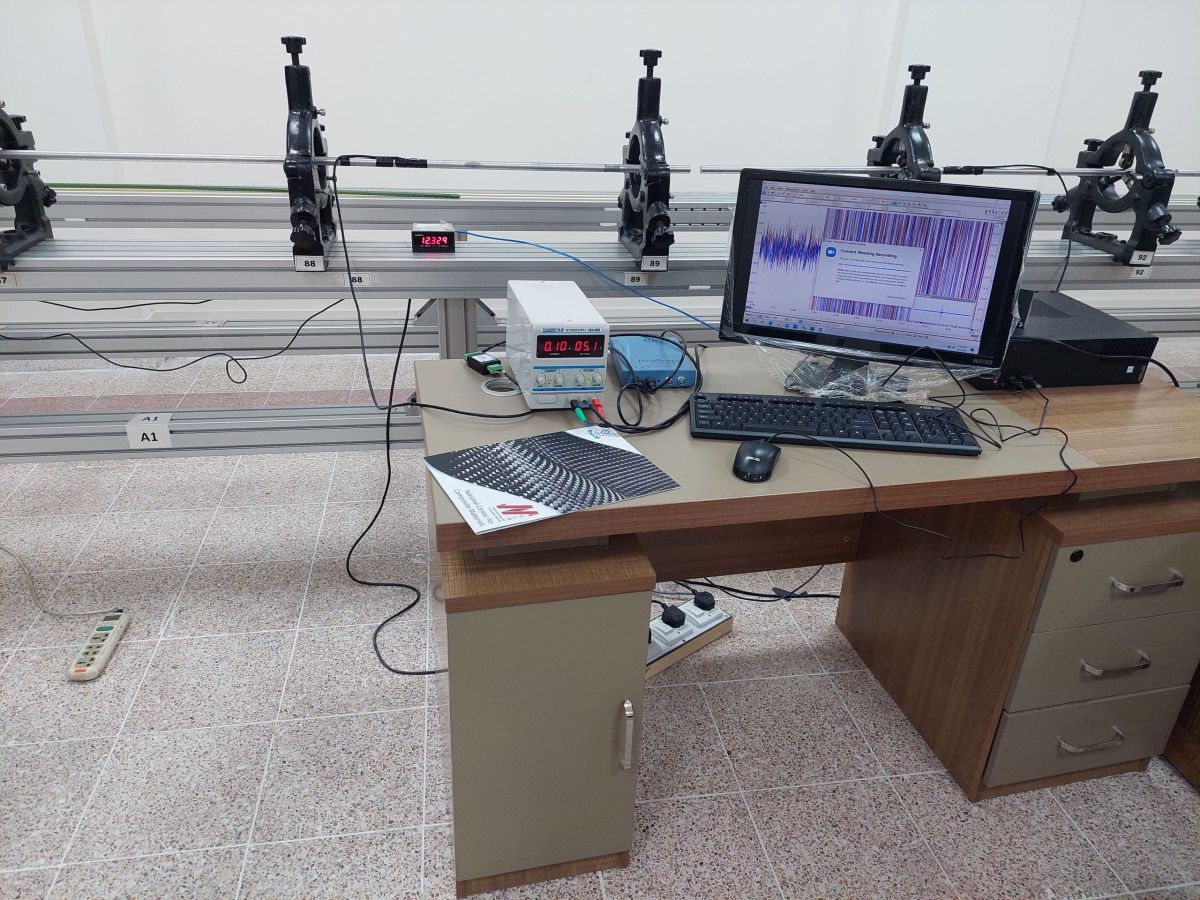
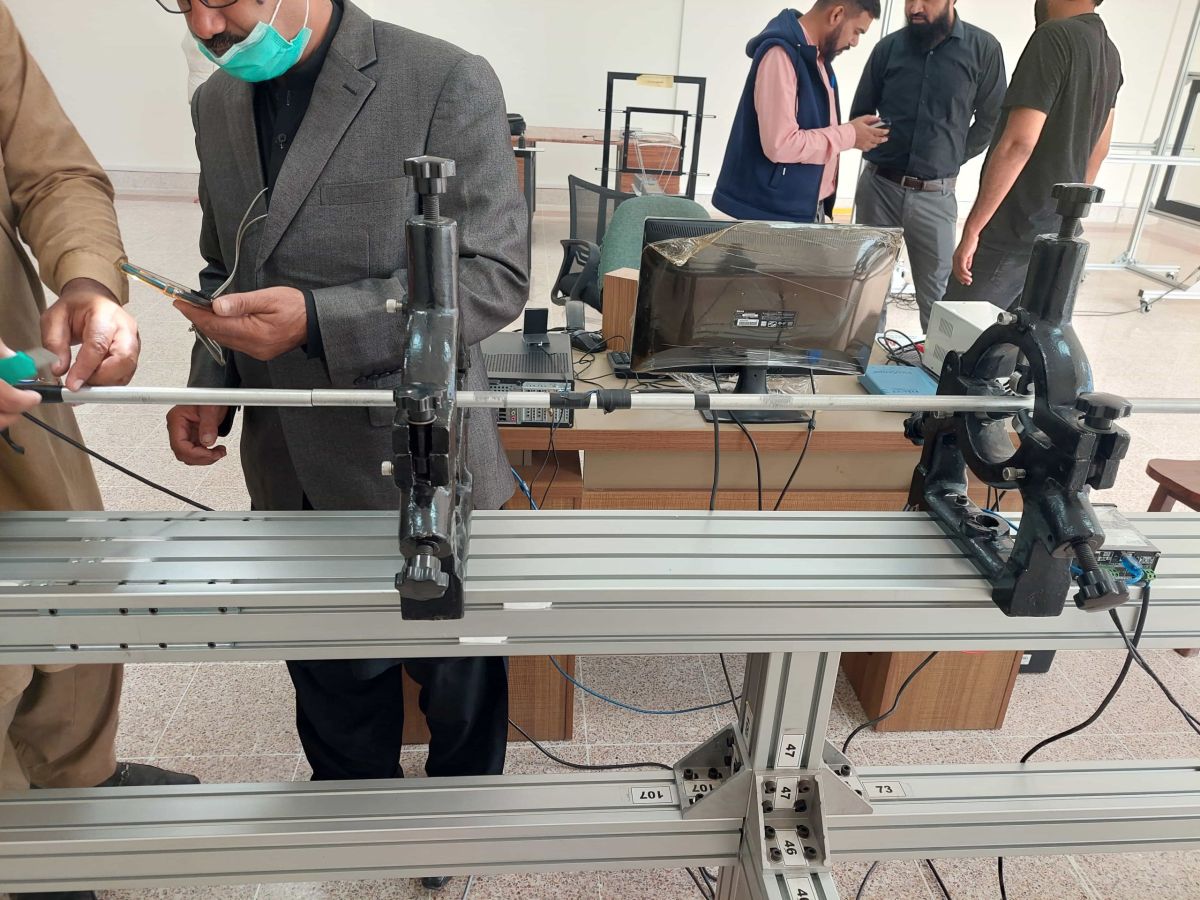
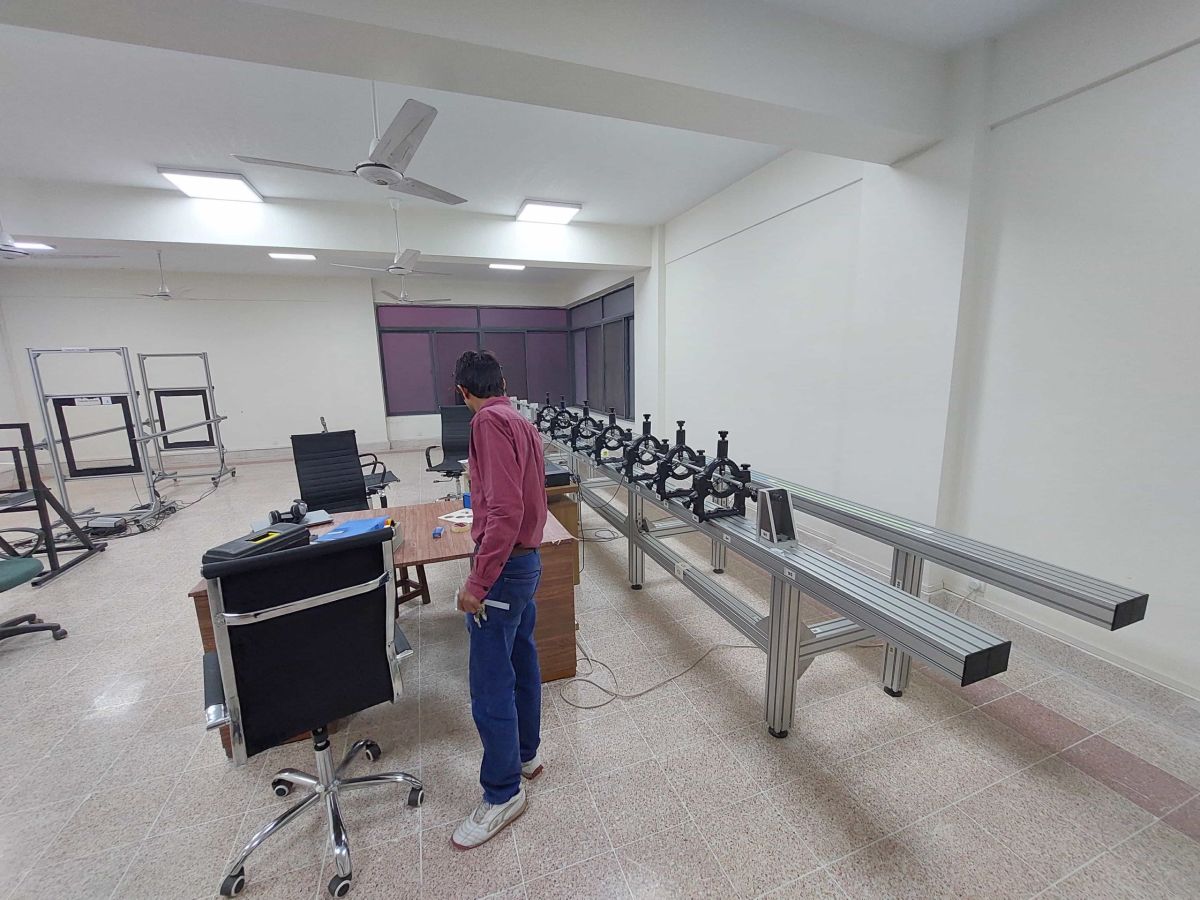
Split Hopkinson Pressure Bar (SHPB), also called a Kolsky bar, is a research system for measuring the high-strain-rate compression response of materials. A gas-driven striker generates an elastic stress pulse in the incident bar; strain gauges record incident, reflected and transmitted waves so specimen stress, strain and strain rate can be calculated under validated one-dimensional wave assumptions.
System Architecture
Pulse Generation
Pressure vessel, launch barrel and interchangeable striker bars generate a controlled incident pulse at a measured impact velocity.
Pressure Bars
Aligned incident and transmission bars carry elastic waves across the specimen; bar material and diameter are selected to specimen impedance and force level.
Measurement Chain
Strain gauges, bridge conditioning, high-speed acquisition and analysis software recover calibrated wave histories and derived material response.
Reference Compression Configuration
The following describes the existing reference system associated with this product. It is a project configuration, not a universal specification. Final supply values and achieved strain-rate range are confirmed through detailed design, calibration and acceptance tests.
| Subsystem | Reference configuration |
|---|---|
| Test mode | Dynamic compression |
| Incident bar | Aluminium 7075, 18 mm diameter, 1900 mm length |
| Transmission bar | Aluminium 7075, 18 mm diameter, 850 mm length |
| Momentum / throw-off bar | 1200 mm reference length with energy-absorbing buffer |
| Launch barrel | 2600 mm reference length |
| Striker bars | 100, 200, 300, 400 and 600 mm reference lengths |
| Striker velocity | Design target up to 50 m/s; measured with optical sensors |
| Pressure vessel | 25 L reference volume; design pressure up to 4 MPa subject to certified pressure design |
| Overall footprint | Up to approximately 9 m for the reference installation |
| Instrumentation | Four-channel strain measurement, signal conditioning, oscilloscope/DAQ and velocity sensors |
Configurable Test Capability
- Compression, tension or torsion architecture by project
- Metallic, polymer, composite, rock, concrete or cellular specimens
- Bar material and diameter matched to mechanical impedance
- Interchangeable striker lengths and pulse-shaper options
- Room-temperature or instrumented thermal variants
- Optical velocity, high-speed camera and DIC interfaces
- DAQ channel count, bandwidth and sample rate
- Custom fixtures, confinement and specimen recovery
A nominal strain-rate objective may span roughly 10² to 10⁴ s⁻¹ in conventional SHPB work, but the achievable, defensible range is material-, specimen- and configuration-dependent. It is established by tests rather than guaranteed by gas pressure alone.
Measurement and Analysis
Strain gauges on the bars measure elastic wave histories. After bridge calibration, time alignment and dispersion review, standard one-wave or three-wave relations can be applied when the assumptions are satisfied. The analysis workflow should report engineering or true stress/strain definitions, strain-rate history, pulse-shaping method and uncertainty.
- Incident, reflected and transmitted strain signals
- Striker velocity and trigger synchronization
- Specimen stress, strain and strain-rate histories
- Dynamic stress-equilibrium comparison at both specimen faces
- Optional force, displacement, temperature, DIC and high-speed-video data
- Raw-data export, processing trace and reproducible report template
Bar and Specimen Selection
High-Strength Materials
Steel or high-strength bars may suit metals and high-force specimens where adequate elastic range and signal quality are maintained.
Low-Impedance Materials
Aluminium, magnesium, polymeric or hollow bars may improve transmitted-signal resolution for polymers, foams or biological analogues.
Brittle Materials
Rock, concrete and ceramics may require larger diameters, careful pulse shaping, confinement options and fragment containment.
Specimen diameter, length-to-diameter ratio, face parallelism, lubrication and pulse duration are selected to promote uniform deformation and dynamic equilibrium.
Calibration and Acceptance
- Dimensional and straightness inspection of all bars
- Elastic wave-speed and density verification for bar material
- Strain-gauge bridge calibration and channel polarity check
- DAQ timing, bandwidth, gain and noise-floor verification
- Optical velocity calibration across the working range
- Free-end or bar-to-bar pulse tests for wave quality and dispersion
- Reference specimen tests with equilibrium and repeatability analysis
Safety Engineering
The system combines stored pneumatic energy, a high-speed projectile, long precision bars and dynamic specimen failure. It therefore requires pressure-system certification, a fully contained striker path, interlocked guarding, safe venting, remote firing, projectile capture, fragment shielding and documented operating procedures.
- Rated pressure vessel, relief device, regulator and pressure indication
- Interlocked launch controls and visible system status
- Enclosed barrel, specimen zone and momentum trap
- Emergency depressurisation and lockout/tagout provisions
- Controlled access, operator training and pre-test checklist
- Site-specific risk assessment before commissioning
Research Applications
Constitutive Models
High-rate stress–strain data for material models used in crash, impact, forming and defence simulations.
Metals & Polymers
Strain-rate sensitivity, work hardening, failure and temperature-dependent response.
Composites
Through-thickness or in-plane dynamic compression with configuration-specific specimen design.
Rock & Concrete
Dynamic strength, fracture and energy absorption using larger bars or shaped pulses.
Foams & Cellular Solids
Low-impedance measurements using sensitivity-enhanced bars and longer pulse durations.
Process Research
Data for high-speed machining, forming, impact and other rapid-deformation events.
Installation and Support in Pakistan
MPI can provide mechanical installation, bar alignment, instrumentation integration, commissioning, calibration guidance, software workflow and researcher training across Pakistan. Civil foundations, compressed-air plant, electrical supply, room access, safety zoning and optional high-speed diagnostics are defined in the project scope.
Information Required for a Proposal
- Material classes and expected strength/impedance
- Compression, tension or torsion test mode
- Target strain-rate and temperature range
- Specimen size and available preparation capability
- DAQ, DIC, camera and software requirements
- Room dimensions, utilities and safety constraints
- Calibration, uncertainty and acceptance criteria
- Training, documentation and delivery schedule
Frequently Asked Questions
What is a Split Hopkinson Pressure Bar?
It is a high-strain-rate material-testing system in which a striker generates an elastic wave in an incident bar and strain gauges record incident, reflected and transmitted waves across a specimen.
Is an SHPB also called a Kolsky bar?
Yes. Split Hopkinson Pressure Bar and Kolsky bar are commonly used names for this family of dynamic material-test systems.
What strain rate can the system achieve?
Conventional systems often address approximately 10² to 10⁴ s⁻¹, but the defensible range depends on specimen, material, bar impedance, pulse duration, velocity and dynamic equilibrium.
Can the system test polymers and foams?
Yes, but low-impedance materials usually need sensitivity-enhanced bar materials or geometry, carefully shaped pulses and suitable specimen dimensions to obtain a measurable transmitted signal.
Why are different striker lengths used?
Striker length primarily controls incident-pulse duration. It is selected with specimen deformation time, equilibrium requirement and desired strain history.
What is pulse shaping?
A small deformable element placed at the impact interface modifies the incident pulse to reduce high-frequency ringing and help the specimen reach dynamic stress equilibrium.
How is striker velocity measured?
Typically with two optical or magnetic sensors at a known spacing near the launch barrel. Their timing difference is converted to velocity after calibration.
Does the system provide automatic stress–strain curves?
Software can calculate curves from calibrated signals, but the researcher must verify time alignment, wave assumptions, equilibrium, specimen dimensions and the selected analysis method.
What safety systems are required?
Rated pressure hardware, relief and regulation, enclosed projectile path, interlocked guards, remote firing, momentum capture, emergency venting and trained access are fundamental.
What is needed for a quotation?
Provide material and strength range, test mode, strain-rate objective, specimen size, required diagnostics, room and utility details, calibration criteria, training and delivery location.
Define a High-Strain-Rate Test System
Share the materials, test mode and measurement objectives. MPI will configure the bars, launcher, instrumentation, guarding and acceptance plan for a research-grade SHPB installation in Pakistan.