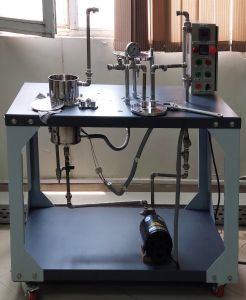


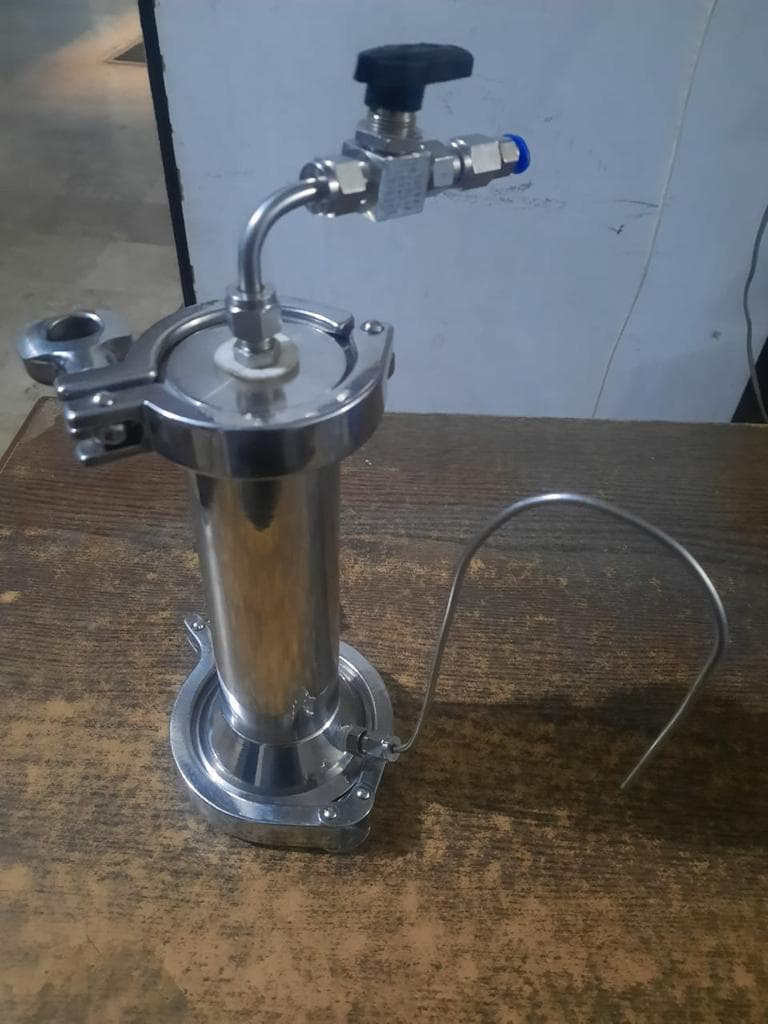
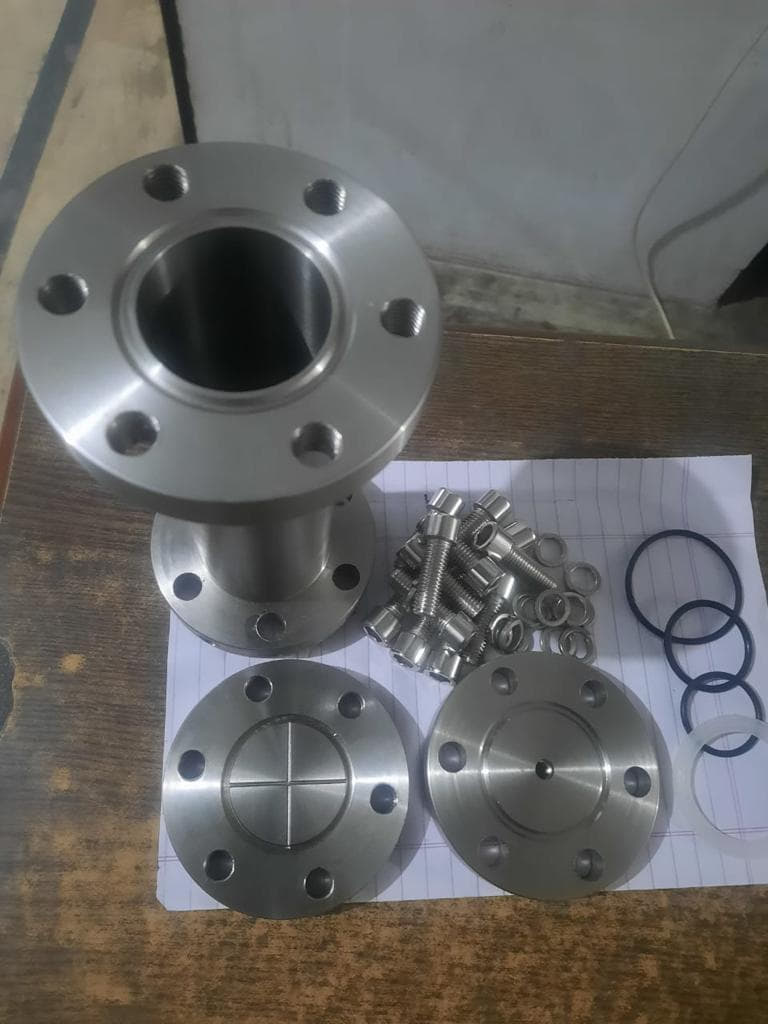
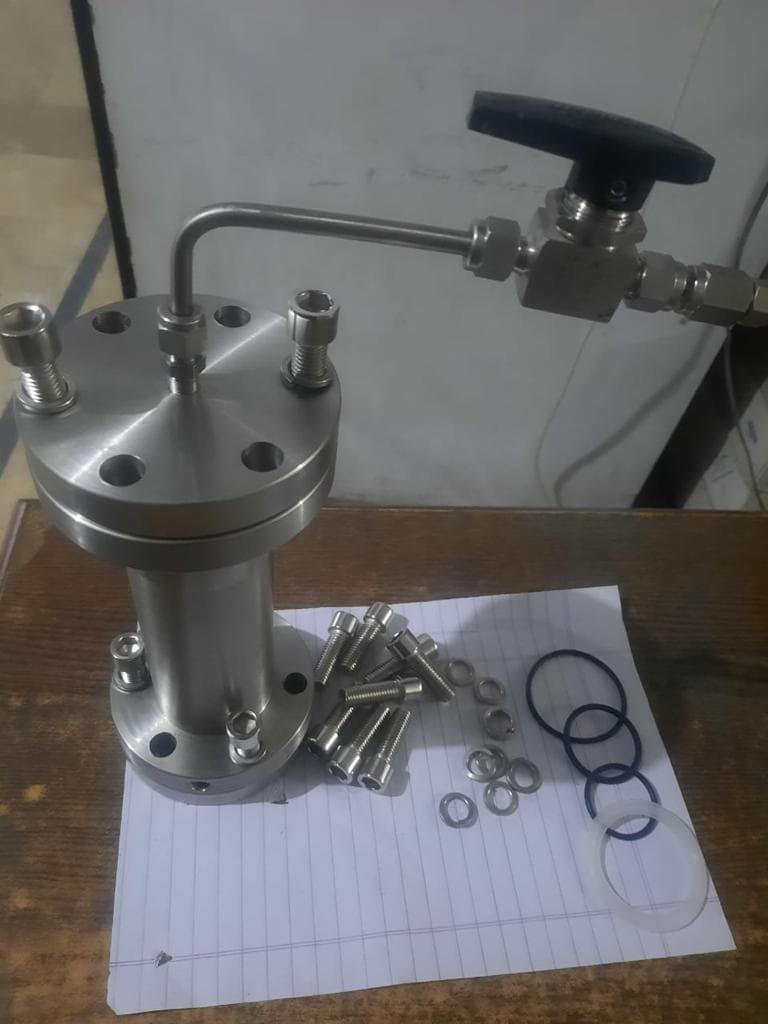
Dead End Filtration Cell is a laboratory pressure-filtration device for evaluating flat-sheet membrane discs, determining permeate flux, observing rejection or retention and studying fouling under controlled conditions. Feed moves perpendicular to the membrane: permeate passes through, while retained material accumulates on or near the membrane surface.
Marjan Polymer Industries supplies configurable dead-end and stirred-cell systems in Pakistan for universities, membrane laboratories, water research, biotechnology and industrial process development. Cell volume, membrane diameter, pressure rating, wetted materials, seals, agitation and instrumentation are finalized against the test method and fluid compatibility.
Dead-end filtration working principle
- A conditioned membrane disc is installed on the porous support with the correct active-layer orientation.
- A measured feed volume is charged to the cell and the assembly is sealed.
- Clean regulated gas or another approved pressure source applies transmembrane pressure.
- Permeate is collected as a function of time, pressure and membrane area.
- Retained solute or particles concentrate in the cell and may form a concentration-polarization layer or filter cake.
- The membrane and samples are removed for flux, rejection, fouling and cleaning analysis.
Dead-end filtration versus cross-flow filtration
| Feature | Dead-end cell | Cross-flow cell |
|---|---|---|
| Feed direction | Primarily normal to the membrane | Tangential across the membrane surface |
| Feed circuit | Usually batch or reservoir-fed without a recirculation pump | Normally recirculated by a pump |
| Concentration polarization | Can develop rapidly; optional stirring reduces its effect | Cross-flow velocity helps sweep the membrane surface |
| Typical use | Screening, pressure tests, flux/rejection studies and small-volume concentration | Longer recirculating trials, scale-up and shear-dependent performance studies |
| System complexity | Compact and comparatively simple | Requires pump, loop, controls and larger hold-up volume |
Available cell configurations
- Basic pressure cell: compact batch testing using a removable membrane disc.
- Stirred filtration cell: magnetic stirring near the membrane helps limit concentration polarization.
- Reservoir-fed cell: an external pressure vessel expands feed volume or supports diafiltration work.
- Parallel cell manifold: multiple cells can be operated under a common, properly regulated pressure source.
- High-pressure research cell: separately engineered construction with an approved pressure rating, relief protection and compatible fittings.
Reference laboratory configuration
| Parameter | Configurable reference scope |
|---|---|
| Filtration mode | Pressure-driven dead-end filtration; stirred mode available where required |
| Reference working volume | Approximately 300 mL for the existing laboratory design; other volumes require an approved cell drawing |
| Membrane disc | Typically around 47–52 mm diameter for the reference cell; holder and active area are confirmed before manufacture |
| Wetted construction | SS 316 or SS 316L options with a porous membrane support and compatible tubing/fittings |
| Reference pressure | Up to approximately 6 bar for a low-pressure research configuration only when shown on the approved datasheet and nameplate |
| Higher-pressure option | Available only as a separately calculated, component-rated and safety-reviewed design |
| Temperature | Ambient or project-specific range limited by membrane, seal, tubing, fittings and cell design |
| Pressure source | Clean regulated nitrogen, compressed air or another process-compatible source approved for the fluid |
| Seals | NBR, EPDM, silicone, Viton/FKM, PTFE or another compatible material according to chemical and temperature duty |
| Instrumentation | Pressure regulator, gauge or transmitter, relief device and optional temperature or balance data connection |
Membrane disc and support selection
The membrane diameter, thickness, backing, active-layer orientation and pressure limit must match the holder and support. Polymer microfiltration, ultrafiltration, nanofiltration or reverse-osmosis discs and selected ceramic discs require different supports, seals and pressure conditions. MPI confirms the actual membrane format rather than assuming one holder suits every disc.
Stirred-cell operation
A magnetic stir bar located above the membrane can reduce the stagnant boundary layer and delay concentration polarization without converting the system into a cross-flow cell. Stirring speed is optimized experimentally: excessive speed can damage shear-sensitive samples or unsupported membranes, while insufficient speed may not control polarization.
Pressure source and regulation
The cell requires a clean, stable pressure source with a correctly sized regulator, isolation valve, gauge and relief protection. Nitrogen is often preferred where oxidation, carbon-dioxide dissolution or biological sensitivity makes compressed air unsuitable. The membrane’s own pressure limit may be lower than the vessel rating and always governs operation.
Membrane flux and permeability testing
Permeate volume or mass is recorded against time and divided by active membrane area to calculate flux. Pure-water permeability can be determined across several stable pressures. Temperature, membrane conditioning, compaction, mixing, feed concentration and sampling intervals must be controlled for meaningful comparison.
Solute rejection and retention studies
Feed, permeate and retentate are analysed using an appropriate concentration method. Reported rejection should identify membrane, pressure, temperature, pH, ionic strength, stirring, recovery and analytical uncertainty. Apparent rejection can change as concentration polarization and recovery increase.
Fouling, cake formation and cleaning evaluation
Dead-end operation is useful for accelerated fouling studies because retained particles remain at the membrane surface. A test sequence may include initial clean-water permeability, feed filtration, rinse, chemical cleaning and final permeability recovery. Mass balance and visual membrane inspection strengthen the result.
Concentration and diafiltration options
Stirred cells can concentrate retained macromolecules and, with a suitable external reservoir and valve arrangement, support discontinuous or constant-volume diafiltration. Cell level, pressure balance, hold-up volume and product recovery must be included in the experimental method.
Applications
- Flat-sheet membrane screening and formulation development.
- Water, wastewater and environmental sample filtration research.
- Polymer-membrane flux, permeability, rejection and fouling studies.
- Protein, enzyme, colloid and macromolecule concentration where compatible.
- Food, beverage, biotechnology, pharmaceutical and chemical R&D.
- Teaching laboratories and comparative membrane-testing programmes.
Chemical compatibility and wetted materials
Compatibility must cover the vessel, membrane, support, O-rings, tubing, valves, gauge isolation and stir bar. A stainless-steel body does not make the complete assembly universally solvent-resistant. Feed composition, pH, cleaning chemicals, temperature and exposure time are reviewed before approval.
Safe assembly and operation
The cell must be depressurized, isolated and verified at zero pressure before opening. Required safeguards include a rated regulator, pressure indication, relief protection, compatible tubing, secure closures and an approved maximum operating pressure. Operators must never use oxygen or an uncontrolled gas cylinder connection.
Cleaning and contamination control
After use, the cell is depressurized, drained, disassembled and cleaned with a method compatible with all wetted parts. Seals and membrane supports are inspected for particles, swelling, cuts or deformation. Sterilization or autoclaving is allowed only when every component in the approved assembly is rated for it.
Data quality and reporting
A defensible test record includes membrane identification, active area, feed composition, temperature, pressure, stirring speed, permeate mass or volume versus time, sampling plan, analytical method, recovery and cleaning history. MPI can configure data collection around a balance, pressure transmitter or laboratory data system.
Accessories and optional equipment
- Regulator, gauge, relief valve, isolation valves and pressure tubing.
- Magnetic stir bar, drive coupling or external magnetic stirrer arrangement.
- Membrane supports, spare seals and membrane-disc cutting tools.
- External reservoir, selector valve and parallel-cell manifold.
- Permeate collection vessel, balance interface and temperature measurement.
- Cleaning kit, spares, operating procedure and test-report template.
Commissioning and operator training
Commissioning can include component verification, seal inspection, pressure hold or leak test, relief-device check, water trial, membrane installation, pressure ramp, permeate collection and operator training. Acceptance conditions are defined at the ordered pressure, approved liquid and specified membrane format.
Supply and support in Pakistan
Marjan Polymer Industries supplies Dead End Filtration Cell systems in Pakistan for universities, research institutes and industrial membrane laboratories. The scope may include design review, fabrication, pressure components, accessories, installation guidance, commissioning, documentation, spares and after-sales support.
Information required for a technical quotation
- Feed composition, pH, solvent, solids and safety data.
- Membrane type, diameter, thickness, support and pressure limit.
- Required cell and working volume, active area and sample recovery target.
- Operating pressure, temperature and stirred or unstirred mode.
- Wetted material, seal and chemical-cleaning requirements.
- Pressure source, regulator, instrumentation, reservoir and collection accessories.
- Documentation, pressure testing, installation and training requirements.
Frequently asked questions
What is a Dead End Filtration Cell?
It is a pressure-filtration device in which feed moves mainly perpendicular to a membrane disc, permeate passes through and retained material accumulates in the cell or on the membrane surface.
Is dead-end filtration the same as cross-flow filtration?
No. Cross-flow uses tangential recirculation across the membrane. A dead-end cell is generally a compact batch device without a recirculation pump.
Which membrane sizes can be used?
The reference laboratory cell commonly uses a disc around 47–52 mm, but the holder, support and active area are finalized for the customer’s actual membrane.
What pressure can the cell operate at?
The low-pressure reference configuration can be designed up to approximately 6 bar. Operation is allowed only within the approved datasheet, nameplate and component limits; higher pressure requires separate engineering.
Why is magnetic stirring used?
Stirring near the membrane reduces concentration polarization and can delay fouling, improving the stability of flux during concentration or membrane screening.
Can the cell test microfiltration and ultrafiltration membranes?
Yes, when membrane diameter, support, pore size or MWCO, orientation, chemical compatibility and pressure limit are suitable for the configured holder.
Can the cell use solvents?
Potentially, but the complete wetted assembly—including seals, tubing, membrane and instruments—must be verified for the exact solvent, concentration, temperature and exposure time.
Can it be used for diafiltration?
A stirred cell can support batch or constant-volume diafiltration when a compatible reservoir, valves and pressure arrangement are included.
Is the Dead End Filtration Cell available in Pakistan?
Yes. Marjan Polymer Industries supplies configurable dead-end membrane filtration cells in Pakistan with technical review, accessories, commissioning and local support.
What is required for a quotation?
Provide the feed chemistry, membrane format, cell volume, pressure, temperature, wetted materials, seals, stirring, accessories and documentation requirements.
Request a filtration-cell proposal
Contact Marjan Polymer Industries with your membrane, feed, pressure, cell volume, wetted-material and test requirements. MPI will prepare an application-specific Dead End Filtration Cell configuration and quotation.