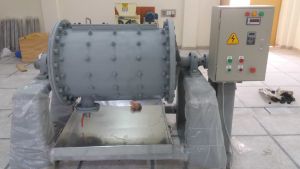
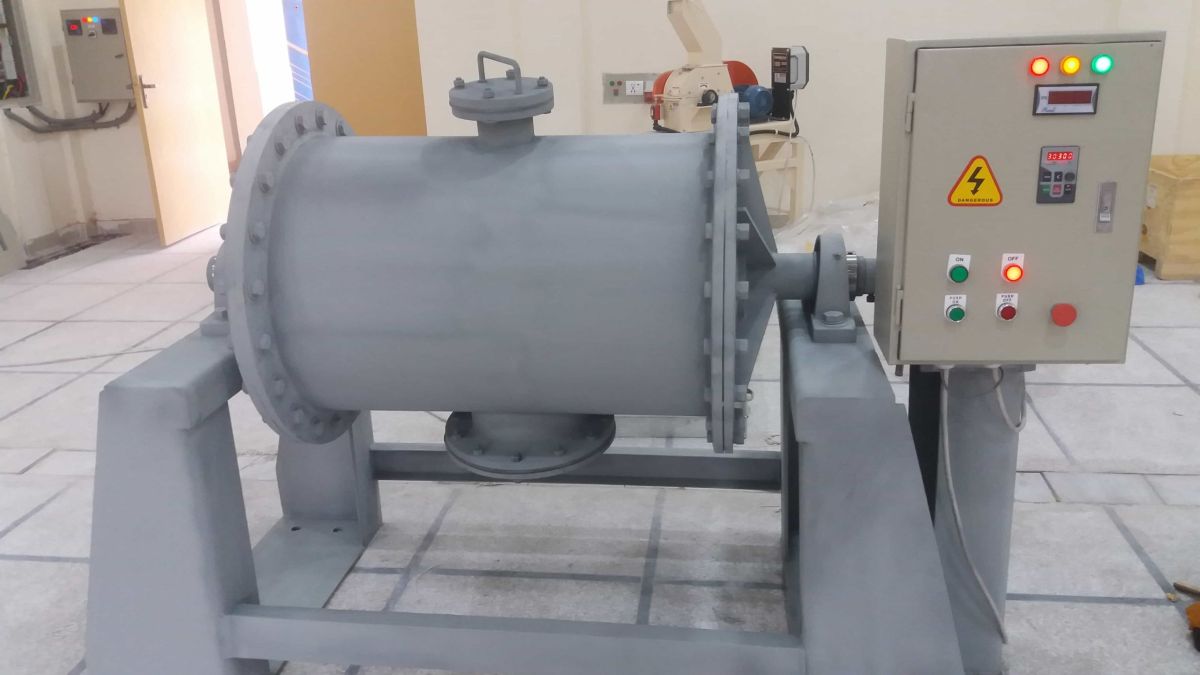
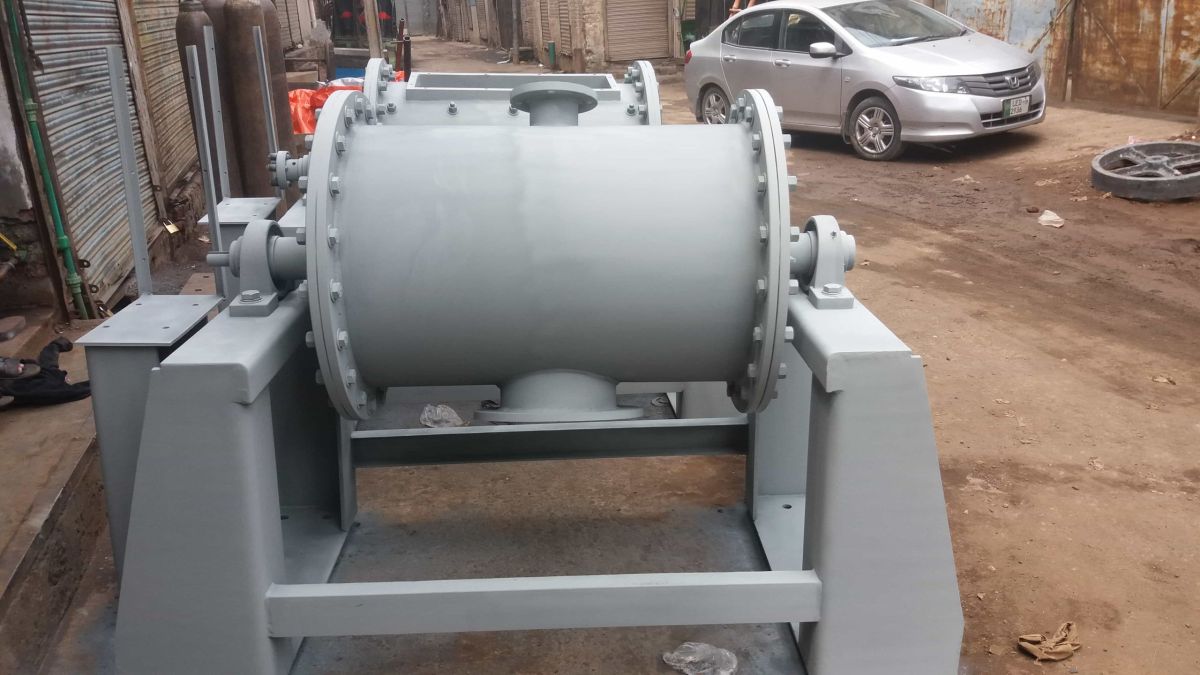
A Ball Mill is a rotating-drum grinding system for reducing dry or wet materials by impact and attrition between the product and selected grinding media. Marjan Polymer Industries (MPI) engineers horizontal drum-type Ball Mill systems for laboratory, pilot and industrial duties in Pakistan, with the mill geometry, lining, media, drive and discharge arrangement matched to the actual material.
This page covers conventional drum Ball Mills rather than high-speed planetary mills. Every quotation is based on the feed, target fineness, batch mass or throughput, contamination limits, temperature sensitivity and cleaning requirement. MPI does not represent one nominal model as suitable for every powder or slurry.
Grinding Purpose and Operating Principle
The cylindrical chamber rotates below its critical speed so the grinding charge rises and cascades or cataracts through the material. Particle breakage depends on drum diameter, speed, media size and density, solids loading, residence time and material behaviour. The correct process window is established from customer data and, where necessary, test work.
Ball Mill Configurations
| Configuration | Typical purpose | Project options |
|---|---|---|
| Batch drum mill | Flexible recipes, controlled residence time and clean-down between lots | Manual or assisted charging, timer/VFD control, tilting or removable vessel where practical |
| Continuous drum mill | Steady production with matched feed and discharge | Overflow or controlled discharge, feeder, classifier or screen interface |
| Dry grinding | Powders with controlled moisture and dust handling | Enclosure, extraction connection, inerting review and dust-control interfaces |
| Wet grinding | Slurries, dispersions and contamination-controlled processing | Sealed charging, drain/discharge valve, jacket review and wash-down features |
Configurable Technical Range
| Parameter | Typical engineering range | Selection basis |
|---|---|---|
| Useful chamber class | Approximately 10–500 L for common laboratory, pilot and batch-industrial projects; larger systems by review | Batch mass, bulk density, media charge, free volume and production target |
| Drum speed | Typically 15–70 rpm with VFD control | Drum diameter, critical-speed ratio, media motion and product response |
| Installed drive | Typically 1.5–30 kW; project-specific outside this band | Loaded torque, start duty, transmission, drum size and service factor |
| Feed size | Commonly pre-crushed below approximately 3–10 mm | Material hardness, mill size, media and target product |
| Product fineness | Application-dependent; fine and micron-class products may be achievable | Test work, residence time, media, classification and agglomeration tendency |
| Process mode | Dry or wet; batch or continuous | Product chemistry, contamination, dust, slurry and downstream process |
Grinding Chamber, Lining and Media
| Item | Available engineering choices |
|---|---|
| Chamber construction | Carbon steel, stainless steel or fabricated shell with a replaceable lining, subject to corrosion and contamination review |
| Lining | Wear-resistant steel, rubber, polyurethane, alumina/ceramic or other application-selected protection |
| Grinding media | Hardened steel, stainless steel, alumina, zirconia, ceramic or selected pebbles |
| Media grading | Single or graded media size selected from feed size, target fineness and impact requirement |
| Access and discharge | Flanged cover, charging port, drain, screen/retainer or controlled outlet according to batch and media-handling method |
Drive, Controls and Instrumentation
- Geared motor or engineered drive train with service factor for loaded starts.
- Variable-frequency drive for controlled acceleration, speed setting and soft stopping.
- Timer or recipe sequence for batch operation, with optional forward/reverse or jog where mechanically suitable.
- Motor overload, drive fault, speed monitoring and guard-interlock integration.
- Optional bearing-temperature, vibration, product-temperature or load monitoring for critical duties.
Safety and Containment Philosophy
A rotating mill requires engineered guarding, controlled access and safe isolation. MPI can incorporate fixed or interlocked guards, emergency stops, drive overload protection, safe charging/discharge access and lockout provisions. Dust explosion, solvent, toxic product, pressure, inert-gas or food/pharmaceutical duties require a separate hazard and compliance review; an ordinary Ball Mill must not be assumed suitable for such service.
Applications in Pakistan
- Paint, pigment, ink, coating and ceramic raw-material preparation.
- Minerals, fillers, limestone, silica, refractory and glass-related grinding.
- Chemical, fertilizer and catalyst-support preparation where materials are compatible.
- Laboratory and pilot evaluation of powders, composites and advanced materials.
- Wet slurry preparation and selected food or pharmaceutical applications only with validated hygienic materials and cleaning design.
Batch versus Continuous Selection
| Decision factor | Batch mill | Continuous mill |
|---|---|---|
| Recipe flexibility | High | Best for stable, repeatable feed |
| Residence-time control | Set by batch cycle | Set by feed, hold-up and discharge system |
| Cleaning between products | Generally simpler to plan | Requires line-level clean-down planning |
| Throughput | Discrete lots | Continuous production |
| Ancillary equipment | Charging and discharge handling | Metered feeder, discharge control and optional classification |
Factory Acceptance and Documentation
| Deliverable | Typical scope |
|---|---|
| Design data | Approved general arrangement, motor/drive data, chamber and lining specification |
| Inspection | Fabrication, rotation, guard, no-load and functional checks against the approved protocol |
| Controls | Panel drawings, set-point checks, alarms and interlock verification |
| Documentation | Operation, maintenance, lubrication, wear-parts and recommended spare-parts information |
| Process test | Customer material trial only when agreed material quantity, method and acceptance criteria are included in the quotation |
Information Required for a Proposal
- Material name, hardness/abrasiveness, bulk density, moisture and safety data.
- Feed particle-size distribution and required product distribution or test method.
- Batch mass or hourly throughput, dry/wet mode and slurry solids/viscosity where applicable.
- Permitted product-contact materials, liner and media contamination limits.
- Cleaning, dust extraction, inerting, solvent or temperature-control requirements.
- Available power supply, installation area, upstream feed and downstream discharge arrangement.
Installation and After-Sales Support
MPI can provide site-interface review, installation supervision, commissioning, operator training and maintenance guidance across Pakistan. Foundations, lifting, ventilation, extraction, utilities and customer responsibilities are defined in the approved project scope.
Frequently Asked Questions
What is a Ball Mill?
A Ball Mill is a rotating cylindrical grinder in which selected balls or other media reduce material by impact and attrition. It may operate dry or wet, and in batch or continuous mode.
Is this a planetary Ball Mill?
No. This page covers conventional horizontal drum-type Ball Mills. Planetary mills use jars on a rotating planetary carrier and are selected differently for small laboratory samples and high-energy milling.
Can MPI supply both dry and wet grinding?
Yes, where the material and hazard review support the requested mode. Chamber material, seals, discharge, dust control and cleaning are selected separately for dry powder and wet slurry service.
What capacity Ball Mill is available?
MPI configures the mill from the required batch mass or throughput. Approximately 10–500 litre chambers cover many laboratory, pilot and batch-industrial projects, while larger systems require separate engineering review.
What final particle size can be guaranteed?
No universal fineness can be guaranteed from machine size alone. The result depends on feed, hardness, media, speed, solids loading, residence time and classification. A guarantee requires an agreed test method and validated process data.
Which grinding media can be used?
Options include steel, stainless steel, alumina, zirconia, other ceramics and selected pebbles. Density, wear, contamination and cost determine the correct media.
Can the speed be adjusted?
Yes. A variable-frequency drive can provide a project-defined speed band, controlled acceleration and soft stopping. The permitted range is limited by drum diameter, drive design and safe media motion.
Can a Ball Mill process food or pharmaceuticals?
Only a purpose-designed hygienic system should be used. Product-contact materials, surface finish, seals, cleanability, contamination control and applicable validation must be agreed before design.
Does MPI provide installation in Pakistan?
MPI can provide installation supervision, commissioning, training and after-sales support in Pakistan as defined in the commercial and technical proposal.
What information is needed for a quotation?
Provide the material and safety data, feed and target size, batch mass or throughput, dry/wet mode, contamination limits, operating hours, utilities and handling interfaces.
Request a Ball Mill Proposal
Send MPI your material data, feed size, target particle distribution, batch mass or throughput, preferred process mode and installation requirements. Marjan Polymer Industries will prepare a project-specific Ball Mill proposal for your facility in Pakistan.