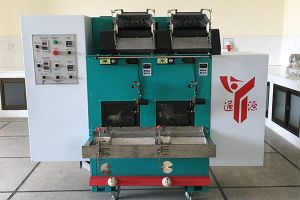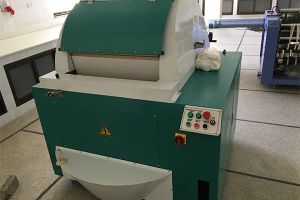


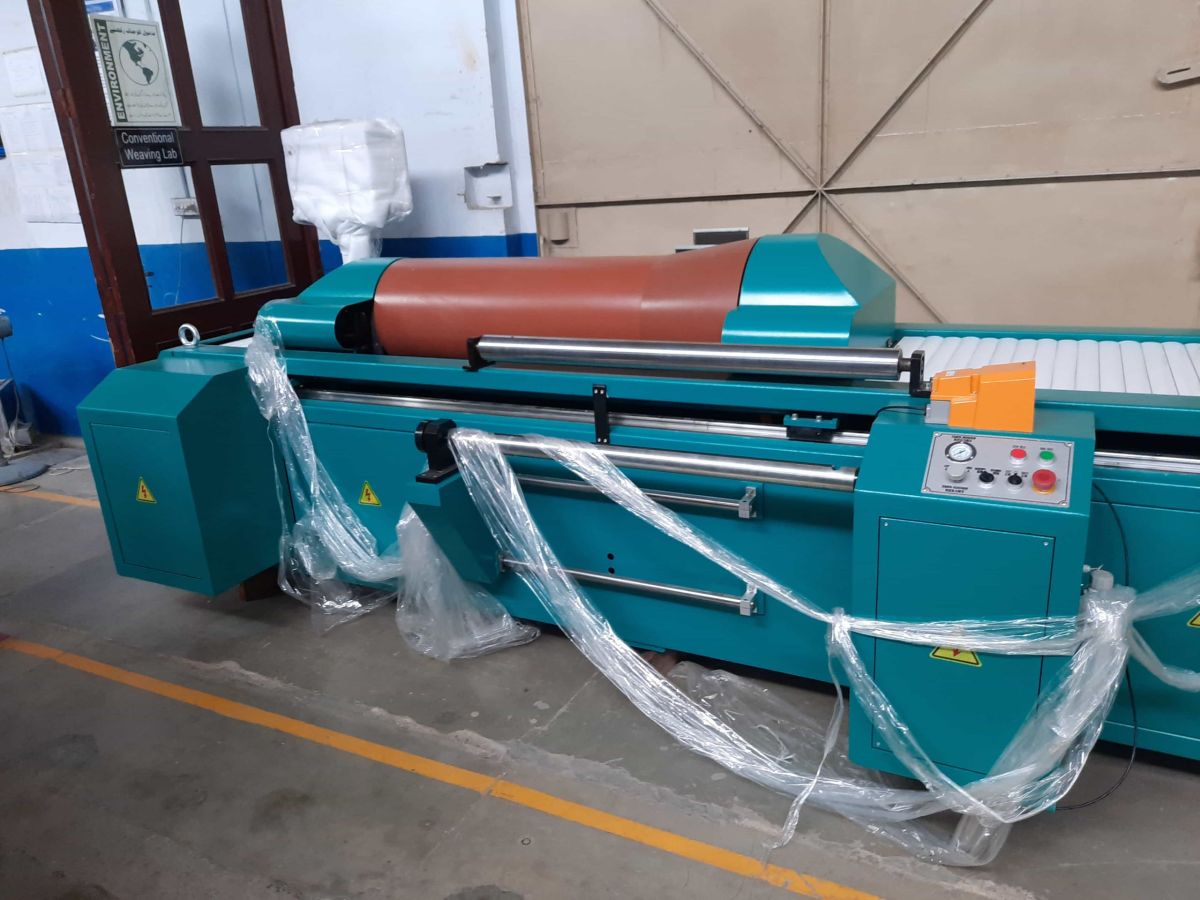
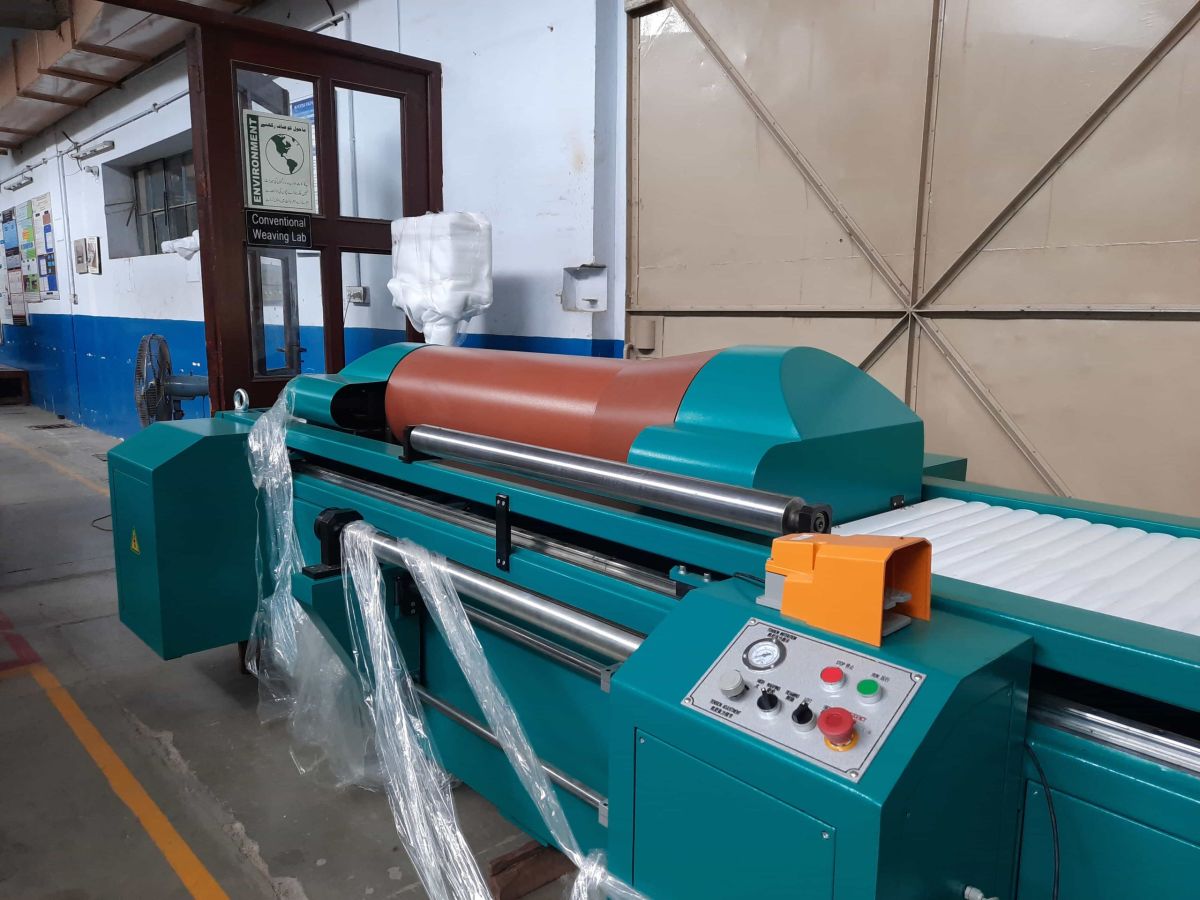
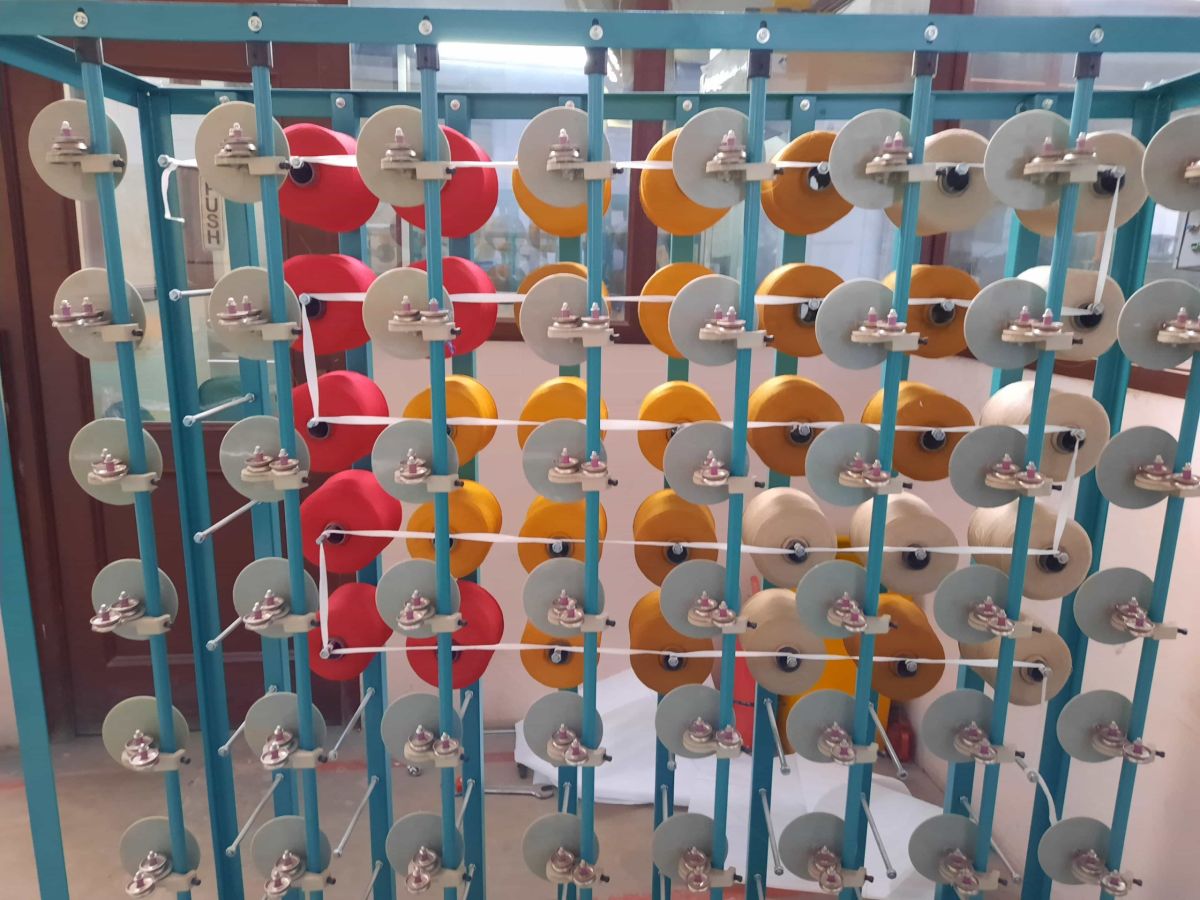
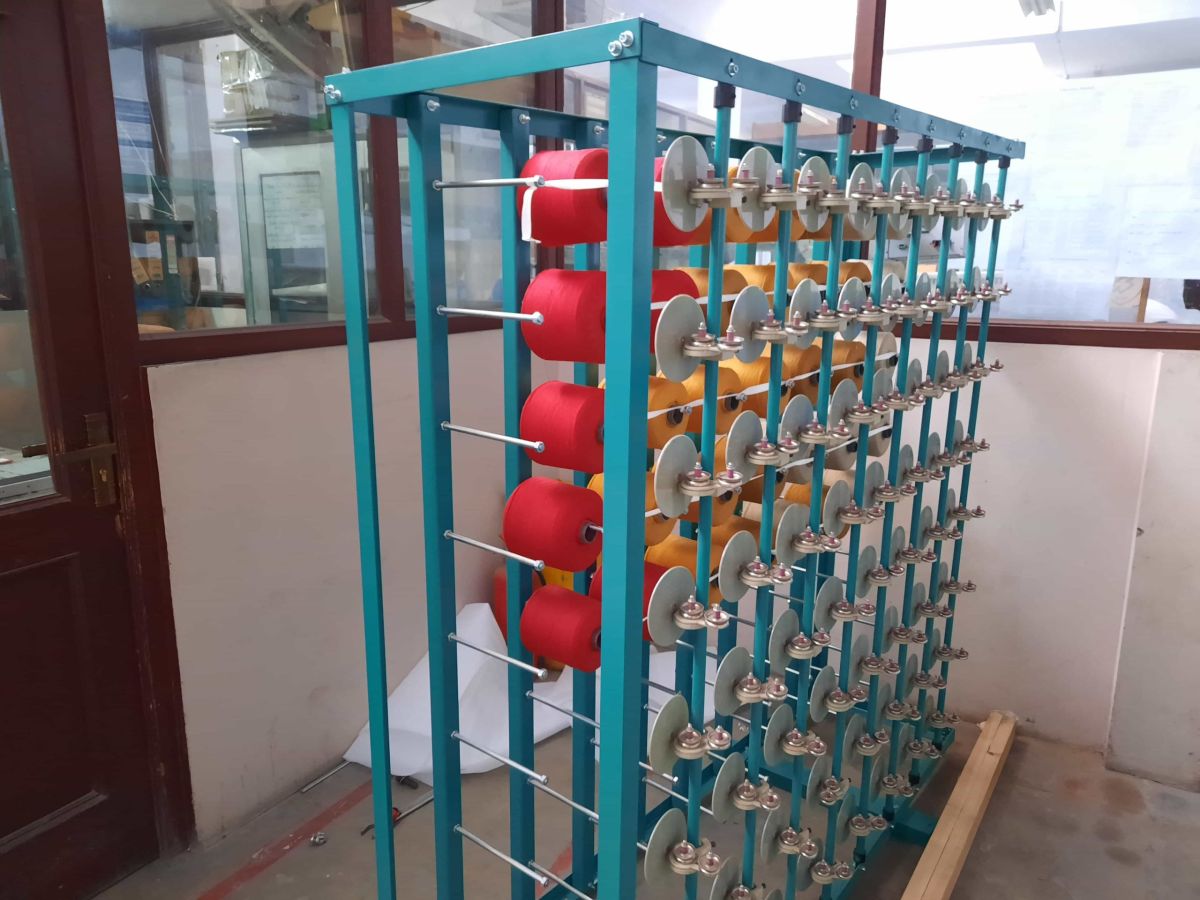
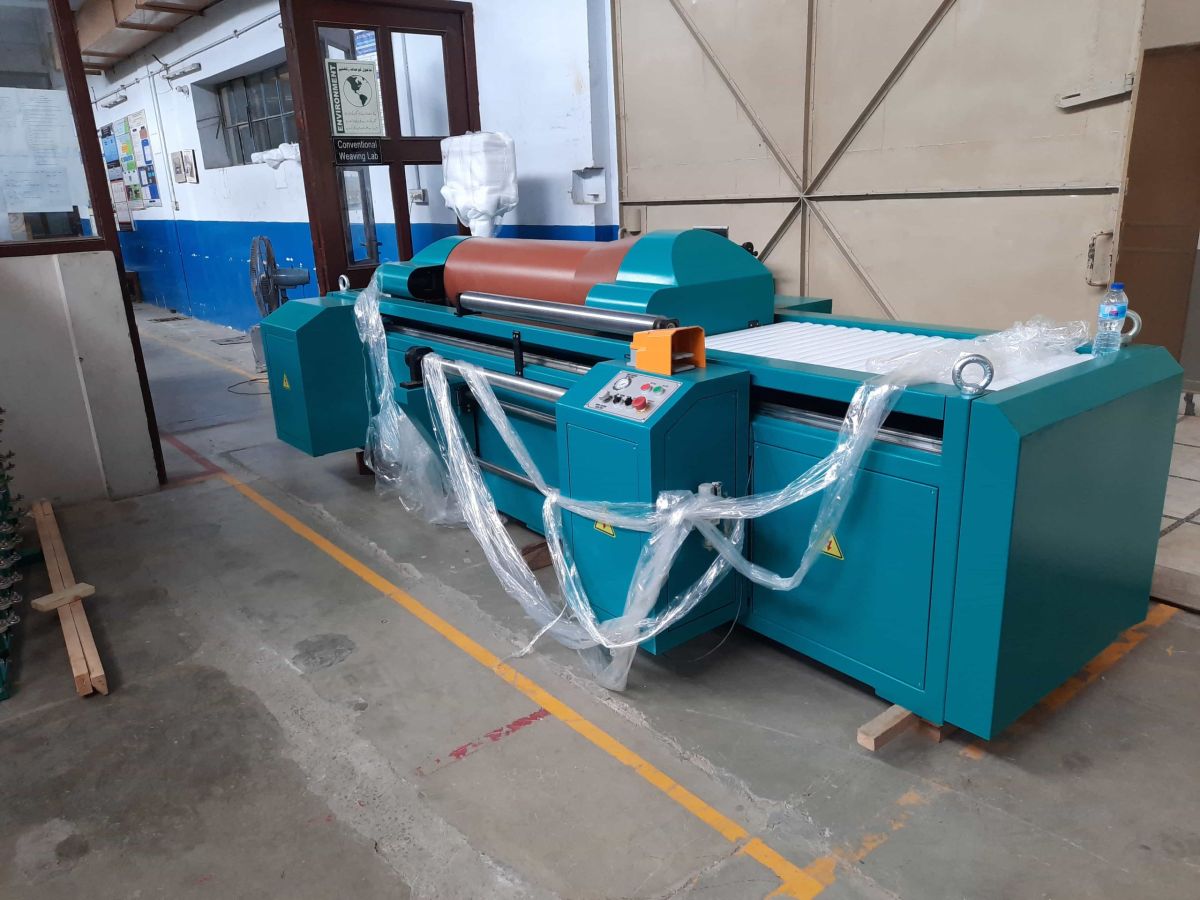
Marjan Polymer Industries designs and supplies Beam to Beam Sizing Machines in Pakistan for controlled application of size to a warp sheet, drying, separation and winding onto a loom or weaver’s beam. Systems can be developed for textile laboratories, pilot plants, product-development centres and selected production requirements.
The machine is engineered around yarn type, yarn count, total ends, warp width, beam dimensions, size recipe, target add-on, squeeze pressure, drying duty, winding tension, speed and available utilities. MPI does not treat one creel, one width or one speed as suitable for every cotton, blended or filament-warp programme.
Purpose of Beam-to-Beam Warp Sizing
Warp yarns face repeated abrasion, cyclic tension and bending at the loom. Sizing applies a controlled protective film that can improve abrasion resistance, bind surface fibres, reduce hairiness and support weaving efficiency. Too little size may leave the yarn unprotected, while excessive or uneven size can increase stiffness, dust, cost and desizing load.
In a beam-to-beam process, warp yarn already wound on one or more beams is unwound under controlled tension, passed through the size application and drying sections, separated where required, and rewound as a prepared loom beam. The final result depends on the whole process, not only the size box.
Available Beam to Beam Sizing Configurations
| Configuration | Typical Use | Design Approach |
|---|---|---|
| Laboratory beam-to-beam sizer | Teaching, formulation screening and small warp trials | Compact beam stand, controlled size box, electric drying and instrumented winding |
| Pilot-scale sizing machine | Process development, sample weaving and scale-up studies | Configurable beam positions, width, tension zones, drying and PLC/HMI functions |
| Single-beam-to-beam system | Filament, technical yarn or defined warp-sheet preparation | High-precision let-off, application, drying and headstock tension control |
| Multi-beam full-end sizer | Combining warp beams and sizing a wider production sheet | Multi-position beam creel, industrial size box, modular dryer and loom-beam winding |
| Custom research sizing line | Nonstandard fibres, binders, coatings or technical-textile studies | Purpose-built contact materials, sensors, data logging and acceptance method |
Textile Applications
- Cotton and cotton-blend warp preparation
- Polyester, nylon and selected filament-yarn sizing
- Shirting, apparel and home-textile warp development
- Terry towel and cleaning-textile applications
- Denim and workwear process trials where machine width and tension are suitable
- Industrial and technical-textile warp preparation
- University teaching and textile-engineering research
- Size-recipe comparison, add-on optimization and weaving trials
Staple-fibre and filament warps can require very different size chemistry, wet-zone geometry, squeeze pressure, tension and drying. The final machine and recipe must be selected for the actual yarn family.
Complete Process Architecture
| Machine Section | Primary Function | Key Engineering Variables |
|---|---|---|
| Beam creel / let-off | Unwinds one or more warp beams into a stable sheet | Beam diameter, brake or drive, tension feedback and alignment |
| Pre-wet or preparation zone | Optional yarn conditioning before size application | Liquor, temperature, immersion and squeeze arrangement |
| Size box | Applies size liquor to the warp sheet | Dip and nip path, immersion depth, liquor level, temperature and circulation |
| Squeeze section | Controls liquor expression and wet pick-up | Roll hardness, pressure, loading uniformity and line speed |
| Drying section | Removes controlled moisture after sizing | Hot air, cylinders, electric or steam duty, temperature and exhaust |
| Splitting and leasing | Separates adjacent ends and preserves yarn order | Lease rods, comb, static control and residual moisture |
| Headstock / beaming | Winds the sized warp onto the loom beam | Winding tension, taper, width, beam pressure, length and build quality |
| Control system | Synchronizes speed, tension, temperature and safety functions | PLC, HMI, drives, encoders, load cells, recipes and alarms |
Reference Pilot-System Capability
The existing reference concept is a configurable pilot or compact Beam to Beam Sizing Machine with automatic tension control, yarn-break stop motion, electronically controlled size preparation, variable drying and an electronic length counter. The recorded project data includes up to eight beam or spindle positions, adjustable machine speed, individual section control and servo-assisted winding.
| Reference Parameter | Recorded Value / Arrangement | Contract Note |
|---|---|---|
| Creel capacity | Up to 8 beam or spindle positions in the recorded concept | Final quantity and beam loading are confirmed by drawing |
| Machine speed | Approximately 20–250 m/min stated range | Operational speed is limited by yarn, size, drying duty, width and quality target |
| Yarn-break protection | Photoelectric or project-specific stop motion | Sensor type depends on end count, yarn and sheet geometry |
| Tension control | Automatic section tension with configurable feedback | Load-cell, dancer or drive architecture is selected per zone |
| Size preparation | Detachable or cleanable vessel with electronic heating control | Working volume, material and agitation are project-specific |
| Drying | Electrically heated reference arrangement | Hot-air, cylinder, steam or combined options are available separately |
| Reference yarn scope | Approximately 5–500 tex recorded design window | Suitability is confirmed from actual yarn and end count |
| Reference sized-beam width | Up to approximately 1000 mm in the compact concept | Wider pilot and industrial systems require separate engineering |
| Electrical supply | 220 V, 50/60 Hz reference control supply | Final connected load and incoming supply depend on drives and heaters |
Specification control: these values describe the page’s existing reference concept. The approved quotation, general arrangement, datasheet and nameplates govern the actual machine.
Configurable Technical Scope
| Parameter | Available Selection | Defined From |
|---|---|---|
| Working width | Laboratory, pilot and project-specific production widths | Warp width, end count, beam flange and loom requirement |
| Beam creel | Single beam, multi-beam, braked or driven positions | Beam quantity, diameter, mass and tension accuracy |
| Size box | Single or multiple dip/nip paths with controlled circulation | Yarn type, penetration, add-on and process speed |
| Squeeze system | Pneumatic, hydraulic or motor-controlled loading | Required wet pick-up, roll width and pressure uniformity |
| Dryer | Electric hot air, steam cylinders, combined dryer or special design | Water removal, speed, energy source and yarn sensitivity |
| Winding | AC or servo drive with taper-tension and beam-build control | Loom beam dimensions, warp tension and density target |
| Automation | Manual, semi-automatic or PLC/HMI coordinated control | Recipe repeatability, data, alarms and operator skill |
| Documentation | Drawings, manuals, utility schedule, test protocol and configurable records | Customer quality and project requirements |
Beam Creel and Let-Off Tension
Stable let-off prevents local stretch, slack ends and tension steps when beam diameter changes. Each beam position can use mechanical or pneumatic brakes, driven let-off, dancer feedback, load cells or a coordinated combination. The selection depends on beam inertia, operating speed and required precision.
Beam alignment, flange condition and warp build must be inspected before loading. A machine cannot correct a severely uneven incoming beam. Where multiple beams are combined, individual tension balance is essential to prevent stripes and differential elongation in the final warp.
Size Box, Dip and Nip Arrangement
The size box controls yarn wetting, penetration and coating. Available paths can include single dip/single nip, double dip/double nip or other project-specific arrangements. Liquor temperature, level, viscosity, concentration, circulation and filtration should remain stable through the run.
Roller geometry and immersion length influence the time that yarn remains in the wet zone. Bearings, seals and contact materials must tolerate heat and the selected starch, PVA, acrylic or other sizing formulation. Easy access and drainage reduce cleaning time and contamination between recipes.
Squeeze Pressure and Size Add-On
Squeeze pressure removes excess liquor and affects both add-on and moisture entering the dryer. Pressure must be uniform across the width; incorrect crown, rubber hardness, loading or alignment can cause side-to-centre variation.
Size add-on is verified by an agreed laboratory method using conditioned yarn or warp samples. Machine settings should record squeeze load, size concentration, viscosity, temperature, speed and yarn data so the result can be reproduced. Increasing pressure alone is not a substitute for stable liquor properties.
Drying-System Options
- Electric hot-air chamber for compact laboratory and pilot systems
- Steam-heated drying cylinders for production-scale energy transfer
- Hot-air and cylinder combination for selected filament or specialty processes
- Independently controlled drying zones where moisture profiling is required
- Exhaust, insulation and condensate handling matched to the energy source
The dryer must remove the required water without overheating, flattening or over-stretching the warp. Useful speed is therefore the speed at which target residual moisture and yarn quality are maintained, not simply the drive’s maximum setting.
Splitting, Leasing and Warp-Sheet Guidance
After drying, adjacent sized ends may adhere and must be separated in a controlled sequence. Lease rods, split rods, guide rollers and an expansion comb preserve yarn order and distribute the sheet to the final beam width.
Splitting tension depends on size recipe, add-on and residual moisture. Excessive force can damage yarn or produce dust; insufficient separation can create crossed or stuck ends. Static control and smooth yarn-contact surfaces are important for sensitive filaments.
Headstock Winding and Beam Build
The headstock controls final winding tension, length, beam speed and surface build. A coordinated AC or servo drive can taper tension as beam diameter increases. Encoders and length measurement support repeatable production records.
Beam flange diameter, barrel diameter, working width, maximum mass and shaft or bearing arrangement are confirmed before design. Beam pressure or surface control may be included where required to achieve a firm, cylindrical build without crushing the warp.
PLC, HMI and Drive Coordination
A PLC/HMI system can synchronize let-off, wet section, dryer and winding drives while monitoring tension, temperature, speed, length and safety interlocks. Recipes may store target values for different warp styles, although operator checks and laboratory measurements remain necessary.
Available functions can include ramped start and stop, tension-zone display, heater control, alarms, yarn-break response, length counters, production totals, password levels and data export. Exact connectivity and software licensing are defined in the control scope.
Process Parameters and Quality Records
| Parameter | Why It Matters | Typical Verification |
|---|---|---|
| Size concentration and viscosity | Influence penetration, film formation and add-on | Recipe record, solids test and calibrated viscosity method |
| Liquor temperature | Affects viscosity, wetting and stability | Calibrated temperature measurement |
| Squeeze pressure | Controls expressed liquor and cross-width uniformity | Pressure record and add-on profile |
| Section tension | Controls stretch, sheet stability and beam quality | Load-cell or calibrated tension check |
| Drying temperature and moisture | Affect film quality, flexibility and splitting | Zone record and residual-moisture test |
| Speed and length | Define dwell time, output and traceability | Encoder, timer and length-counter verification |
| Final beam build | Affects loom let-off and weaving efficiency | Width, hardness, circumference and visual inspection |
Size Chemistry and Yarn Compatibility
Common sizing systems use starch derivatives, polyvinyl alcohol, acrylic binders, lubricants, waxes and application-specific additives. Selection depends on fibre, yarn construction, loom conditions, required abrasion resistance, desizing route, wastewater and customer restrictions.
MPI supplies the machine and can support process trials, but the customer or its textile technologist must approve the recipe. Chemical suppliers’ safety data, handling limits and compatibility with stainless steel, rubber, seals and heating equipment should be reviewed before use.
Laboratory and Pilot-Scale Development
A pilot sizer allows a mill or university to compare recipes, squeeze settings, drying conditions and tensions using less yarn than a production trial. Results can support scale-up, but a small machine has different heat transfer, warp density and residence time from an industrial line.
A useful trial records yarn count, ends, incoming strength and hairiness, recipe, solids, viscosity, temperature, add-on, moisture, elongation, abrasion result, dust and weaving performance. Scale-up should be based on comparable process conditions rather than a single machine-speed ratio.
Utilities and Site Requirements
- Stable electrical supply sized for drives, controls, heaters, pumps and auxiliaries
- Steam, condensate return or thermal system where cylinder drying is selected
- Compressed air of the specified pressure and quality for pneumatic controls
- Water supply, drainage and size-kitchen connection where included
- Exhaust and ventilation for heat, humidity and chemical handling
- Level foundation, beam-handling clearance and safe material flow
- Access for cleaning, roller removal, maintenance and emergency response
Safety and Operator Protection
Required safeguards can include emergency stops, rope or trip switches, fixed and interlocked guards, nip-point protection, heater and pressure interlocks, safe beam supports and electrical isolation. Hot liquor, steam, rotating beams and squeeze nips require documented procedures and trained operators.
A site risk assessment must cover chemical preparation, lifting, steam, condensate, spills, manual intervention and cleaning. The machine must not be operated with defeated guards or while a person is inside a hazardous zone.
Cleaning and Preventive Maintenance
Size tanks, filters, pipes, squeeze rolls and guides should be cleaned before deposits harden. Recipe changes require a defined flush and contamination check. Rubber-roll surfaces must be protected from cuts, swelling and incompatible cleaners.
Preventive maintenance includes brake and drive checks, load-cell or dancer inspection, bearing lubrication, roll alignment, heater and steam-system inspection, sensor verification, belt and coupling checks and emergency-function tests. Maintain records for calibration, service, rubber grinding and roll replacement.
Supply and Technical Support in Pakistan
MPI supports textile mills, universities and research organisations in Lahore, Faisalabad, Karachi and other industrial regions of Pakistan. The project scope can include requirements review, design, fabrication, sourcing, factory inspection, delivery, installation, commissioning and operator training.
Recommended spares can include bearings, seals, rubber rollers, heaters, sensors, belts, pneumatic components, drive-service items and control-system backups. The final list reflects machine configuration and expected operating hours.
Information Required for a Quotation
- Yarn fibre, construction, count and total number of ends
- Incoming beam quantity, barrel, flange, width, shaft and maximum mass
- Required loom-beam dimensions and winding tension
- Warp width, target speed, batch length and production schedule
- Size recipe, concentration, viscosity, temperature and target add-on
- Preferred dip/nip and squeeze arrangement
- Drying method, residual-moisture target and available energy
- Electrical, steam, air, water, drainage and exhaust utilities
- PLC/HMI, recipe, data logging and acceptance requirements
- Installation city, delivery schedule, training and spare-parts scope
Beam to Beam Sizing Machine Price in Pakistan
Price depends on working width, beam positions and mass, size-box design, squeeze loading, drying system, drive and tension control, headstock, PLC/HMI, utilities, documentation, freight, installation and acceptance tests. A compact pilot machine and an industrial multi-cylinder line are not comparable scopes.
MPI prepares a technical quotation after reviewing the warp programme and site. The offer lists inclusions, exclusions, beam details, working range, utilities, delivery basis, warranty and optional equipment.
Installation, Training and Limited Warranty
Installation can include positioning, alignment, utility checks, dry commissioning, water or reference-recipe trials, tension verification, heater or steam checks and a supervised sizing run. Training covers safe operation, threading, recipe entry, tension, cleaning, fault response and maintenance.
Warranty terms are stated in the commercial offer and normally cover eligible manufacturing defects for the agreed period. Rubber coverings, seals, belts and other wear items, chemical attack, scale deposits, incorrect utilities, misuse and unauthorized modifications are excluded unless the contract states otherwise.
Frequently Asked Questions
What is a Beam to Beam Sizing Machine?
It unwinds a warp sheet from one or more beams, applies size, controls wet pick-up, dries and separates the yarns, and rewinds them onto a loom or weaver’s beam.
Why is warp yarn sized before weaving?
Sizing can bind surface fibres, reduce hairiness and improve abrasion resistance so warp yarn better tolerates loom friction and cyclic tension.
Can MPI supply laboratory, pilot and production systems?
Yes. MPI can engineer compact laboratory and pilot machines and develop larger project-specific systems after reviewing width, ends, beams, speed, drying and utilities.
Which yarns can be processed?
Cotton, blends, polyester, nylon and selected filament or technical yarns can be considered. The size box, tension and dryer must be configured for the actual yarn and recipe.
Which drying systems are available?
Options include electric hot air, steam-heated cylinders and project-specific combined arrangements. The selection follows water-removal duty, speed, yarn sensitivity and site energy.
How is size add-on controlled?
Add-on depends on recipe solids, viscosity, liquor temperature, immersion, squeeze pressure, roll condition, yarn and speed. It is verified by an agreed sampling and test method.
Can the machine use PLC and HMI control?
Yes. PLC/HMI systems can coordinate drives, tension zones, temperatures, speed, length, alarms and saved recipes according to the project scope.
What determines production speed?
Useful speed is limited by yarn, warp width, size penetration, squeeze performance, drying capacity, tension stability and final quality, not only by drive rating.
Is installation and training available in Pakistan?
Yes. MPI can provide delivery, installation, commissioning and operator training in Pakistan when included in the quotation.
What information is required for a quotation?
Provide yarn and end data, beam drawings, warp width, speed, size recipe, add-on, dryer preference, winding tension, utilities, automation and acceptance requirements.
Request a Beam to Beam Sizing Proposal
Send MPI your warp specification, beam drawings, size recipe, target add-on, speed and factory utilities. We will define a suitable Beam to Beam Sizing Machine configuration and prepare a clear technical and commercial proposal for supply in Pakistan.