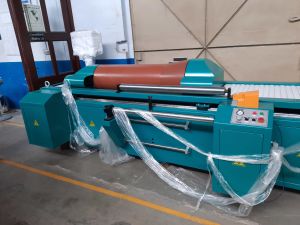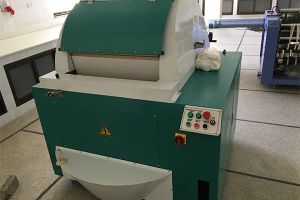

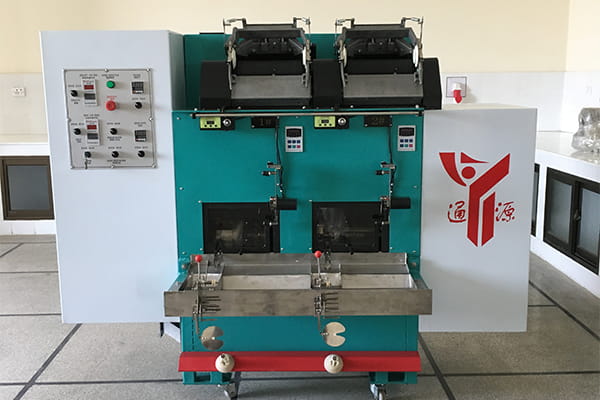
Single End Sizing Machine applies a controlled sizing formulation to individual yarn ends, dries the coating and rewinds each yarn into a package for weaving trials, product development and short-lot preparation. The GA392 reference platform lets textile laboratories and sample departments study size chemistry, add-on, hairiness, abrasion resistance, tensile behaviour and loom performance without preparing a full warp beam.
Marjan Polymer Industries configures the machine for the required yarn range, spindle count, sizing bath, drying method, winding package and control system. Speed, temperature and applicable yarn range are reference values; stable performance depends on yarn construction, size formulation, viscosity, pickup, tension and drying load.
Single-end sizing process
- Package unwinding: unsized yarn is withdrawn under controlled tension.
- Size application: the yarn passes through the prepared sizing bath and application path.
- Pickup control: guides, rollers and process settings regulate wet pickup and coating uniformity.
- Drying: heated air or an approved steam/electric drying system removes moisture without damaging the yarn or size film.
- Winding: the sized yarn is traversed and rewound into a stable parallel or conical package.
- Evaluation: length, speed, breaks, add-on and downstream weaving performance are recorded.
Reference GA392 configuration
| Parameter | Reference development scope |
|---|---|
| Machine type | Individual-end yarn sizing, drying and package winding machine |
| Spindle options | 2, 4, 8 or 12 spindles in common configurations; larger counts require an approved layout and drive scope |
| Reference sizing speed | Approximately 20–300 m/min, adjusted to yarn, size pickup, drying capacity and package quality |
| Reference yarn linear density | Approximately 5–500 tex; actual suitability is confirmed by yarn and formulation trials |
| Typical yarn families | Cotton, wool, silk, hemp/flax, polyester, polyester-cotton and other approved spun or filament yarns |
| Sizing method | Single-end dipping/application path with circulated sizing solution |
| Reference bath temperature | Up to approximately 80 °C where required by the selected formulation |
| Drying | Electric or steam-heated drying arrangement; reference drying temperature up to approximately 120 °C |
| Spindle control | Individual spindle/drive control with inverter or stepless speed regulation |
| Yarn traverse | Servo-tracked guide cylinder or grooved-drum winding arrangement |
| Length and speed | Electronic length counter with digital speed display |
| Stop motion | Individual yarn-break detection and spindle stop where configured |
| Winding package | Parallel or conical package according to yarn and downstream requirement |
| Reference electrical supply | 380–415 V, 50 Hz, three-phase for a typical multi-spindle electric-heated system; final load is configuration-specific |
| Reference four-spindle footprint | Approximately 3,100 × 850 × 1,750 mm; additional spindle sections extend machine length |
| Reference mass | Approximately 1,000–1,100 kg for a representative multi-spindle configuration |
These are reference GA392/AT240-class values. The contracted datasheet, machine drawing and acceptance sample govern the final supply.
Why yarn is sized before weaving
Sizing forms a controlled film around fibres or filaments to improve abrasion resistance, bind protruding fibres, reduce hairiness and help the yarn withstand repeated tension, bending and rubbing in shedding, beat-up and loom guidance. Excessive or unsuitable size can make yarn brittle, reduce flexibility, create deposits or impair desizing and finishing, so application must be optimized rather than maximized.
Size formulations and compatibility
Starch, modified starch, polyvinyl alcohol, acrylic polymers, cellulose derivatives, waxes, lubricants and blended formulations may be used according to fibre, yarn construction and finishing route. The customer must define the formulation, solids, pH, viscosity, preparation temperature, storage stability and desizing requirement. Food-grade, restricted-substance or wastewater constraints must be stated before trials.
Control of size pickup and add-on
Dry add-on depends on bath solids, viscosity, yarn speed, immersion path, roller condition, contact pressure, yarn tension, temperature and drying. A practical development plan weighs a known yarn length before sizing, conditions and weighs it after drying, then relates add-on to tensile strength, elongation, abrasion, hairiness and weaving behaviour.
Yarn tension and elongation management
Excessive tension can permanently stretch or flatten yarn and distort test results. Low or unstable tension can cause uneven immersion, loops and poor package build. Unwinding, bath, dryer and winding zones should be balanced so that the sized yarn retains the required elongation and runs without uncontrolled shrinkage or slippage.
Drying without damaging the size film
Drying must remove water or carrier solvent sufficiently for winding while avoiding surface scorching, internal moisture, film cracking, yarn yellowing or thermal damage. Air temperature, airflow, residence time and yarn speed are adjusted together. The highest chamber temperature is not necessarily the correct yarn temperature.
Individual spindle and winding control
Independent drives allow each end to stop for a break or package change without sacrificing process control on the remaining positions. A servo yarn guide or grooved drum produces a stable package. Package diameter, traverse, density, taper and winding tension are selected for storage, testing, warping or sample-loom use.
Typical yarn and textile applications
- Cotton and cotton-blend warp-yarn development.
- Polyester, polyamide and other synthetic filament or spun yarn trials.
- Wool, silk, hemp, flax and specialty natural-fibre research.
- Dyed-yarn, coloured-woven and sample-loom preparation.
- Size-formulation comparison and supplier qualification.
- University textile laboratories and weaving-preparation training.
- Short-length yarn preparation for abrasion, tensile and loom-performance testing.
Laboratory sizing versus production warp sizing
A single-end machine prepares individual yarn packages and is ideal for controlled experiments and samples. It does not replace a slasher, beam-to-beam or sectional sizing line used to process hundreds or thousands of warp ends onto weaving beams. Production sizing requires separate engineering for creel or beam handling, multi-end tension, size box, drying cylinders, stretch control and beaming.
Reference drive and heating loads
Published GA392-class references use separate package, guide, dryer-air and sizing-pump drives, with electric or steam heating. One reference lists approximately 0.18 kW package drive and 0.75 kW guide drive per spindle, approximately 1.8 kW drying duty per spindle, a shared hot-air circulation drive, 0.75 kW sizing pump and about 3 kW bath heating. Final connected load must be calculated from spindle count and heating method.
Quality measurements for a sizing trial
- Dry size add-on and coefficient of variation.
- Yarn moisture regain after conditioning.
- Tensile strength, elongation and strength variation.
- Hairiness and abrasion resistance.
- Package density, build, unwinding tension and residual moisture.
- Yarn-break rate and loom efficiency in the downstream trial.
- Desizing efficiency, fabric handle and finishing compatibility.
Configurable machine options
- Spindle count and modular machine length.
- Electric or steam heating and independent temperature zones.
- Alternative size-box, immersion and pickup-control arrangements.
- Individual break sensors and automatic spindle stop.
- Servo traverse, grooved drum and parallel/conical package options.
- Recipe control for speed, bath temperature and dryer temperature.
- Inline tension, moisture or diameter measurement.
- Stainless-steel size-contact components and enhanced cleaning access.
- Exhaust, condensate, ventilation and heat-recovery provisions.
Cleaning and formulation changeover
Residual size can gel, harden or support microbial growth. The bath, pump, piping, rollers, guides and return lines should be drained and cleaned according to the formulation supplier’s instructions. Changeover verifies that previous chemistry, colour or solids do not contaminate the next trial. Waste size and wash water require an approved disposal route.
Site, utilities and installation planning
MPI confirms machine footprint, maintenance clearance, electrical load, steam and condensate if used, exhaust or ventilation, water supply, drain, floor loading and safe chemical storage. The customer provides stable utilities, appropriate fire and chemical controls, lifting access and local statutory compliance unless expressly included.
Commissioning and operator training
The agreed service scope can include placement, levelling, electrical checks, drive and sensor verification, bath circulation, temperature tests, dry running, reference-yarn trials, package inspection and operator training. Acceptance should use an approved yarn, sizing recipe, target add-on and package specification.
Safety and preventive maintenance
Guards and safe isolation are required around rotating packages, traverse mechanisms, pumps, heaters and fans. Operators must be protected from hot size, steam, hot surfaces and cleaning chemicals. Maintenance includes guide and roller cleaning, bearing and drive checks, sensor verification, pump inspection, heater and airflow testing, tension checks and electrical-panel housekeeping.
Supply and support in Pakistan
Marjan Polymer Industries supplies single end sizing machines in Pakistan for textile mills, universities, research centres and sampling departments. Services may include requirements review, machine configuration, sourcing or fabrication coordination, installation planning, commissioning, formulation trials, operator training, documentation and after-sales support.
Information required for a technical quotation
- Yarn fibre, construction, linear density/count, twist and package type.
- Required spindle count, speed range, package build and daily sample volume.
- Size formulation, solids, viscosity, bath temperature and cleaning method.
- Target dry add-on, yarn moisture and quality acceptance criteria.
- Electric or steam heating preference and required dryer temperature.
- Available electricity, steam, ventilation, water and floor space.
- Required sensors, recipe control, data logging, spares and training.
Frequently asked questions
What is a single end sizing machine?
It applies sizing solution to individual yarn ends, dries the coating and rewinds each end into a package for sampling, testing or short-lot weaving preparation.
What yarn range can the machine process?
The reference range is approximately 5–500 tex for approved cotton, wool, silk, hemp/flax and synthetic yarns. Actual suitability depends on yarn construction and formulation.
What sizing speed is available?
The common reference range is approximately 20–300 m/min. Stable speed depends on yarn, size pickup, drying load, spindle count and package quality.
How many spindles can be supplied?
Common configurations use 2, 4, 8 or 12 spindles. Other counts can be evaluated with the required drives, footprint, heating and electrical load.
Can it use electric or steam drying?
Yes. Electric and steam-heated configurations are available. The selected method depends on utilities, spindle count, formulation and temperature-control requirement.
Can the machine size cotton and polyester yarn?
Yes, after confirming yarn count, twist, formulation, bath temperature, pickup and drying conditions. Natural and synthetic yarns do not necessarily use the same recipe.
Does the machine replace a production slasher sizing line?
No. It is intended for individual-end sampling and short-lot preparation. Bulk warp-beam sizing requires separate multi-end production machinery.
How is sizing add-on checked?
A known yarn length is conditioned and weighed before and after sizing, or another approved test method is used, then add-on is related to yarn and weaving performance.
Is the Single End Sizing Machine available in Pakistan?
Yes. Marjan Polymer Industries supplies configured single-end yarn sizing machines in Pakistan with technical review, installation planning and after-sales support.
Are commissioning and operator training available?
Yes. Machine checks, reference-yarn trials, recipe setup, maintenance orientation and operator training can be included in the agreed service scope.
Request a sizing-machine proposal
Contact Marjan Polymer Industries with your yarn, spindle count, size recipe, speed, drying method, package and utility requirements. MPI will prepare a suitable configuration and quotation.