
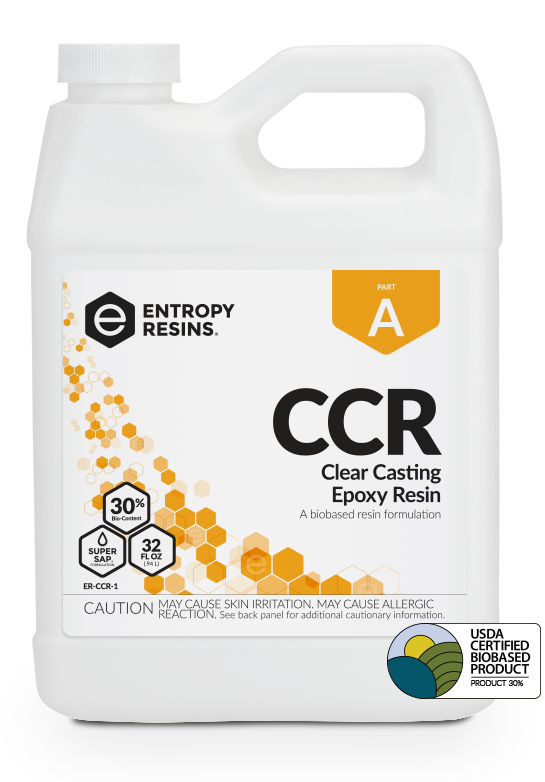
Clear Casting Epoxy is the Entropy Resins CCR system for water-clear casting, potting and embedding. Marjan Polymer Industries supplies CCR in Pakistan with CCF Fast or CCS Slow hardener selected against casting mass, working time and heat-control requirements.
Product Identity
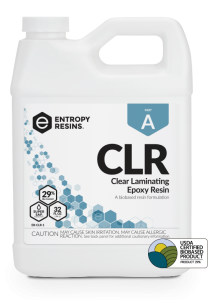
The current manufacturer designation is CCR Clear Casting Epoxy. It is a low-viscosity, UV-stabilized two-component system developed for transparent castings and encapsulation. It is distinct from CLR laminating epoxy and must be processed as a casting system with strict control of batch mass, section thickness and exotherm.
System Options
- CCR + CCF Fast: approximately 90-minute published pot life for smaller controlled castings and faster handling.
- CCR + CCS Slow: approximately 360-minute published pot life for larger or more complex work requiring slower reaction and improved air release.
Manufacturer-Published Processing Data
| Parameter | CCF Fast | CCS Slow |
|---|---|---|
| Mix ratio by volume | 2:1 | 2:1 |
| Mix ratio by weight | 100:43 | 100:42 |
| Mixed viscosity at 25°C | 370 mPa·s | 270 mPa·s |
| Pot life at 25°C | 90 min | 360 min |
| Tack-free time at 35°C | 24 h | 72 h |
| Full cure at 25°C | 7 days | 7 days |
Values are typical manufacturer data. Pot life and peak temperature change with total mass, depth, mould insulation and ambient temperature. Never scale a small-cup result directly to a large casting without qualification.
Key Characteristics
- water-clear appearance with UV stabilization;
- low mixed viscosity to aid mould filling and bubble release;
- fast and slow hardener options for different casting windows;
- suitable for transparent potting, embedding and decorative casting trials;
- room-temperature cure with optional controlled post-cure according to current guidance.
Typical Applications
- transparent mould castings and decorative objects;
- encapsulation of dry, compatible inclusions;
- clear electrical or sensor potting after dielectric and thermal qualification;
- prototype optical-display and model-making work;
- table, artwork and industrial casting development where the section is qualified.
Recommended Casting Workflow
- Define the casting: record length, width, maximum depth, total mass, mould material and release system.
- Dry and condition: remove moisture from moulds, fillers and inclusions and stabilize all materials at the approved temperature.
- Measure: use the exact hardener-specific weight ratio or accurate 2:1 volumetric metering.
- Mix carefully: scrape sides and bottom, then transfer to a second clean container for critical clear work.
- De-air: use a qualified vacuum, pressure or controlled pouring method without creating excessive foam.
- Pour and manage heat: respect the qualified maximum layer and wait time between stages.
- Cure and finish: protect from contamination, allow full cure, then sand, polish or coat only after verification.
Exotherm and Pour-Depth Control
Large epoxy masses retain reaction heat. Excessive depth can cause rapid temperature rise, yellowing, cracking, shrinkage, distortion or a hazardous runaway cure. MPI does not publish one universal pour depth because mould geometry and heat loss differ. Qualify the exact casting in conservative stages.
Clarity, Colour and Inclusions
Dryness and compatibility are essential. Porous wood, flowers, pigments, metals and electronic assemblies can release air or moisture and may discolor or inhibit the result. Seal and trial inclusions before a production casting. UV stabilization improves colour retention but does not eliminate all long-term yellowing.
Storage and Safety
Store sealed components according to current manufacturer instructions. Wear suitable gloves and eye protection and provide ventilation. Keep mixed material away from skin and combustible contamination. Do not leave a large mixed batch unattended in a deep container.
Information Required for a Quotation
Provide the casting dimensions and total volume, maximum layer depth, mould material, inclusion or pigment, required clarity, workshop temperature, preferred working time, trial or production quantity and delivery city. MPI will confirm the appropriate hardener, pack and current documentation.
Frequently Asked Questions
What is Entropy CCR Clear Casting Epoxy?
CCR is a water-clear, UV-stabilized, low-viscosity epoxy resin used with CCF Fast or CCS Slow hardener for casting, potting and embedding applications.
What is the mixing ratio?
Both systems use 2:1 resin to hardener by volume. The published weight ratio is 100:43 with CCF Fast and 100:42 with CCS Slow.
Which hardener is better for a longer pour?
CCS Slow provides the longer published pot life—about 360 minutes at 25°C—while CCF Fast is approximately 90 minutes under the stated test conditions.
How thick can I pour CCR?
Maximum safe pour depth is application-specific and depends on mass, mould geometry, ambient temperature and heat dissipation. A representative staged-pour trial and the current technical data sheet are required before production.
Can CCR be used as a laminating resin?
It is optimized for casting, potting and embedding. Use CLR or another qualified laminating system when fibre wetting, laminate cure speed and structural composite processing are the main requirements.
How long does CCR take to cure?
The manufacturer lists seven days at 25°C for full cure. Published tack-free times at 35°C are approximately 24 hours with CCF and 72 hours with CCS.
Will clear casting epoxy never yellow?
UV stabilization improves colour retention, but no epoxy should be represented as permanently non-yellowing under every light and heat exposure. Test the final construction and protective finish.
How can bubbles be reduced?
Warm and dry materials, accurate mixing, slow stirring, a shallow transfer container and a suitable vacuum or pressure process can reduce bubbles. Avoid overheating because it accelerates reaction.
What information does MPI need for a quotation?
Provide casting dimensions, maximum section thickness, mould material, inclusion or pigment details, clarity requirement, shop temperature, quantity and delivery city in Pakistan.
Is CCR suitable for food-contact or medical use?
Do not assume regulatory suitability. Any food-contact, medical or potable-water application requires the exact current compliance documentation and customer qualification before use.