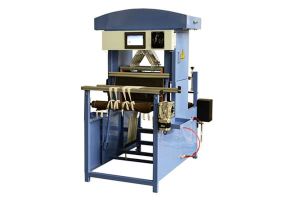
Needle-Punching Nonwoven Production Line is a complete staple-fibre processing system that opens and feeds fibre, forms a uniform card web, crosslays the web to the required mass and width, mechanically bonds it in a needle loom, and winds or cuts the finished material. Marjan Polymer Industries configures the line for wool, polyester, polypropylene, recycled textile fibres and other approved raw materials.
The reference MPI project is a compact development line for sheep-wool and technical-fibre research, with a 500 mm carding width and an approximately 1,000 mm final working width. Production capacity, fabric weight, needle-board pattern, punching intensity and winding speed are engineered as one balanced line; individual machine maximum values must not be treated as guaranteed continuous output.
Complete process flow
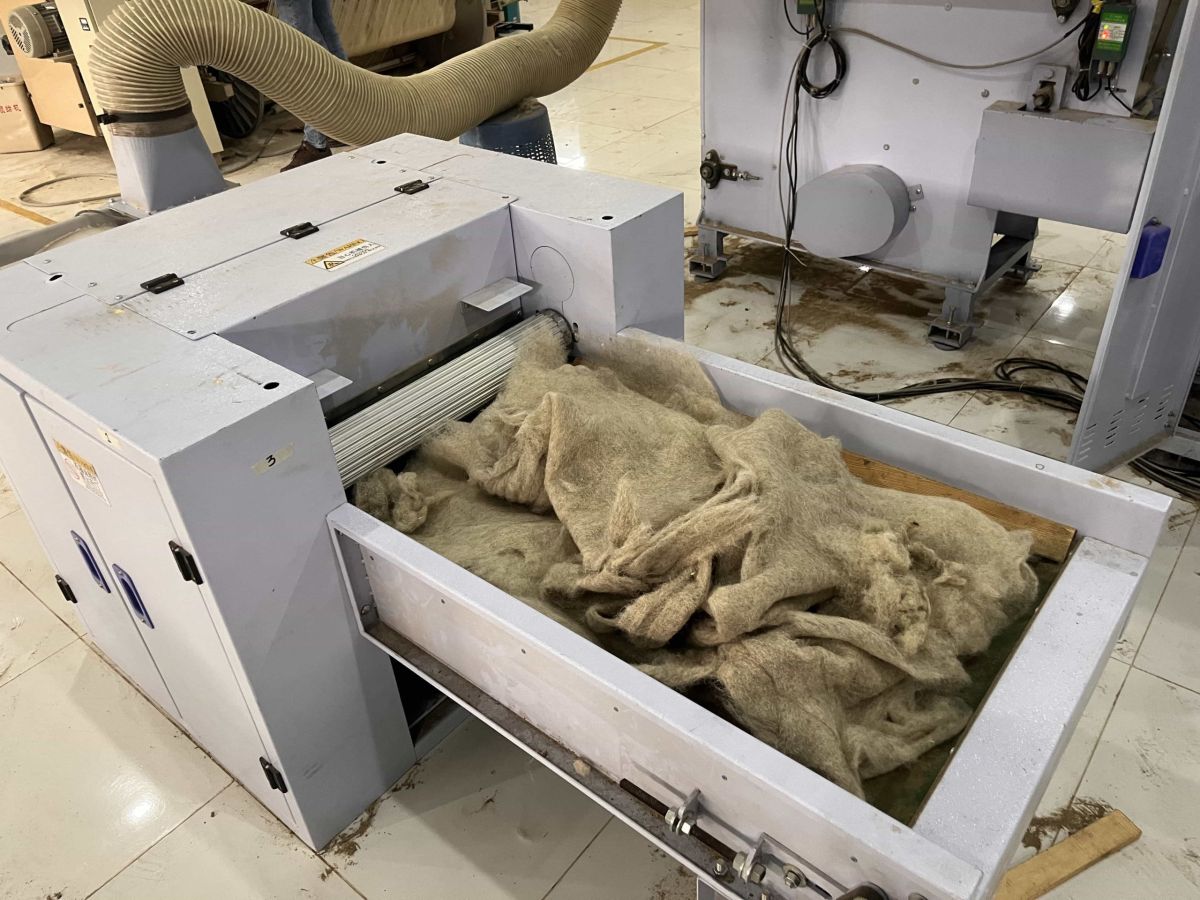
- Fibre preparation: bales or loose fibres are opened, blended and checked for foreign material.
- Controlled feeding: the feeder meters an even fibre supply to the card.
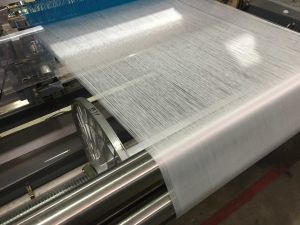
- Carding: fibre tufts are separated and oriented into a lightweight web.
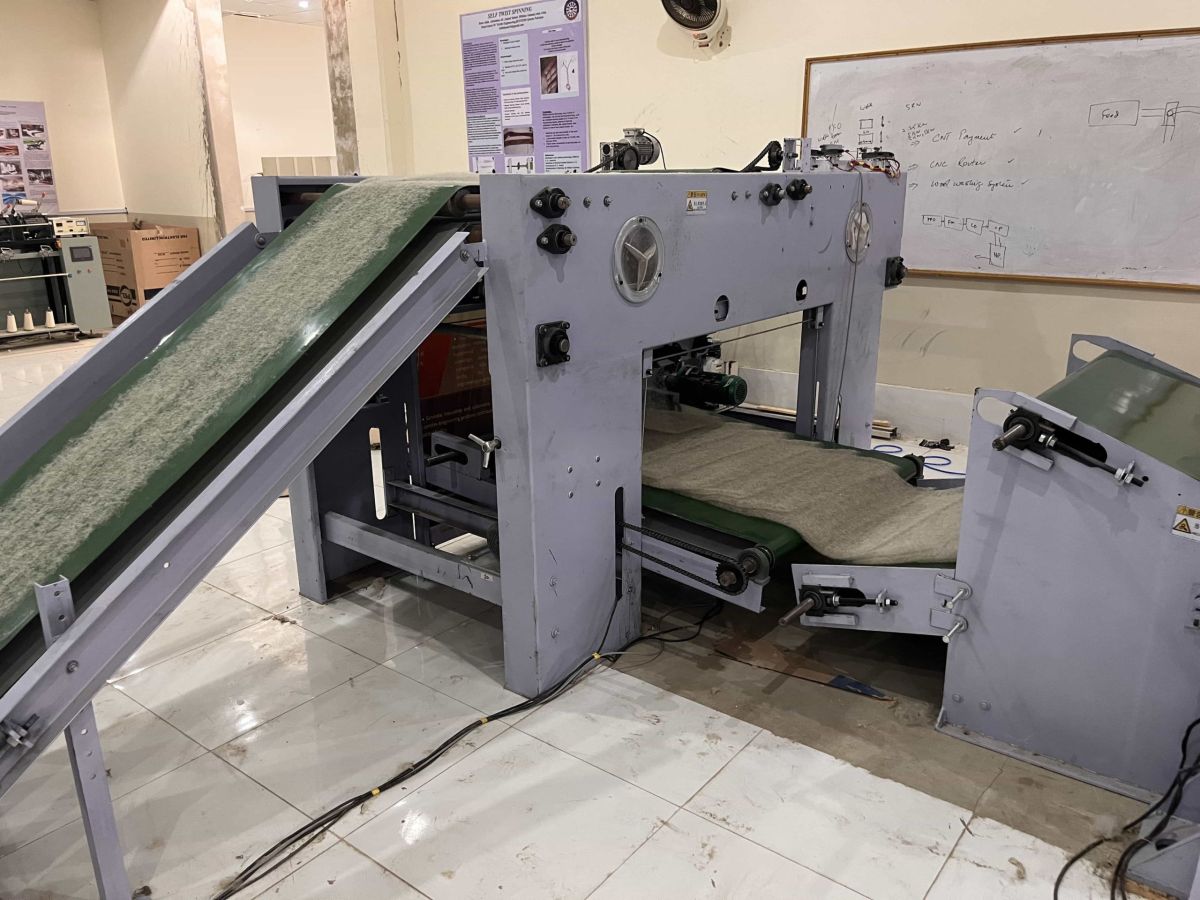
- Crosslapping: successive web layers are laid across the line to build width and basis weight.
- Needle punching: barbed needles repeatedly penetrate the batt and mechanically entangle the fibres.
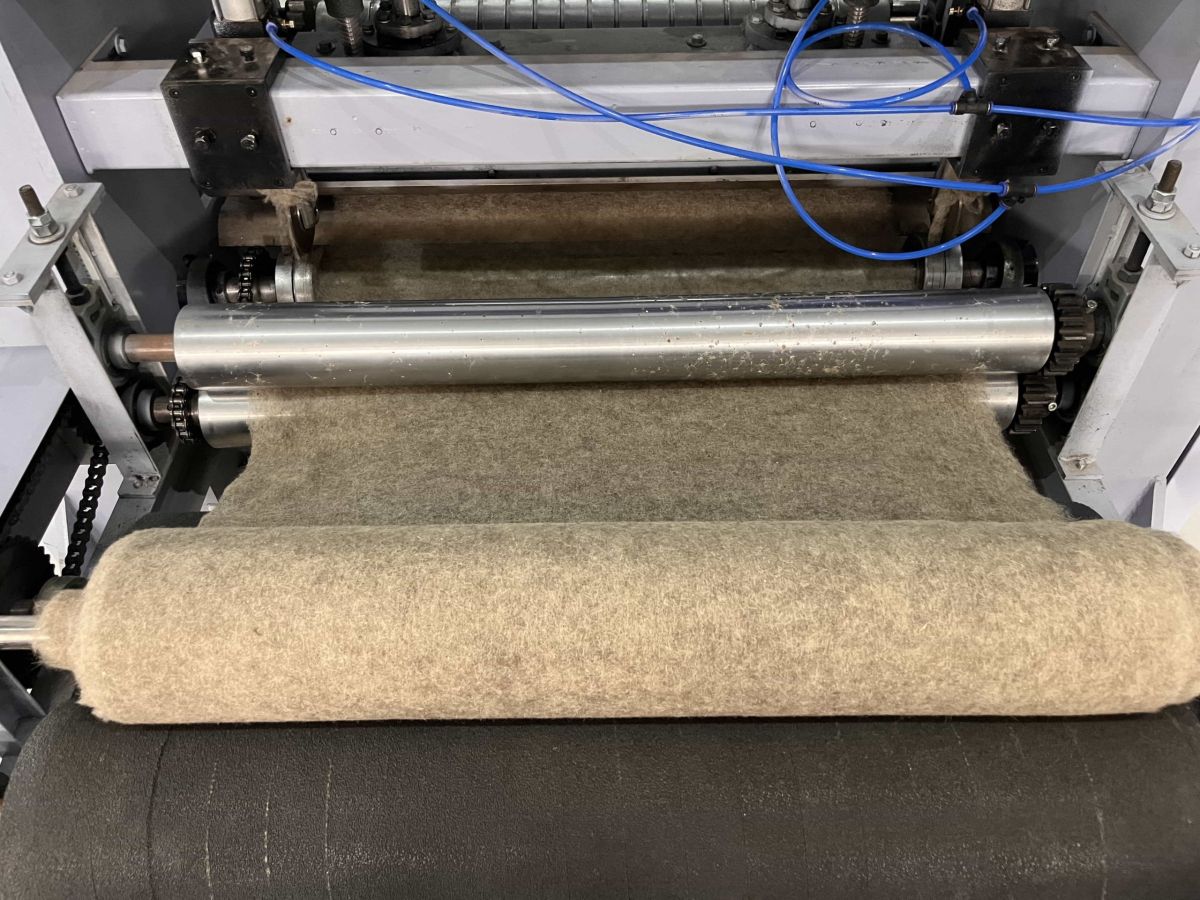
- Finishing: the bonded nonwoven is guided, trimmed, cut and wound for handling or further processing.
Reference pilot-line configuration
| Line section | Reference development scope |
|---|---|
| Pre-fibre opener | Approximately 400 mm machine width; notch-type opening roller, blower transfer and magnetic foreign-metal protection |
| Metering feeder | Approximately 500 mm width; photoelectric level control and vibrating feed arrangement |
| Carding machine | 500 mm working width with approximately 500 mm main cylinder; variable-speed feed and metal-protection provision |
| Crosslapper | 500 mm input apron and approximately 1,000 mm output width; variable reciprocal laying motion |
| Needle loom | Approximately 1,000 mm working width; reference needle stroke about 55–60 mm; pre-needling or single-/double-direction arrangements subject to scope |
| Reference needle rate | Up to approximately 600 strokes/min in the compact reference scope; actual rate depends on fibre, batt and needle pattern |
| Winding and cutting | Approximately 1,000 mm width with adjustable winding speed and application-specific slitting or length cutting |
| Controls | Sectional variable-speed drives with coordinated line operation; PLC/HMI and closed-loop options available |
| Reference installed drives | Individual section drives are selected to duty; the existing compact concept uses approximately 1.5–5 kW per principal section |
| Continuous line output | Confirmed from fibre, target GSM, width, speed and bonding requirement during project engineering |
These are reference development values, not a universal catalogue guarantee. The slowest approved process section and the required fabric quality determine continuous production capacity.
Why published subsystem capacities must be balanced
An opener may process fibre faster than a laboratory card or needle loom can accept. Quoting each machine’s isolated maximum as the line output creates an unrealistic specification. MPI develops a mass-flow balance from the required fabric width, basis weight, line speed, fibre recovery, crosslap ratio and needle-punching intensity, then defines an acceptance rate for the complete line.
Fibre opening and controlled feeding
The opening section separates compacted fibre bundles while limiting unnecessary fibre shortening. A magnet or other foreign-material protection reduces the risk of metal entering the card. The feeder then meters the fibre using level or weight-control logic so the card receives a stable feed. Optional blending bins, weigh-pan feeders and multiple-fibre dosing systems can be evaluated for recipes containing recycled or dissimilar fibres.
Carding and web formation
The card progressively individualises and aligns fibres into a thin, even web. Card clothing, roller geometry, speed ratios and clearances are selected for fibre length, fineness, crimp and sensitivity. Wool, polyester and recycled fibres cannot be assumed to use identical settings. Anti-metal protection, suction and accessible cleaning zones are important for consistent operation and maintenance.
Crosslapping and basis-weight development
A crosslapper places successive card-web layers across a wider output conveyor. The lap profile, carriage speed and apron synchronisation influence final GSM uniformity and the machine-direction/cross-direction strength balance. Optional web drafting and profile-correction systems can be added where tight weight uniformity or dimensional stability is required.
How needle punching bonds a nonwoven
A needle loom uses boards fitted with barbed felting needles. Repeated vertical penetration carries fibres through the batt and mechanically interlocks them without conventional yarn weaving. Product properties depend on needle type, penetration depth, punch density, board pattern, feed rate, fibre morphology and whether pre-needling or multiple needling passes are used.
Needle frequency is expressed as strokes or punches per minute, not metres per minute. Line speed remains a separate value measured in metres per minute.
Approved fibre families
| Raw material | Typical considerations |
|---|---|
| Sheep wool | Scouring condition, moisture, contamination, fibre length, card clothing and gentle opening |
| Polyester or polypropylene staple | Denier/dtex, staple length, crimp, finish and static control |
| Recycled textile fibre | Blend variability, residual yarn or fabric pieces, dust, metal and fibre-length distribution |
| Cotton, hemp, jute or kenaf | Moisture, trash content, brittleness, dust extraction and suitable carding configuration |
| Aramid, glass or other technical fibre | Special needle, contact-material, dust, abrasion and operator-protection requirements |
Material compatibility is confirmed against representative fibre samples. Hazardous, brittle, conductive or highly abrasive fibres require a dedicated safety and process review.
Typical needle-punched products
- Wool felt and laboratory-developed natural-fibre nonwovens.
- Geotextiles, drainage layers and construction substrates.
- Automotive acoustic, thermal and interior felts.
- Filtration media and industrial technical felts.
- Carpet backing, underlay and floor-covering substrates.
- Furniture, mattress, insulation and protective padding.
- Recycled-fibre panels and semi-finished material for thermal bonding or moulding.
Needle-punching is different from spunbond and meltblown
This line processes staple fibres through opening, carding, web forming and mechanical bonding. A spunbond or meltblown line starts with polymer resin and forms continuous filaments or microfibres by extrusion. A nonwoven bag-making machine converts an already manufactured fabric roll. Customers seeking those processes require different machinery.
Configurable line options
- Single- or multi-component opening and blending systems.
- Weigh-pan, volumetric or closed-loop controlled feeding.
- Alternative carding widths, roller arrangements and fibre-contact components.
- High-speed crosslapper, web drafter and automatic profile correction.
- Pre-needleloom, down-stroke, up-stroke or double-board needling.
- Replaceable needle-board patterns and controlled penetration-depth adjustment.
- Online GSM scanner, metal detection and broken-needle management.
- Calendering, thermal bonding, spraying, coating or drying equipment.
- Accumulator, edge trimming, slitting, cross cutting and automatic winding.
- PLC/HMI recipe control, production logging and remote-support provisions.
Quality parameters to define before purchase
The customer should specify finished width, basis-weight range in GSM, thickness, roll diameter, tensile strength in machine and cross directions, elongation, air permeability, filtration or insulation performance, surface appearance and allowable weight variation. The machinery can then be configured around measurable acceptance criteria rather than general claims such as “high quality.”
Reference installation in Pakistan
MPI has documented the supply and installation of a complete wool-processing nonwoven fabric line for the Textile Laboratory of BUITEMS University in Quetta, Pakistan. The project included fibre opening, controlled feeding, carding, crosslapping, needle punching and winding/cutting equipment. View the documented nonwoven line project.
Site, utilities and layout planning
Before dispatch, MPI confirms the line footprint, material-flow direction, maintenance clearances, operator access, foundation or levelling requirements, electrical supply, compressed air, ventilation and dust extraction. The customer provides a compliant building, utilities, fire protection, lifting access and local statutory approvals unless those items are expressly included in the contract.
Installation, commissioning and training
The agreed service scope can include mechanical placement, alignment, electrical and pneumatic checks, dry cycling, fibre trials, line balancing, operator training and maintenance orientation. Commissioning uses the approved fibre and target product whenever possible. Documentation may include layout drawings, utility schedules, operating instructions, maintenance plans, electrical information and recommended spare parts.
Safety and preventive maintenance
Opening and carding rollers, reciprocal lapper movement, needle boards, cutters and winders require guards, emergency stops and safe isolation procedures. Maintenance includes card clothing inspection, roller clearance checks, apron tracking, needle replacement, board inspection, lubrication, drive alignment, dust removal and verification of sensors and interlocks. Fibre dust must be controlled according to the raw material and factory risk assessment.
Supply and after-sales support in Pakistan
Marjan Polymer Industries supplies configured needle-punching nonwoven production lines in Pakistan for universities, laboratories and industrial manufacturers. Services can include feasibility review, line configuration, sourcing or fabrication coordination, factory inspection, installation planning, commissioning, operator training and after-sales support. International enquiries can also be evaluated.
Information required for a technical quotation
- Raw fibre type, staple length, fineness, moisture and bale or loose-feed condition.
- Required finished width, GSM range, thickness and roll dimensions.
- Target products and required tensile, elongation, permeability or insulation performance.
- Required hourly output and planned operating hours.
- Needling arrangement, finishing, slitting, cutting and winding requirements.
- Available factory space, electricity, compressed air and dust-extraction system.
- Required installation, commissioning, training, spare parts and warranty scope.
Frequently asked questions
What is a needle-punching nonwoven production line?
It is a complete staple-fibre line that opens and feeds fibre, cards it into a web, crosslays the web, mechanically bonds it with barbed needles and winds or cuts the finished nonwoven.
Can the line process sheep wool?
Yes. The reference MPI project was configured for sheep-wool and technical-fibre development. Scouring condition, moisture, contamination, length and carding suitability must be reviewed.
Can it process polyester or recycled fibre?
Yes, subject to fibre trials and the selected opening, feeding, carding, needle and dust-control configuration. Recycled blends require particular attention to contamination and fibre-length variation.
What is the finished working width?
The compact reference development line has an approximately 1,000 mm final working width after a 500 mm card and crosslapping stage. Other widths require separate engineering.
What production capacity can be expected?
Capacity depends on fibre, finished width, GSM, carding rate, crosslap ratio, needling intensity and winding speed. MPI confirms a balanced continuous-line capacity in the quotation.
Is this a spunbond or meltblown line?
No. This is a dry-laid staple-fibre needle-punching line. Spunbond and meltblown systems use polymer extrusion and require different machinery.
Can it make geotextile or automotive felt?
These products can be evaluated, but the line width, GSM, fibre, needleloom arrangement, finishing and testing requirements must be configured for the intended specification.
Which machines are included in a complete line?
The reference flow includes an opener, metering feeder, card, crosslapper, needleloom and winding/cutting section. Blending, drafting, calendering, scanning and other finishing equipment are optional.
Is the nonwoven production line available in Pakistan?
Yes. Marjan Polymer Industries supplies configured needle-punching nonwoven production lines in Pakistan with application review, installation planning and training.
Are installation and operator training available?
Yes. Installation supervision, commissioning, fibre trials and operator training can be included according to the agreed site and service scope.
Request a nonwoven production-line proposal
Contact Marjan Polymer Industries with your fibre data, target fabric width, GSM range, required output and factory location. MPI will develop a suitable line configuration and technical quotation.