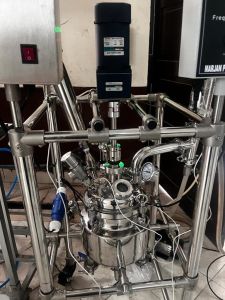


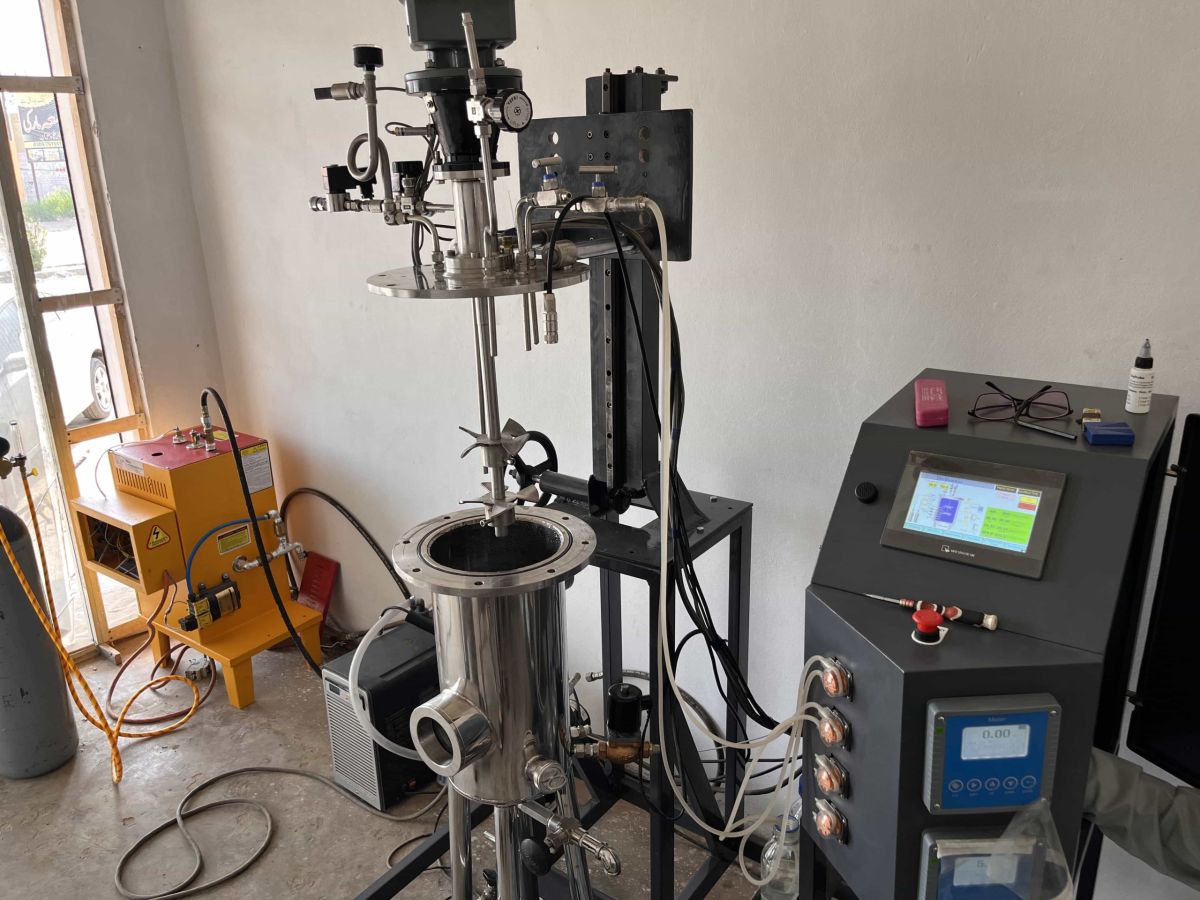
Marjan Polymer Industries designs and fabricates custom bioreactors and fermenters in Pakistan for laboratory research, pilot development and industrial bioprocessing. Each system is engineered around the customer’s organism, process mode, working volume, sterility requirement, utilities and control philosophy.
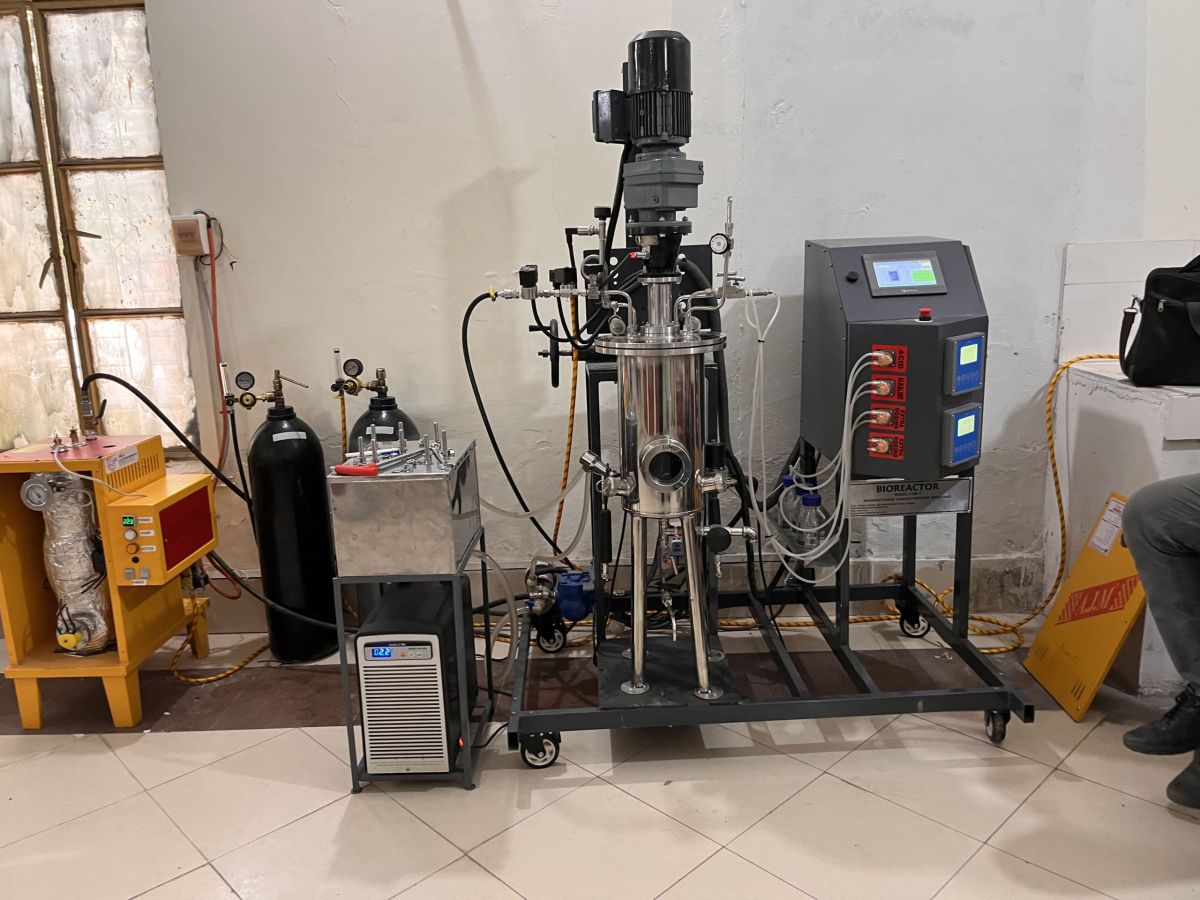
MPI can manufacture a simple manually operated laboratory unit, a semi automatic research fermenter or a fully automated PLC controlled bioreactor with HMI or SCADA supervision. Vessel hardware, sensors, pumps, gas handling, agitation, heating, cooling, sterilization and software are selected as one integrated system rather than assembled around a fixed catalogue specification.
Engineered for the Process
A bioreactor that works well for bacteria may not be suitable for mammalian cells, algae or a shear sensitive plant culture. The required agitation, oxygen transfer, vessel geometry, surface finish, feeding strategy and cleaning method can change completely between applications. For this reason, MPI does not present one volume, one speed or one pressure rating as suitable for every buyer.
The design begins with a user requirement specification. We review the biological system, target output, batch method, working and total volume, allowable shear, gas demand, temperature range, pressure conditions, cleaning method, sterilization method, data requirements and available utilities. The final quotation is then based on an agreed technical scope.
Available Bioreactor and Fermenter Configurations
| Configuration | Typical Use | Available Design Approach |
|---|---|---|
| Laboratory bioreactor | University research, teaching, strain screening and process development | Glass or stainless steel vessel, autoclavable or independently sterilizable, with manual or automatic control |
| Parallel bioreactor system | Comparative studies, media optimization and design of experiments | Multiple vessels with independent measurement, dosing and recipe control |
| Pilot scale bioreactor | Scale up studies, process confirmation and preproduction work | Stainless steel skid with configurable automation, utilities and cleaning arrangement |
| Industrial fermenter | Commercial fermentation and biological production | Sanitary stainless steel vessel with process piping, gas system, feed system and plant integration |
| Stirred tank bioreactor | Microbial, cell culture and general bioprocess applications | Application selected impellers, spargers, baffles and drive system |
| Airlift or bubble column reactor | Processes requiring lower mechanical shear or different mass transfer behaviour | Custom circulation, sparging and vessel geometry based on the process |
| Photobioreactor | Algae, cyanobacteria and light dependent cultures | Illumination, transparent sections, gas exchange and temperature control selected for the culture |
| Special purpose bioreactor | Research rigs, immobilized systems, enzyme processes and nonstandard applications | Purpose built mechanical, electrical and software design |
Systems can be developed for batch, fed batch, semi batch, continuous or perfusion operation when the process and equipment scope support that mode.
Applications Across Research and Industry
MPI bioreactor systems can be configured for universities, research institutes, biotechnology laboratories, pharmaceutical development, agriculture, food technology and industrial biotechnology. Common project areas include the following.
- Bacterial, yeast and fungal fermentation
- Enzyme, protein and metabolite production
- Biofertilizers, microbial inoculants and agricultural biotechnology
- Probiotics, starter cultures and selected food fermentation processes
- Plant, insect and mammalian cell culture when the required sanitary and control conditions are defined
- Vaccine and pharmaceutical research systems where the project documentation and validation scope are agreed
- Algae and other photosynthetic culture processes
- Environmental biotechnology and application specific biological treatment systems
- Academic teaching, process development and scale up studies
The same vessel should not be assumed to serve all of these applications. MPI selects the construction, impeller, seal, sparger, sensors and automation according to the actual culture and process risk.
PLC Automation and Bioprocess Control
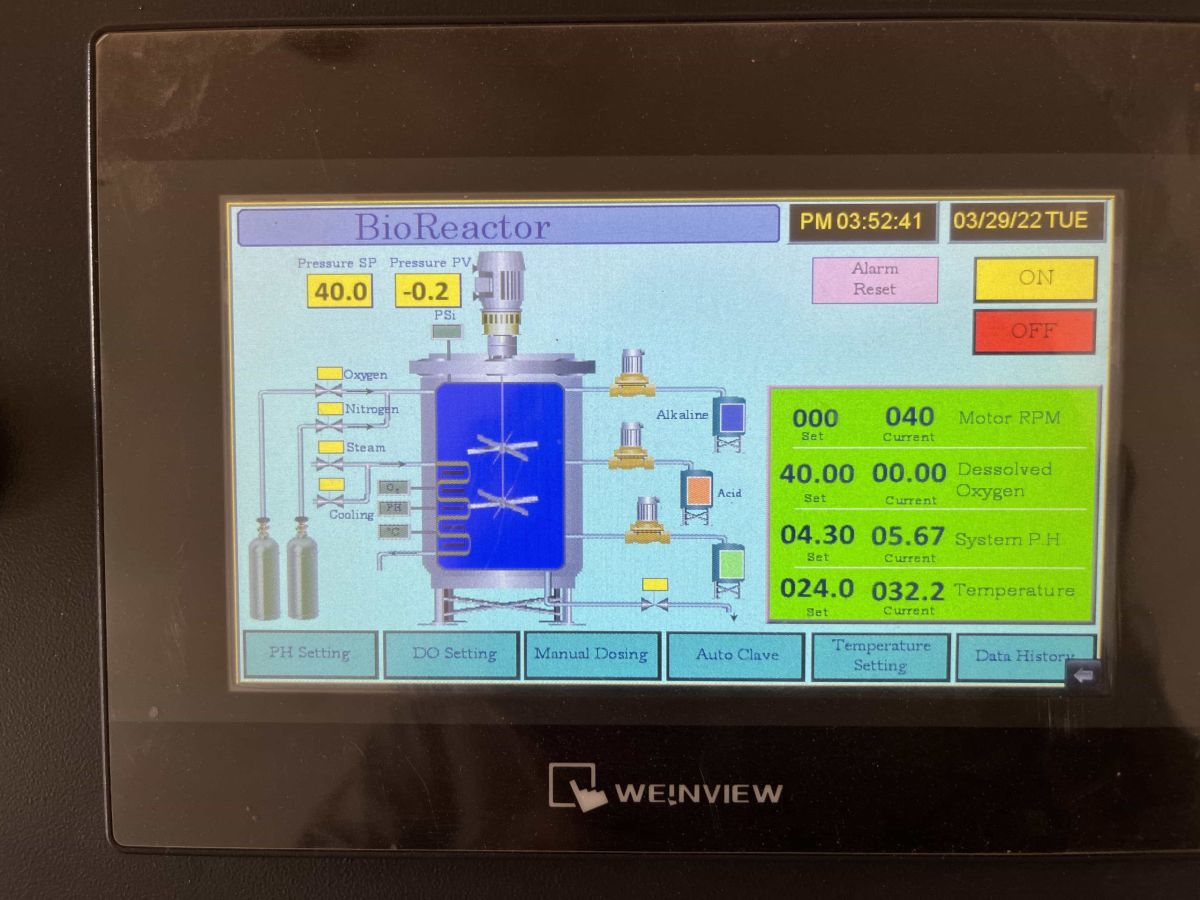
A fully automatic bioreactor can be supplied with a PLC, touch screen HMI and process software. A SCADA based configuration can also be developed when the project requires centralized supervision, batch records or integration with a laboratory or plant control network.
Available control functions include temperature regulation, agitator speed, pH dosing, dissolved oxygen control, gas blending, foam control, pressure control, level control and programmed feeding. Dissolved oxygen can be managed through a process specific cascade using agitation, total gas flow and oxygen enrichment. Feed, acid, base and antifoam pumps can follow fixed rates, timed profiles or feedback signals.
Software options can include recipe management, live trends, alarm history, user access levels, set point limits, data export and batch reporting. Audit trails, electronic records and remote connectivity are included only when they are specified and supported by the selected control platform. Cybersecurity and access rules are agreed before any remote function is enabled.
Sensor and Instrument Options
The instrument package is selected according to the organism, process range, sterilization method, accuracy requirement and budget. Common and advanced measurement options include the following.
| Measurement | Purpose | Possible Integration |
|---|---|---|
| Temperature | Culture and sterilization temperature monitoring | PT100 or another suitable sanitary temperature element |
| pH | Continuous measurement and acid or base dosing control | Sterilizable electrochemical or compatible optical probe |
| Dissolved oxygen | Oxygen availability and automatic cascade control | Polarographic or optical dissolved oxygen probe |
| Vessel pressure | Headspace monitoring, control and safety interlock | Pressure transmitter with project specific range |
| Foam | Foam detection and automatic antifoam dosing | Conductive or application compatible foam probe |
| Level or vessel weight | Volume monitoring, feed control and mass balance | Level instrument or load cell arrangement |
| Agitator speed and load | Mixing control and mechanical condition monitoring | Speed feedback, motor current or torque measurement |
| Gas flow | Air, oxygen, nitrogen or carbon dioxide delivery | Rotameters, electronic flow controllers or mass flow controllers |
| Off gas oxygen and carbon dioxide | Respiration monitoring and process analysis | Compatible exhaust gas analyzer |
| Dissolved carbon dioxide | Cell culture and fermentation process monitoring | Application compatible dissolved carbon dioxide probe |
| Redox potential | Oxidation and reduction condition monitoring | Sterilizable ORP probe |
| Conductivity | Media, cleaning and process condition monitoring | Sanitary conductivity sensor |
| Optical density or turbidity | Growth and total biomass indication | Inline optical sensor or external analyzer connection |
| Viable cell density | Online cell concentration and viability related monitoring | Capacitance or other compatible biomass technology |
| Substrate and metabolite analysis | Monitoring glucose, lactate or other process components | External analyzer, Raman, near infrared or other PAT integration when technically justified |
Not every sensor is required on every machine. Probe selection must account for operating range, cleanability, calibration, process compatibility and replacement availability.
Vessel, Mixing and Gas Handling Options
| System Area | Configurable Options |
|---|---|
| Product contact material | SS 316L is normally considered for stainless steel product contact parts. Glass and other compatible materials can be assessed for laboratory systems. |
| Non contact construction | SS 304, coated steel or another suitable structural material according to the environment and budget |
| Vessel arrangement | Single wall, jacketed, insulated, autoclavable or fixed in place design |
| Agitation | Top or bottom drive, mechanical seal or magnetic coupling where suitable, with variable speed control |
| Impellers | Rushton turbine, pitched blade, marine, hydrofoil, low shear or a process specific combination |
| Gas delivery | Overlay, ring sparger, drilled sparger, microsparger or another application selected arrangement |
| Liquid handling | Feed, inoculation, acid, base, antifoam, sampling and harvest connections with selected pumps and valves |
| Exhaust system | Sterile filter, condenser, pressure control and off gas analysis provisions where required |
| Cleanability | Manual cleaning, spray device or clean in place arrangement according to vessel size and process need |
| Sterilization | Autoclavable laboratory assembly or steam in place configuration for a suitably designed fixed vessel |
Working volume, total volume, agitation range, design pressure and temperature limits are finalized through engineering calculations and component selection. They are stated on the approved datasheet for the specific machine rather than treated as universal values.
Utilities and Optional Support Equipment
The supply scope can cover the reactor alone or a complete operating package. Optional equipment includes a heating and cooling unit, chiller, steam generator, oil free compressed air system, gas manifold, sterile filters, feed pumps, transfer pumps, control panel, skid, piping and selected safety instruments.
Facility gases and cylinders are not assumed to be part of every bioreactor. Gas supply, regulators, purity, pressure and site safety requirements are confirmed during engineering. Equipment is then matched to the available electricity, cooling water, steam, compressed air and laboratory services.
Hygienic Design and Documentation
Surface finish, weld treatment, drainage, passivation, sanitary fittings, gasket materials, calibration and documentation are agreed according to the intended process. Pharmaceutical or high hygiene projects can require a much stronger documentation package than a teaching or general research unit.
When required, the project can include design drawings, instrument lists, control philosophy, material certificates, calibration records, operating manuals, factory acceptance testing and installation qualification or operational qualification support. Compliance with ASME BPE, pressure vessel rules, GMP expectations or electronic record requirements is never implied by default. Any required standard, certification or validation duty must be written into the approved project scope.
Benefits of Local Bioreactor Manufacturing
Local fabrication gives Pakistani laboratories and industries direct access to the people designing the equipment. The vessel, control system and utility connections can be matched to the actual site instead of forcing the user to adapt an imported standard machine.
- Technical discussion before design and quotation
- Customization around the process and available utilities
- Local installation, commissioning and operator training
- Faster access to service, modifications and fabricated spare parts
- Easier integration with existing laboratory or plant equipment
- Direct support for universities, research teams and industrial users in Pakistan
MPI has previously completed a bioreactor fabrication and installation project for a university laboratory in Faisalabad. New systems are not restricted to that earlier design and are developed against the next customer’s requirement.
Bioreactor, fermenter and process selection
Bioreactor is the broad equipment term for a controlled biological process. Fermenter is commonly used for microbial systems involving bacteria, yeast or fungi. The correct mechanical design still depends on the organism, shear sensitivity, oxygen demand, sterility strategy and scale; the two names are not treated as interchangeable specifications.
MPI can evaluate stirred-tank, parallel, airlift, bubble-column, photobioreactor and special-purpose configurations. A classical stirred tank is often the most scalable general platform because vessel and impeller geometry, mixing and gas-transfer relationships can be assessed from laboratory through pilot scale.
Process modes and feeding strategy
Configured systems may support batch, fed-batch, semi-batch, continuous or perfusion operation when the biological process, vessel, pumps, sensors and retention arrangement support that mode. Feed profiles may be time based, gravimetric, recipe controlled or linked to an approved process signal.
Each proposal identifies which mode is included. Continuous and perfusion operation require additional engineering for harvest, cell retention, contamination control, mass balance and long-duration equipment reliability.
Mixing, aeration and dissolved-oxygen control
Impeller type, diameter, speed range, sparger, baffles, gas flow and back-pressure are selected together. Microbial fermentation can require high oxygen-transfer capability, while mammalian, plant or insect cells may need a lower-shear configuration. A dissolved-oxygen cascade can coordinate agitation, total gas flow and oxygen enrichment when the selected instruments and control platform support it.
MPI does not promise one universal rpm, gas rate or kLa value. The quotation states the agreed process target and the basis for acceptance; final performance is influenced by broth rheology, antifoam, temperature, pressure, working volume and culture oxygen uptake.
Reference laboratory and pilot architecture
| System level | Typical architecture | Configuration decision |
|---|---|---|
| Benchtop research | Autoclavable glass or stainless vessel, compact controller, pumps and pH/DO instrumentation | Commonly selected for education, screening and process development; final vessel volume is project-specific |
| Parallel development | Two or more independently controlled vessels with comparable sensors and recipes | Selected for media studies, strain comparison and design of experiments |
| Pilot stirred tank | Jacketed sanitary vessel, drive, gas train, feed pumps, control panel and skid | Designed around scale-up criteria, utilities, cleaning and installation access |
| Industrial fermenter | Fixed stainless-steel vessel with plant piping, automation, SIP/CIP scope and safety systems | Requires a formal URS, design review, site data and defined documentation package |
Scale-up and acceptance criteria
Scale-up is not based on volume alone. Depending on the process, engineering may review geometric similarity, power input per volume, impeller tip speed, mixing time, gas superficial velocity, oxygen-transfer capability, heat removal, foam behaviour and allowable shear. The governing criteria are written into the approved design basis.
Factory and site acceptance can cover vessel inspection, instrument calibration evidence, control-loop checks, alarms and interlocks, agitation, temperature response, gas and pump functions, water runs and an agreed reference process. Biological yield is accepted only when a defined organism, medium, method and responsibility matrix form part of the contract.
Supply boundary and project deliverables
The quotation distinguishes MPI supply from customer responsibilities. It can include the vessel, skid, piping, control panel, software, sensors, pumps, gas train, heating or cooling package, steam generator, manuals, drawings, factory testing, installation, commissioning and training. Facility utilities, gases, exhaust, drains, civil work and regulatory approvals are excluded unless expressly listed.
Information Required for a Bioreactor Quotation
To prepare a serious technical proposal, the buyer should provide the intended organism or process, required working volume, batch mode, temperature range, pressure condition, agitation requirement, gas strategy, required sensors, sterilization method, cleaning method, automation level, data requirements, available utilities and installation location.
If the full user requirement specification is not available, MPI can help structure the requirement through a technical discussion. Final performance criteria must still be agreed before fabrication begins.
Bioreactor Price in Pakistan
A custom bioreactor does not have one reliable catalogue price. Cost changes with vessel volume, material, surface finish, pressure design, agitation system, sensors, automation, pumps, gas control, sterilization, utilities, documentation and installation scope.
MPI provides a quotation after reviewing the application. This prevents the buyer from paying for instruments that are not required and prevents important process functions from being omitted simply to show a low initial price.
Installation, Training and Limited Warranty
Installation, commissioning, operator training and after sales technical support can be included in the supply. The normal company warranty is a one year limited warranty covering the agreed MPI fabricated assembly and covered components under correct operation and specified utility conditions.
Consumables, calibration, sensor membranes, electrodes, filters, seals, gaskets, normal wear, process contamination, chemical attack, misuse, operation outside the approved limits, unsuitable utilities and unauthorized modification are not treated as manufacturing defects. Third party instruments and components remain subject to their applicable manufacturer terms.
Frequently asked questions
What is a bioreactor?
A bioreactor is a controlled vessel system used to cultivate cells, microorganisms or other biological processes while regulating variables such as temperature, agitation, pH, dissolved oxygen, gas flow and feeding.
What is the difference between a bioreactor and a fermenter?
Bioreactor is the broader term. Fermenter is commonly used for microbial cultivation involving bacteria, yeast or fungi. The required vessel, agitation, aeration and sensors must still be selected for the actual process.
Can MPI manufacture laboratory, pilot and industrial systems?
Yes. MPI can engineer benchtop research units, parallel systems, pilot-scale stirred tanks and industrial fermenters. The practical configuration depends on the process, site, utilities and approved design basis.
Can the Bioreactor use PLC and HMI control?
Yes. Manual, semi-automatic and PLC/HMI-controlled configurations are available. The agreed system can automate temperature, agitation, dosing, gas control, dissolved oxygen, alarms, recipes and data functions.
Which sensors can be integrated?
Options include temperature, pH, dissolved oxygen, pressure, foam, level or load cells, gas flow, off-gas analysis, redox, conductivity, turbidity and compatible process analytical instruments.
Which process modes are available?
Batch and fed-batch are common. Semi-batch, continuous and perfusion modes can be engineered when the vessel, feed, harvest, retention, instrumentation and contamination-control scope support them.
Are CIP and SIP or autoclavable configurations available?
Yes. Small systems can use an autoclavable vessel arrangement. Suitable fixed stainless-steel systems can be engineered with clean-in-place and steam-in-place functions when utilities and the approved design support them.
Which product-contact materials are available?
SS 316L is normally considered for stainless-steel product-contact parts, while borosilicate glass can be used for suitable laboratory systems. Surface finish, seals and compatibility are confirmed for each process.
Is the Bioreactor available in Pakistan?
Yes. Marjan Polymer Industries designs and supplies custom bioreactor and fermenter systems in Pakistan with engineering review, local installation, commissioning, training and after-sales support.
What information is required for a quotation?
Provide the organism or process, working volume, operating mode, temperature and pressure, agitation and gas needs, sensor list, sterilization method, automation, documentation, utilities and installation location.
Request a bioreactor proposal
Contact Marjan Polymer Industries to discuss a custom laboratory, pilot or industrial bioreactor in Pakistan. Share your process requirement or user requirement specification so the vessel, controls, sensors and support equipment can be engineered as one complete system.